
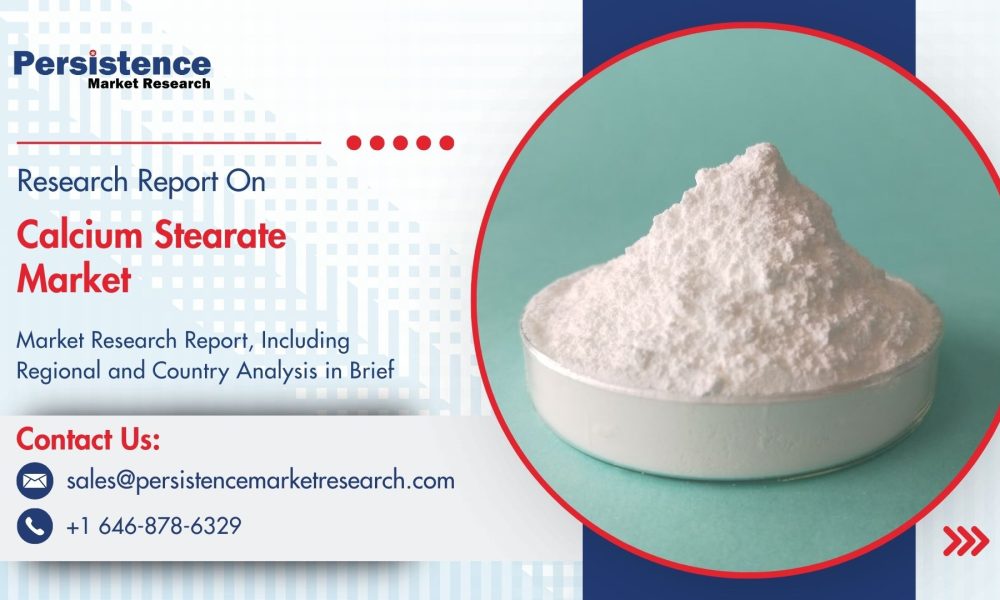
Calcium Stearate Market: Versatile Additive Driving Industrial Growth
The global chemical additives market is undergoing sustained expansion as industrial processes evolve to meet rising consumer demand, sustainability goals, and stringent regulatory standards. Among these additives, calcium stearate stands out as a multifunctional compound that plays a critical role in a variety of industries — from plastics and construction to pharmaceuticals and personal care. As a lubricant, stabilizer, anti-caking agent, and water repellent, calcium stearate has become essential in modern manufacturing and product formulation. This blog explores the calcium stearate market’s current dynamics, growth drivers, challenges, and future outlook.
What is Calcium Stearate?
Calcium stearate is a calcium salt of stearic acid — a long-chain fatty acid derived from natural fats and oils. Its chemical structure gives it excellent lubricity, water repellency, and thermal stability, making it ideal for diverse applications. In plastics and rubber manufacturing, it reduces friction and facilitates processing; in construction, it improves water resistance; in personal care and pharmaceuticals, it functions as a stabilizer and excipient.
Get Your FREE Sample Report Instantly – Click Now: https://www.persistencemarketresearch.com/samples/26305
Market Size and Growth Forecast
According to Persistence Market Research, the global calcium stearate market was valued at approximately US$0.9 billion in 2026 and is projected to reach US$1.3 billion by 2033, growing at a compound annual growth rate (CAGR) of 5.4% during 2026–2033.
This sustained growth reflects increasing demand across several end-use sectors, technological innovation, and broader adoption of the compound as industries shift toward high-performance and sustainable materials.
Key Market Drivers
- Expanding Plastics and Rubber Industries
One of the most significant drivers of calcium stearate demand is its role in the plastics and rubber sectors. In plastics manufacturing, particularly polyvinyl chloride (PVC) processing, calcium stearate functions as an internal lubricant and stabilizer that improves material flow during extrusion and molding. This reduces production defects, enhances surface quality, and improves energy efficiency on manufacturing lines — essential benefits for industries such as packaging, automotive components, and consumer goods.
In the rubber industry, calcium stearate serves as a mold release agent and helps disperse reinforcing fillers such as carbon black, improving the uniformity and durability of products like tires, seals, and hoses. As automotive and industrial machinery production continues to grow globally, the requirement for durable and high-performance rubber goods supports calcium stearate demand.
- Growth in Construction and Infrastructure
The construction industry’s expansion — particularly in Asia Pacific and the Middle East — has bolstered the use of calcium stearate in concrete and cement formulations. Its water-repellent properties help enhance moisture resistance and reduce efflorescence (salt migration on surfaces), thereby extending the durability of building materials. These characteristics are especially valuable in regions with high humidity or where quality infrastructure is a priority.
Infrastructure development, urban expansion, and public investment in housing and commercial projects continue to drive demand for high-performance construction additives, creating a strong growth trajectory for calcium stearate in this segment.
- Rising Use in Personal Care, Cosmetics, and Pharmaceuticals
Beyond industrial applications, calcium stearate is widely used in personal care and pharmaceutical products. It functions as an anti-caking agent, lubricant, and stabilizer in powdered cosmetics, creams, tablets, and nutritional supplements. The compound’s recognized safety profile — including approval by regulatory bodies such as the U.S. Food and Drug Administration (FDA) — makes it suitable for products intended for human use.
The booming consumer goods market, particularly in emerging economies with growing middle-class populations, has enhanced demand in these segments. As disposable incomes rise, so does consumption of personal care products and health supplements, supporting long-term market growth.
- Sustainability and Eco-Friendly Variants
Environmental sustainability has become a defining trend across all industries, driving demand for bio-based and eco-friendly materials. Calcium stearate derived from renewable plant oils — such as palm or soybean oils — aligns with this shift toward greener materials. Companies seeking to reduce their environmental footprint are increasingly adopting bio-based calcium stearate, particularly in products like biodegradable polymers, personal care formulations, and food-grade applications.
This trend aligns with broader regulatory pressures to phase out heavy-metal stabilizers and toxic additives, further positioning calcium stearate as a safer and sustainable alternative in many applications.
Segment Insights
By Product Form
Calcium stearate is available in several product forms: powder, flakes, granules, and liquid. Among these:
- Powder form dominates the market due to its excellent dispersion properties and cost-effectiveness, accounting for approximately 65% of revenue share in 2026. Its uniform particle size and compatibility with large-scale processes make it ideal for plastics and rubber production.
- Granules, meanwhile, are expected to grow quickly, particularly in automated pharmaceutical and electronics manufacturing, due to ease of handling, reduced dust emissions, and enhanced performance in precision systems.
By Application
The plastics segment remains the largest application, projected to capture around 32% of market revenue in 2026. Calcium stearate’s role in enhancing melt flow and processing stability in polymer production — especially PVC — keeps it central to this segment.
The personal care and cosmetics segment is expected to grow at the fastest rate through 2033, driven by expanding pharmaceutical tablets and cosmetic powder production. This reflects broader consumer trends toward health, wellness, and beauty products.
By End-Use Industry
- Construction dominates the end-user landscape, with over 28% share in 2026, propelled by massive construction projects in Asia Pacific and the Middle East.
- Automotive is forecasted to be the fastest-growing end-user segment through 2033, as manufacturers increasingly adopt lightweight polymers and composite materials where calcium stearate enhances processability and component performance.
Regional Market Trends
Asia Pacific
Asia Pacific holds approximately 40% of the market share and is anticipated to remain the fastest-growing region through 2033. This leadership stems from strong industrial growth, particularly in plastics, automotive, electronics, and construction sectors in countries like China and India. Rapid urbanization, rising manufacturing capabilities, and growing consumer markets underpin this regional dominance.
North America and Europe
North America maintains a strong position due to its mature industrial base and demand for high-performance applications, including pharmaceuticals, food processing, plastics, and construction. The U.S. market benefits from regulatory oversight ensuring quality and safety standards. Europe’s market is shaped by stringent sustainability regulations and demand for environmentally compliant additives, with countries like Germany, France, and Italy leading activity.
Challenges and Market Restraints
Despite a positive outlook, the calcium stearate market faces challenges such as:
- Substitution by alternative stearates (e.g., zinc or magnesium stearate), which sometimes offer similar performance at competitive costs.
- Raw material price volatility, particularly in feedstock like stearic acid derived from vegetable oils.
- Regulatory compliance costs and environmental requirements, which can vary across countries and add complexity for manufacturers seeking global market access.
Key Players and Competitive Landscape
The calcium stearate market remains moderately consolidated, with major producers such as Baerlocher GmbH, Dover Chemical Corporation, Peter Greven GmbH & Co. KG, Valtris Specialty Chemicals, FACI Corporate S.p.A., and Global Calcium leading the industry. These companies compete through product innovation, global distribution networks, and specialized offerings tailored to diverse industrial needs.
Get a Customized Market View in One Click: https://www.persistencemarketresearch.com/request-customization/26305
Future Outlook
Looking forward, the calcium stearate market is set to continue its steady expansion. Its broad application across high-growth industries, compatibility with sustainability initiatives, and multifunctional utility provide a robust foundation for long-term demand. As global manufacturing evolves, calcium stearate will likely play a central role in supporting efficiency, product quality, and environmental compliance across multiple sectors.
Conclusion
The calcium stearate market offers a compelling example of how a chemical additive — once a niche industrial material — has transformed into a strategic component across multiple high-growth industries. Driven by expanding end-use applications, sustainability trends, and global industrialization, calcium stearate is poised for consistent growth through 2033 and beyond. Manufacturers, investors, and industry stakeholders would benefit from tracking regulatory shifts, embracing innovation, and aligning production strategies with emerging sectors to fully capitalize on this market’s potential.
About Persistence Market Research:
Persistence Market Research delivers strategic research solutions that drive business growth. Founded in 2012 and registered in England and Wales in 2023 as Persistence Research & Consultancy Services Ltd., we have completed 3,600+ custom and syndicated studies and supported 2,700+ projects for leading research firms. Combining traditional methodologies with modern tools, we provide actionable insights to multinational corporations, consultants, investors, and government bodies, earning strong trust through long-term client relationships.
Contact Us:
Persistence Market Research
Second Floor, 150 Fleet Street,
London, EC4A 2DQ, United Kingdom
USA Phone: +1 646-878-6329
UK Phone: +44 203-837-5656
Email: [email protected]
Web: https://www.persistencemarketresearch.com




