
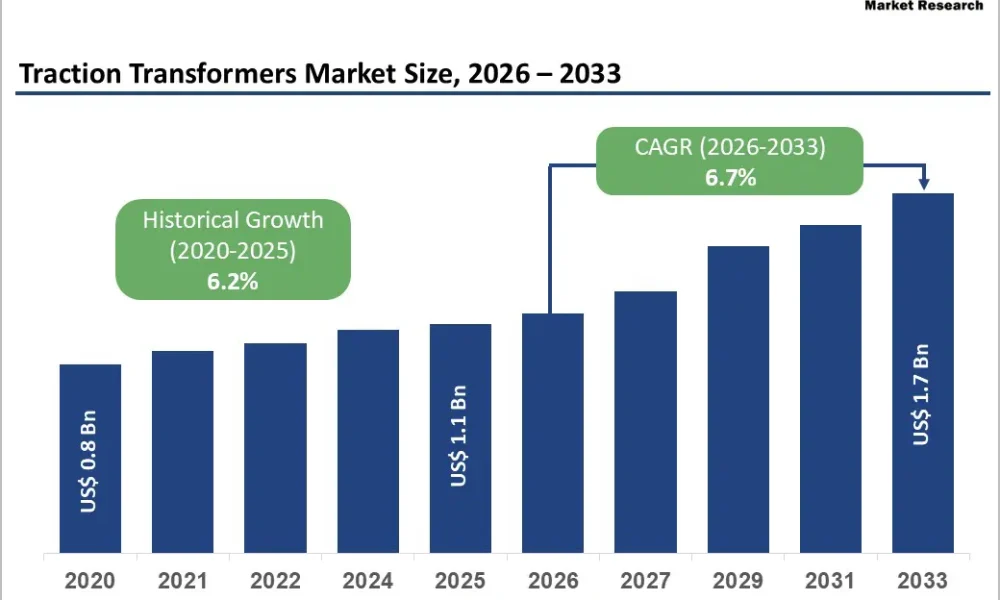
The global traction transformers market is projected to be valued at US$ 1.1 billion in 2026 and is expected to reach US$ 1.7 billion by 2033, expanding at a CAGR of 6.7% between 2026 and 2033. The market’s upward trajectory reflects structural shifts in global rail infrastructure, sustainability mandates, and next-generation electrification technologies.
Three macro forces are shaping the growth narrative:
- Accelerating government investment in rail electrification
- Structural transition toward low-carbon transport systems
- Technological innovation in compact, efficient, and intelligent transformer systems
Major public funding initiatives reinforce this trend. The Infrastructure Investment and Jobs Act allocates US$ 66 billion to rail improvements in North America. Meanwhile, the European Green Deal sets carbon neutrality goals by 2050, heavily dependent on rail electrification. India has electrified 94% of its railway network as of early 2024 and continues progressing toward complete electrification.
Market Overview and Growth Outlook
Between 2020 and 2025, the market grew at a CAGR of 6.2%, driven primarily by high-speed rail expansion and metro modernization. From 2026 onward, growth is expected to accelerate as urbanization intensifies and freight operators seek lower operating costs.
Asia-Pacific leads the market with approximately 40% share, driven by China’s 40,000+ km high-speed rail (HSR) network and India’s rapid electrification drive. North America, however, is poised to be the fastest-growing region due to large-scale federal modernization programs and emerging freight electrification initiatives.
Electric locomotives represent the dominant application segment, accounting for roughly 58% share in 2025. Machine-room-mounted transformers are the fastest-growing mounting configuration, expected to expand at a CAGR of 7.5% through 2032.
Market Drivers
Accelerating Rail Electrification Projects
Governments worldwide are prioritizing electrified rail corridors as part of long-term sustainability strategies.
India has invested over US$ 5.5 billion in electrification since 2014 and is targeting 100% electrification of its network. In Europe, cross-border electrified corridors are expanding under EU infrastructure frameworks. In China, continuous HSR network additions require advanced transformer systems for new rolling stock.
Major suppliers such as ABB Ltd and Siemens AG are securing contracts to supply high-efficiency traction transformers for new rail cars across Asia and Europe.
Electrified locomotives offer approximately 30% greater energy efficiency than diesel alternatives, significantly lowering long-term operating costs and aligning with net-zero goals.
Rising Demand for Energy-Efficient Rail Systems
Decarbonization mandates are fundamentally altering procurement priorities.
Electric rail eliminates direct emissions and integrates seamlessly with renewable-powered grids. Modern traction transformers now deliver efficiency improvements of 1–2 percentage points compared to legacy systems. While this may appear incremental, over 30-year lifecycles on high-density corridors, the savings are substantial.
European operators targeting carbon neutrality by 2050 increasingly specify advanced AC transformer systems capable of supporting regenerative braking and grid feedback mechanisms.
Electricity price stability compared to volatile diesel markets further strengthens the economic case for electrification.
Market Restraints
High Capital Costs in Remote Regions
Electrification remains capital-intensive. Installing overhead catenary systems, substations, and signaling infrastructure can exceed US$ 1–2 million per kilometer in developed markets.
In sparsely populated areas, electrification often lacks economic justification. Countries including Brazil, Mexico, and parts of the United Kingdom continue operating significant diesel fleets due to cost barriers.
These structural limitations restrict transformer deployment primarily to dense urban corridors and intercity routes.
Complex Voltage Standards and Multi-System Requirements
Global railway networks operate under varied voltage systems:
- 15 kV 50 Hz AC
- 25 kV 50 Hz AC
- 16.7 Hz AC (Germanic systems)
- 1.5–3 kV DC (urban transit)
Manufacturers must design multiple transformer variants, increasing engineering complexity and limiting economies of scale. Cross-border operations require multi-system transformers capable of voltage switching, raising production costs by 15–25% compared to single-system units.
Fragmented regulatory and safety standards further complicate standardization efforts.
Market Opportunities
Rapid Urban Metro Expansion
Urban metro systems represent the fastest-growing application segment.
By 2050, 68% of the global population is expected to reside in urban areas. Cities across Asia-Pacific—including Shanghai, Mumbai, Jakarta, and Bangkok—are expanding metro systems to combat congestion and pollution.
Metro networks operate continuously with high duty cycles, requiring compact, reliable traction transformers optimized for space and thermal performance. Machine-room-mounted systems are gaining popularity due to easier maintenance access and improved reliability.
The mounting segment is projected to grow at 7.5% CAGR, reflecting strong urban rail procurement activity.
IoT-Enabled Predictive Maintenance
Digitalization is transforming transformer lifecycle management.
IoT-integrated traction transformers now feature real-time monitoring sensors measuring:
- Temperature
- Dissolved gas levels
- Vibration
- Partial discharge
These systems achieve fault-detection accuracy above 93% and reduce annual maintenance costs by approximately 30%.
Manufacturers such as Hitachi Energy and Siemens AG are expanding portfolios to include smart transformer solutions integrated with cloud analytics platforms.
Recurring service revenue from predictive maintenance software could generate US$ 150–200 million annually by 2033, significantly increasing lifetime customer value.
Elevate your business strategy with comprehensive market data. Request a sample report now: https://www.persistencemarketresearch.com/samples/33524
Segment Analysis
Rolling Stock Insights
Electric locomotives dominate with approximately 58% market share.
These locomotives integrate traction transformers with motors and converters, forming the backbone of electrified freight and passenger operations.
OEMs such as Alstom SA and Siemens AG maintain strong traction system integration capabilities, enabling bundled procurement strategies.
Regenerative braking compatibility and long operational lifespans reinforce electric locomotive dominance.
Mounting Position Insights
Underframe mounting holds roughly 56% market share due to space optimization advantages in passenger vehicles.
However, machine-room-mounted transformers are growing faster. These systems provide:
- Enhanced cooling performance
- Improved reliability
- Simplified preventive maintenance
Premium high-speed and long-distance trains increasingly specify machine-room configurations, supporting higher pricing structures.
Overhead Line Voltage Insights
AC systems account for approximately 70% of market share in 2025.
Alternating current systems dominate mainline and high-speed rail due to reduced transmission losses over long distances and seamless integration with national grids.
AC traction transformers command 30–40% price premiums compared to DC systems due to technical complexity and harmonic management requirements.
Regional Analysis
North America
North America’s growth is catalyzed by the Infrastructure Investment and Jobs Act, allocating US$ 66 billion to rail improvements.
Although electrified track accounts for less than 1% of the U.S. railway network, projects such as California’s high-speed rail corridor and Northeast Corridor upgrades are generating new transformer demand.
Major suppliers including Siemens AG, Alstom SA, and ABB Ltd maintain regional production facilities to support these initiatives.
Europe
Europe is the most electrification-advanced region, with 55% of networks electrified.
The European Green Deal drives aggressive decarbonization targets. Countries including Germany and France are modernizing mainline and regional rail systems.
European operators prioritize advanced features such as:
- IoT integration
- Multi-system compatibility
- Lightweight composite transformer designs
Innovation remains strong, particularly in oil-free dry-type transformers for enhanced safety.
Asia-Pacific
Asia-Pacific commands approximately 40% global market share.
China operates the world’s largest HSR network and continues expansion. India’s electrification rate has reached 94%, with further investments planned.
Companies such as CRRC, Mitsubishi Electric Corporation, and Toshiba Corporation play key roles in regional supply chains.
Southeast Asia’s metro expansion programs are creating strong demand pipelines through 2032.
Competitive Landscape
The market is moderately consolidated, with leading global suppliers including:
- ABB Ltd
- Alstom SA
- Siemens AG
- Hitachi Energy
- Mitsubishi Electric Corporation
- CRRC
- Toshiba Corporation
Competition centers on:
- Integrated traction system capabilities
- Lightweight material innovation
- Thermal efficiency improvements
- Digital monitoring and predictive maintenance
Key Industry Development
In January 2025, Alstom SA secured a €144 million contract to supply Mitrac traction components and electrical equipment for 17 Vande Bharat Sleeper trainsets under India’s Make in India initiative, further strengthening its footprint in the high-growth Asia-Pacific market.
Future Outlook (2026–2033)
The traction transformers market stands at the intersection of electrification, digitalization, and sustainability.
Future growth will be shaped by:
- Continued high-speed rail expansion
- Urban metro modernization
- Smart transformer integration
- Lifecycle service revenue models
- Freight electrification pilots
With revenues projected to reach US$ 1.7 billion by 2033, traction transformers will remain a foundational component of global rail decarbonization strategies.
As governments intensify commitments to sustainable mobility, demand for advanced, efficient, and digitally integrated traction transformer systems will continue expanding across developed and emerging markets alike.
Related Reports:




