
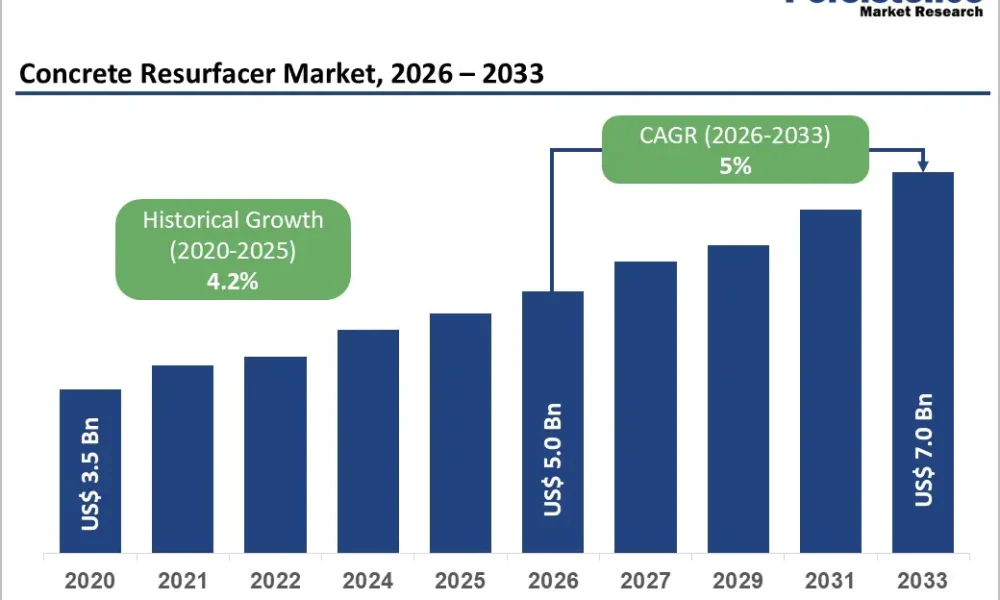
The global Concrete Resurfacer Market is witnessing steady expansion as infrastructure rehabilitation and renovation activities gain momentum worldwide. According to Persistence Market Research, the market is projected to be valued at US$ 5.0 billion in 2026 and is expected to reach US$ 7.0 billion by 2033, registering a CAGR of 5.0% during 2026–2033. Concrete resurfacers are widely used to restore aging, cracked, or damaged concrete surfaces in residential, commercial, and industrial settings. These materials offer cost-effective alternatives to full concrete replacement while improving durability and surface aesthetics.
Market growth is primarily driven by rising investments in infrastructure repair, increasing urban redevelopment projects, and growing preference for decorative and stamped concrete finishes. The leading segment within the market is polymer-modified cementitious resurfacers due to their superior bonding strength and enhanced crack resistance. Regionally, North America holds a dominant position, supported by strong renovation activities and advanced construction practices. Expanding road repair programs and commercial property upgrades further strengthen market demand across developed economies.
Download Your Free Sample & Explore Key Insights : https://www.persistencemarketresearch.com/samples/24943
Key Highlights from the Report
➤ The global concrete resurfacer market is projected to grow from US$ 5.0 billion in 2026 to US$ 7.0 billion by 2033.
➤ The market is expected to register a steady CAGR of 5.0% during the forecast period 2026–2033.
➤ Polymer-modified concrete resurfacers dominate due to enhanced durability and bonding performance.
➤ Infrastructure rehabilitation projects are a key driver fueling market expansion.
➤ North America leads the global market due to strong remodeling activities and road maintenance investments.
➤ Growing demand for decorative concrete finishes is accelerating adoption in residential and commercial segments.
Market Segmentation
The concrete resurfacer market can be segmented based on product type, application, and end user. By product type, the market includes polymer-modified resurfacers, cementitious overlays, and self-leveling resurfacing compounds. Polymer-modified variants hold a substantial share due to their flexibility, improved adhesion, and resistance to harsh weather conditions. Cementitious overlays remain popular for cost-sensitive applications, particularly in large-scale commercial and industrial projects. Self-leveling compounds are gaining traction in flooring restoration where smooth surface finishing is essential.
In terms of end users, the market serves residential, commercial, and industrial sectors. The residential segment benefits from rising home renovation trends and demand for decorative concrete patios, driveways, and walkways. The commercial sector, including retail complexes and office buildings, relies on resurfacing solutions to extend floor life and reduce maintenance costs. Industrial applications focus on restoring warehouse floors and heavy-duty surfaces where durability and load-bearing capacity are critical.
Customize This Report for Your Exact Requirements : https://www.persistencemarketresearch.com/samples/24943
Regional Insights
North America remains a leading regional market for concrete resurfacers due to significant investments in infrastructure rehabilitation and building renovations. Aging highways, bridges, and commercial buildings require cost-effective repair solutions, making resurfacing materials an attractive option. The region’s strong construction standards and preference for sustainable repair solutions further support steady market growth.
Asia Pacific is emerging as a high-growth region driven by rapid urbanization and expanding infrastructure development. Increasing residential construction and public infrastructure projects are contributing to the demand for resurfacing solutions. Governments in developing economies are focusing on extending the life of existing structures, which is expected to create consistent growth opportunities for manufacturers operating in the region.
Market Drivers
The primary driver of the concrete resurfacer market is the growing need for infrastructure repair and rehabilitation. Many developed economies are facing aging concrete structures that require restoration rather than complete reconstruction. Resurfacing solutions provide an economical and efficient alternative, reducing downtime and overall project costs. Rising government spending on road repair and maintenance projects significantly contributes to market growth.
Another key growth driver is the rising demand for decorative and stamped concrete finishes in residential and commercial spaces. Homeowners and property developers increasingly prefer resurfacing solutions that enhance visual appeal while maintaining structural integrity. Technological advancements in polymer-modified resurfacing compounds have improved durability, flexibility, and weather resistance, further supporting widespread adoption across various applications.
Market Restraints
Despite steady growth prospects, the market faces certain restraints. One major challenge is fluctuating raw material prices, particularly cement and polymer additives, which directly impact production costs. Price volatility can affect manufacturer margins and limit the adoption of advanced resurfacing products in cost-sensitive markets.
Additionally, limited awareness in developing regions regarding the benefits of concrete resurfacing over full replacement can slow market penetration. In some cases, contractors and property owners may lack technical expertise required for proper application. Poor surface preparation or incorrect installation may reduce product effectiveness, leading to hesitation among potential end users.
Market Opportunities
Significant opportunities lie in the expansion of smart cities and sustainable construction initiatives. As governments emphasize green building practices, resurfacing solutions that extend the lifespan of existing structures align with sustainability goals. Manufacturers can capitalize on this trend by developing eco-friendly and low-emission resurfacing materials.
Emerging markets also present strong growth potential as urbanization accelerates. Rapid infrastructure development in developing economies increases the need for cost-effective repair solutions. Strategic partnerships with local contractors and infrastructure agencies can help companies strengthen their market presence and capture untapped demand in these regions.
Get Instant Access – Complete Your Purchase : https://www.persistencemarketresearch.com/checkout/24943
Company Insights
Key players operating in the Concrete Resurfacer Market include:
- Sika AG
- BASF SE
- Mapei Corporation
- The Quikrete Companies
- H.B. Fuller Company
- CTS Cement Manufacturing Corporation
- LATICRETE International Inc.
- Ardex Group
- The Euclid Chemical Company
- Westcoat Specialty Coating Systems
- Pidilite Industries Ltd.
- Sakrete Inc.
- TCC Materials
- Fosroc International Ltd.
- W.R. Meadows Inc.
Recent Developments
- March 2024 – A leading manufacturer expanded its polymer-modified resurfacing product line to enhance durability for commercial flooring applications.
- September 2023 – A major industry participant introduced a fast-setting concrete resurfacer designed for rapid infrastructure repair projects.
Future Opportunities and Growth Prospects
The future of the Concrete Resurfacer Market appears promising, supported by infrastructure modernization initiatives and growing renovation activities. As sustainability becomes central to construction strategies, resurfacing solutions will play a vital role in extending structural life cycles while minimizing environmental impact. Continuous innovation in polymer technology and improved application techniques are expected to enhance product performance and expand usage across diverse end-user industries.




