
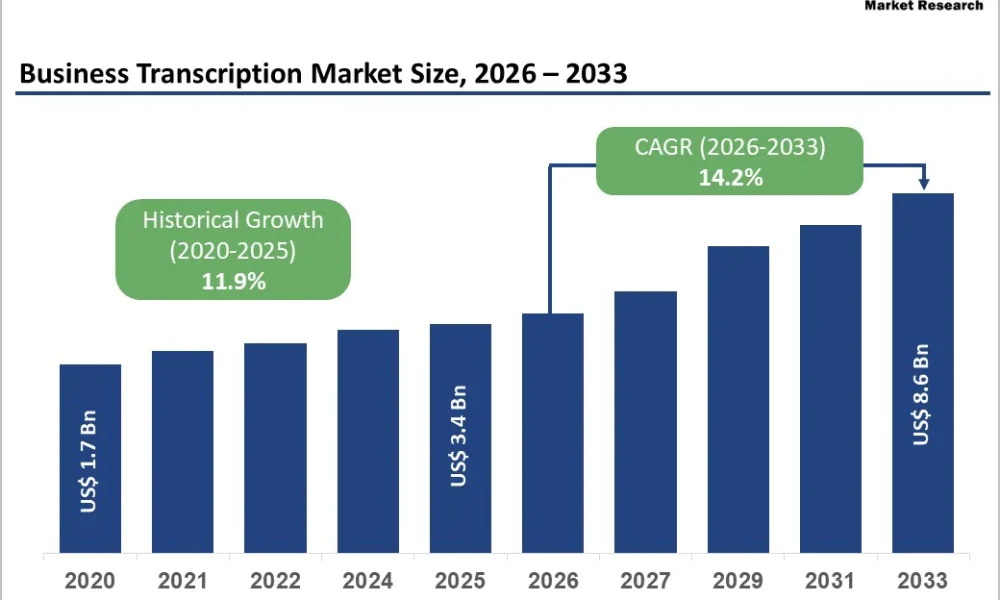
The global business transcription market is entering a high-growth phase, fueled by rapid digital transformation, artificial intelligence (AI) integration, and expanding documentation requirements across industries. Valued at US$ 3.4 billion in 2026, the market is projected to reach US$ 8.6 billion by 2033, growing at a robust CAGR of 14.2% during the forecast period.
Transcription has evolved far beyond manual typing of recorded audio. Today, AI-driven speech recognition, natural language processing (NLP), and cloud-based automation are reshaping how enterprises document meetings, medical consultations, legal proceedings, and customer interactions. As regulatory requirements intensify and remote work becomes permanent, transcription solutions are emerging as mission-critical business tools rather than optional administrative support systems.
Market Overview
Business transcription refers to the conversion of spoken content into structured, readable text for enterprise use. It includes medical transcription, legal transcription, meeting transcription, financial documentation, and multilingual business records.
The market’s growth trajectory reflects several key forces:
- Accelerated adoption of AI-powered speech recognition
- Increasing demand for digital documentation in regulated sectors
- Rapid growth of telemedicine and virtual meetings
- Rising emphasis on compliance with data privacy regulations
- Growing reliance on cloud-based collaboration platforms
North America currently leads the market with approximately 35% global market share, while Asia-Pacific is emerging as the fastest-growing region with a projected CAGR of 16% between 2025 and 2032.
Key Market Highlights
- Market Size (2026): US$ 3.4 Billion
- Forecast Value (2033): US$ 8.6 Billion
- Projected CAGR (2026–2033): 14.2%
- Historical CAGR (2020–2025): 11.9%
- Dominant Component: Software (74.6% share)
- Fastest-Growing Type: Intelligent Transcription (18% CAGR)
- Leading Industry: Healthcare (40% share)
- Fastest-Growing Region: Asia-Pacific
Market Dynamics
Market Growth Drivers
- Rapid Adoption of Artificial Intelligence and Automation
Artificial intelligence is fundamentally transforming transcription workflows. Advanced AI algorithms now deliver accuracy rates exceeding 90%, significantly reducing turnaround times and operational costs.
Major technology companies such as Microsoft, Google, and Amazon are investing heavily in speech recognition and NLP capabilities. A landmark example was Microsoft’s acquisition of Nuance Communications Inc. for US$ 19.7 billion in 2021, underscoring the strategic importance of transcription in healthcare and enterprise ecosystems.
AI-driven transcription software enables:
- Real-time meeting documentation
- Automatic clinical note generation
- Smart speaker identification
- Sentiment and keyword analysis
- Workflow automation and integration with CRMs and EHR systems
The software component accounts for approximately 74.6% of market revenue, driven by subscription-based cloud models and seamless enterprise integration.
- Remote Work and Virtual Collaboration Boom
The shift toward hybrid and remote work has dramatically increased demand for meeting transcription solutions. Collaboration platforms such as Microsoft Teams, Google Meet, and Zoom now integrate native transcription capabilities.
These platforms support multilingual transcription, real-time captioning, and searchable meeting archives. Organizations adopting AI transcription tools report:
- Up to 30% productivity improvement
- 50% reduction in note-taking time
- Enhanced compliance and accountability
- Improved accessibility for hearing-impaired employees
As businesses increasingly operate across geographies, automated transcription has become essential for knowledge retention and collaboration.
Market Restraints
- Workforce Shortage and Talent Transition
Despite automation, human oversight remains critical in specialized domains such as medical and legal transcription. However, the industry faces talent shortages as experienced professionals retire and fewer younger workers enter traditional transcription roles.
This shortage creates:
- Capacity constraints for service providers
- Increased labor costs
- Delays in complex transcription workflows
- Difficulty scaling specialized services
Hybrid AI-human models are emerging as a solution, combining automation speed with expert quality assurance.
- Regulatory and Cybersecurity Burden
Strict data protection regulations such as HIPAA (U.S.) and GDPR (Europe) impose substantial compliance requirements on transcription providers. Sensitive business and healthcare data must be encrypted, securely stored, and protected from breaches.
Compliance demands include:
- End-to-end encryption
- Secure file transfer protocols
- Access control frameworks
- Data retention management
- Audit trails
Smaller providers often struggle to meet these standards, accelerating market consolidation around larger, compliance-ready vendors.
Elevate your business strategy with comprehensive market data. Request a sample report now: https://www.persistencemarketresearch.com/samples/24031
Market Opportunities
- Telemedicine and Healthcare Digital Transformation
Healthcare represents the largest industry segment, accounting for approximately 40% of total market share. The rise of telemedicine and electronic health records (EHRs) is driving demand for automated clinical documentation.
Ambient clinical intelligence tools now transcribe patient-provider conversations in real time and automatically generate structured medical notes. Integration with major EHR platforms enables seamless documentation workflows, reducing physician burnout and administrative burden.
The healthcare sector’s digitization wave presents one of the most significant long-term growth opportunities for transcription vendors.
- Expansion in Emerging Markets
Asia-Pacific is witnessing rapid growth due to expanding healthcare infrastructure, rising internet penetration, and increasing outsourcing activity.
Countries such as India and China are investing heavily in healthcare digitization and enterprise digital transformation. India, in particular, remains a global hub for transcription outsourcing due to its skilled multilingual workforce and cost advantages.
Multilingual transcription services in Mandarin, Hindi, Spanish, and Arabic are increasingly critical for multinational corporations operating globally.
Category-Wise Analysis
Component Insights
The software segment dominates the business transcription market, accounting for nearly three-fourths of revenue share.
Key benefits include:
- Cloud scalability
- Real-time speech-to-text conversion
- Integration with enterprise systems
- Lower upfront investment via subscription models
Cloud-based architectures allow businesses to scale transcription usage on demand while maintaining secure and compliant infrastructure.
Enterprise Size Insights
Small enterprises (1–99 employees) represent approximately 45% of market share in 2025. Modern transcription tools are affordable and accessible, enabling startups, consultants, and SMEs to implement professional documentation practices without heavy capital expenditure.
Pay-as-you-go pricing and SaaS models make transcription solutions particularly attractive to smaller organizations seeking operational efficiency.
Transcription Type Insights
Intelligent Transcription (Fastest Growing – 18% CAGR)
Intelligent transcription removes filler words, false starts, and repetitions while preserving meaning. It balances readability and accuracy, making it ideal for business meetings and internal documentation.
Verbatim Transcription (Approx. 35% Share)
Verbatim transcription captures every spoken word, including pauses and non-verbal utterances. It is essential in legal proceedings and compliance scenarios.
Edited Transcription
Popular for publishing and marketing applications, edited transcription enhances clarity for public-facing content.
Industry Insights
Healthcare (40% Market Share)
Hospitals and clinics generate vast volumes of documentation daily. Medical transcription software supports:
- Clinical documentation
- Patient record management
- Regulatory compliance
- Workflow efficiency
Healthcare’s reliance on accurate documentation ensures its continued dominance in the transcription landscape.
Regional Insights
North America
North America leads with approximately 35% global share. The United States remains the largest contributor, supported by advanced healthcare IT infrastructure and stringent compliance standards.
Strong adoption of AI-powered tools, combined with high healthcare spending, supports premium transcription solution growth.
Europe
Europe represents the second-largest market, driven by GDPR compliance and healthcare digitalization initiatives.
Countries such as Germany and United Kingdom are investing in digital health transformation, increasing demand for secure and cloud-based transcription solutions.
Asia-Pacific
Asia-Pacific is the fastest-growing region with a projected 16% CAGR. Expansion is driven by economic growth, outsourcing capabilities, and expanding enterprise digitization.
East Asia is projected to account for nearly 30% of global market value by 2033, reflecting significant regional consolidation.
Competitive Landscape
The business transcription market is moderately fragmented but gradually consolidating. Leading companies compete on AI accuracy, security compliance, multilingual capabilities, and platform integration.
Notable players include:
- 3Play Media
- TranscribeMe Inc.
- NCH Software
- Digital Nirvana Inc.
- Otter.ai
- Rev
- GoTranscript
Competitive strategies focus on:
- AI-driven automation
- Hybrid human-AI workflows
- Subscription-based pricing
- Enterprise security certifications
- Multilingual service expansion
Key Market Developments
- March 2025: 3Play Media launched a global linguist marketplace and AI-enabled video language solutions to support compliance with the European Accessibility Act.
- September 2024: Focus Forward announced a strategic partnership with a major cloud provider to enhance real-time enterprise speech-to-text capabilities.
Future Outlook
The business transcription market is transitioning from manual, labor-intensive workflows to intelligent, automated, and analytics-driven systems. Over the next decade, several transformative trends will shape the industry:
- Integration of transcription with AI-driven business intelligence tools
- Real-time multilingual speech translation
- Deeper EHR and CRM integration
- Expansion of ambient clinical intelligence
- Stronger cybersecurity and compliance frameworks
As enterprises continue digitizing operations and regulatory pressures intensify, transcription will move from a support function to a strategic enabler of productivity, compliance, and knowledge management.
With projected growth to US$ 8.6 billion by 2033, the business transcription market stands at the intersection of AI innovation, healthcare transformation, and enterprise digital evolution—making it one of the most dynamic segments within the broader digital services ecosystem.
Related Reports:




