
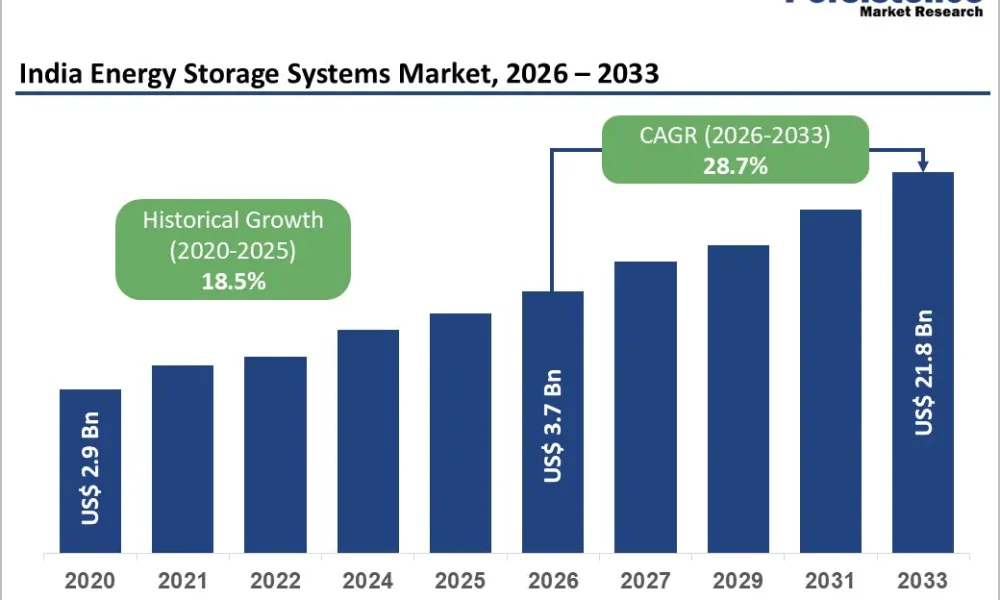
The India Energy Storage Systems Market is entering a transformative growth phase, supported by large-scale renewable energy deployment and grid modernization initiatives. According to Persistence Market Research, the market size is likely to be valued at US$ 3.7 billion in 2026 and is projected to reach US$ 21.8 billion by 2033, expanding at a CAGR of 28.7% between 2026 and 2033. This exceptional growth trajectory reflects the rising integration of battery energy storage systems (BESS), hybrid renewable projects, and decentralized storage solutions across utilities and commercial segments.
India’s commitment to achieving 500 GW of non-fossil fuel-based power capacity by 2030 is a key structural catalyst for the energy storage ecosystem. As solar and wind installations expand rapidly, grid operators require flexible storage infrastructure to manage intermittency, frequency regulation, and peak load balancing. Lithium-ion batteries, pumped hydro storage, and emerging long-duration storage technologies are becoming integral to India’s power transition roadmap, creating strong investment momentum in the sector.
Download Your Free Sample & Explore Key Insights : https://www.persistencemarketresearch.com/samples/36229
Market Statistics, Growth Drivers, and Leading Segments
The India energy storage systems market statistics underline a significant expansion phase, with the market growing nearly six-fold from 2026 to 2033. A CAGR of 28.7% signals accelerated deployment across grid-scale, commercial & industrial (C&I), and residential applications. Rapid renewable capacity additions, supportive regulatory frameworks, and growing demand for grid reliability are key growth drivers behind this momentum. Energy storage is increasingly viewed as a strategic enabler of renewable integration rather than a supplementary technology.
Battery energy storage systems (BESS) are expected to remain the leading segment, driven by their modular scalability and declining lifecycle costs. Among end users, the utility-scale segment is anticipated to dominate due to large renewable parks and hybrid power projects requiring centralized storage solutions. Geographically, western and southern India are likely to lead adoption owing to high solar and wind penetration, established transmission networks, and proactive state-level renewable policies supporting energy storage deployment.
Key Highlights from the Report
➤ India energy storage systems market projected to grow from US$ 3.7 billion in 2026 to US$ 21.8 billion by 2033
➤ Strong CAGR of 28.7% between 2026 and 2033 reflects accelerated renewable integration
➤ 500 GW non-fossil fuel power target by 2030 acting as a structural growth catalyst
➤ Utility-scale battery energy storage systems expected to dominate market share
➤ Western and southern India emerging as leading regional markets
➤ Increasing focus on grid stability, peak shaving, and renewable intermittency management
Market Segmentation
The India Energy Storage Systems Market can be segmented by product type into battery energy storage systems, pumped hydro storage, and other emerging storage technologies. Battery energy storage systems account for a significant share due to their flexibility, quick response time, and suitability for grid-scale as well as distributed applications. Lithium-ion batteries remain the preferred choice for utility and commercial installations because of their efficiency and compact footprint. Pumped hydro storage continues to hold relevance for long-duration storage needs, particularly in large infrastructure projects.
By end-user, the market is divided into utility-scale, commercial & industrial, and residential segments. The utility-scale segment leads the market as renewable energy parks increasingly integrate storage to ensure consistent power supply. Commercial and industrial users are adopting energy storage systems to reduce peak demand charges and improve energy security. Residential adoption, though smaller in share, is gradually increasing in urban areas where rooftop solar installations are paired with storage systems to maximize self-consumption and backup reliability.
Customize This Report for Your Exact Requirements : https://www.persistencemarketresearch.com/request-customization/36229
Regional Insights
Western India is anticipated to remain a key hub for energy storage deployment due to its significant solar capacity and established grid infrastructure. States with large renewable parks require advanced storage solutions to stabilize supply and manage transmission bottlenecks. This region’s early adoption of hybrid solar-plus-storage projects strengthens its position in the India energy storage systems market.
Southern India also represents a strong growth region, supported by high wind energy penetration and progressive renewable policies. The need to balance wind generation variability encourages utility-scale storage installations. Strategic investments in grid modernization and renewable expansion across southern states further reinforce regional leadership in storage integration.
Market Drivers
India’s ambitious renewable energy targets are the primary driver of the India Energy Storage Systems Market. The goal of achieving 500 GW of non-fossil fuel-based capacity by 2030 necessitates large-scale storage deployment to ensure grid stability. Solar and wind generation are inherently intermittent, and energy storage systems provide critical load balancing and frequency regulation services. As renewable penetration deepens, storage becomes essential to maintain grid reliability and prevent curtailment losses.
Additionally, increasing power demand, urbanization, and industrial expansion are fueling the need for dependable electricity supply. Energy storage systems support peak load management and reduce dependency on fossil fuel-based peaker plants. Government-backed hybrid renewable projects integrating storage are further accelerating adoption. These combined structural shifts create a favorable environment for sustained market growth at a CAGR of 28.7% through 2033.
Market Restraints
Despite strong growth potential, high upfront capital costs remain a challenge for the India energy storage systems market. Large-scale battery installations require substantial investment, which may limit adoption among smaller utilities or commercial enterprises. Although long-term cost benefits exist, initial expenditure can slow down project execution in price-sensitive segments.
Supply chain dependencies for advanced battery components also present operational constraints. Fluctuations in material availability and global pricing trends can impact project timelines and financial viability. In addition, limited domestic manufacturing capacity for advanced battery technologies may create import reliance, influencing overall system costs and deployment speed.
Market Opportunities
The rapid scaling of renewable capacity presents significant opportunities for integrated solar-plus-storage and wind-plus-storage projects. Hybrid installations can optimize grid utilization, reduce curtailment, and enhance energy dispatch efficiency. As India moves toward cleaner power systems, energy storage is expected to become a core infrastructure component rather than an auxiliary technology.
Emerging long-duration storage technologies also open new avenues for market expansion. Industrial decarbonization initiatives and distributed energy resources offer additional growth prospects. As regulatory clarity improves and economies of scale are achieved, the India Energy Storage Systems Market is poised to witness robust investment inflows and technological innovation through 2033.
Get Instant Access – Complete Your Purchase : https://www.persistencemarketresearch.com/checkout/36229
Company Insights
Key players operating in the India energy storage systems market include:
- Tata Power Renewable Energy Ltd.
- AES Corporation / Fluence (Fluence JV)
- Reliance New Energy Ltd.
- Exide Energy Solutions Ltd.
- Amara Raja Energy & Mobility Ltd.
- Adani Energy Solutions Ltd.
- JSW Energy Ltd.
- Waaree Technologies / Waaree Energies Ltd.
- HBL Power Systems Ltd.
- Luminous Power Technologies
- Livguard Energy
- Avaada Group
- Rays Power Infra Ltd.
- Delta Electronics India Pvt Ltd.
- BYD Co. Ltd.
- LG Energy Solution / LG Chem
- Panasonic Holdings Corp.
- Samsung SDI Co., Ltd.
- Hitachi Energy India Ltd.
- Siemens Energy India / Siemens Energy AG
- GE Vernova (Grid Solutions) / General Electric
- Kokam
- Saft
- Sungrow Power Supply Co., Ltd.
- NEC Energy (India JV)
Recent Developments:
January 2025 – A leading Indian power utility announced expansion of grid-scale battery energy storage capacity under a hybrid renewable project.
September 2024 – A major renewable energy developer initiated a large-scale solar-plus-storage project to enhance grid reliability in western India.
Future Opportunities and Growth Prospects
The future outlook for the India Energy Storage Systems Market remains highly optimistic, driven by renewable expansion, grid modernization, and supportive policy frameworks. With the market projected to reach US$ 21.8 billion by 2033, sustained investments in battery energy storage systems, hybrid renewable projects, and emerging long-duration storage technologies are expected to reshape India’s energy infrastructure. As scalability improves and costs gradually decline, energy storage will play a defining role in enabling India’s clean energy transition and ensuring long-term energy security.




