
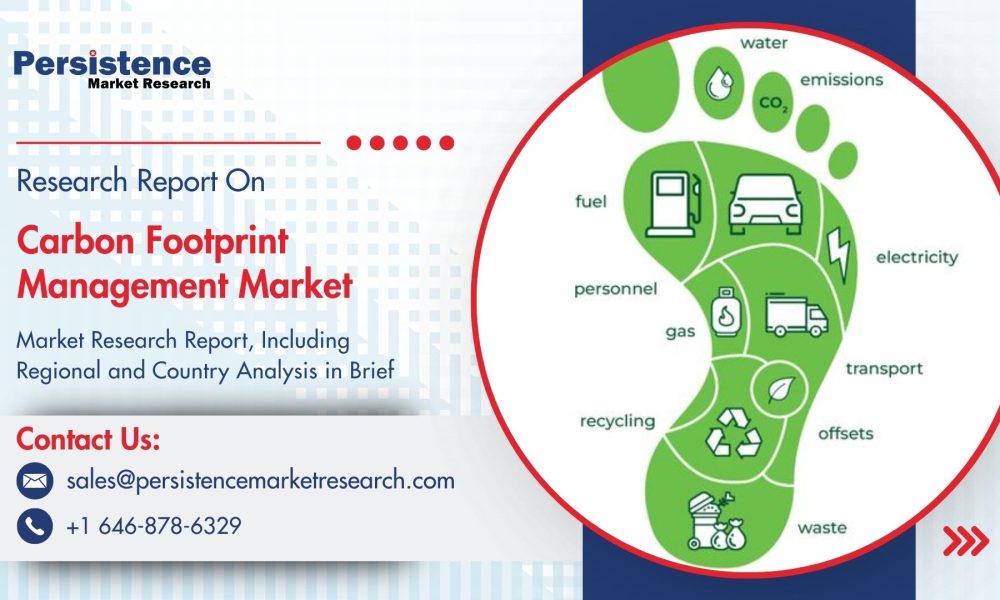
The accelerating climate crisis, rising regulatory scrutiny, and growing stakeholder pressure are reshaping how organizations operate across industries. Businesses are no longer evaluated solely on profitability; environmental performance has become equally critical. In this context, carbon footprint management has emerged as a strategic necessity rather than a voluntary sustainability initiative. According to insights from Persistence Market Research, the global carbon footprint management market is witnessing robust expansion, fueled by stricter climate regulations, corporate net-zero commitments, and rapid digital transformation.
Carbon footprint management refers to the measurement, monitoring, reporting, and reduction of greenhouse gas (GHG) emissions generated by organizations, products, or activities. As governments, investors, and consumers demand greater transparency, companies are increasingly deploying advanced software and services to track and manage emissions across Scope 1, Scope 2, and Scope 3 categories. This growing emphasis on sustainability accountability is laying the foundation for long-term market growth.
Get Your FREE Sample Report Instantly – Click Now: https://www.persistencemarketresearch.com/samples/34288
Understanding Carbon Footprint Management Solutions
Carbon footprint management solutions encompass a combination of software platforms, analytics tools, and consulting services that help organizations calculate and reduce their carbon emissions. These solutions gather data from energy consumption, supply chains, logistics, manufacturing processes, and operational activities to generate accurate emissions reports.
Modern platforms leverage cloud computing, artificial intelligence (AI), machine learning (ML), and IoT integrations to automate data collection and improve reporting accuracy. Businesses can identify emission hotspots, simulate reduction strategies, and align sustainability goals with broader corporate objectives. As reporting standards evolve globally, companies are adopting centralized digital systems to streamline compliance and enhance transparency.
Market Growth Drivers
- Increasing Regulatory Pressure
Governments worldwide are implementing stringent environmental policies to meet international climate targets. Regulatory frameworks now require organizations to disclose emissions data and demonstrate reduction strategies. Regions such as the European Union have introduced comprehensive sustainability reporting directives that mandate climate risk disclosures and emissions accountability.
Similarly, climate-focused policies in the United States are driving corporate investments in carbon management tools. Regulatory enforcement is no longer limited to heavy industries; sectors such as finance, technology, retail, and healthcare are also facing increasing compliance obligations. This regulatory momentum is a key catalyst for market expansion.
- Corporate Net-Zero Commitments
A growing number of multinational corporations have pledged to achieve net-zero emissions within defined timelines. These commitments require precise measurement and ongoing tracking of carbon footprints across complex global operations. Carbon footprint management solutions provide structured frameworks to monitor progress, verify reductions, and report results to stakeholders.
Investors are also integrating environmental, social, and governance (ESG) metrics into decision-making processes. Companies that fail to demonstrate credible emissions reduction strategies risk reputational damage and capital constraints. As ESG investing continues to rise, demand for robust carbon accounting systems is strengthening.
- Growing Awareness of Climate Risks
Climate change poses operational, financial, and reputational risks to businesses. Extreme weather events, supply chain disruptions, and resource scarcity have underscored the importance of environmental resilience. Organizations are increasingly recognizing that proactive carbon management reduces long-term risk exposure while enhancing brand credibility.
In major economies such as China, rapid industrialization combined with national carbon neutrality targets is driving the adoption of emission monitoring technologies. Emerging markets are also beginning to integrate carbon tracking systems as part of sustainable development agendas.
Market Segmentation Overview
The carbon footprint management market can be segmented based on component, deployment mode, industry vertical, and region.
By Component
The market includes software solutions and services. Software platforms dominate revenue share due to their scalability, automation capabilities, and integration with enterprise systems. Services such as consulting, auditing, and implementation support remain essential, particularly for organizations navigating complex regulatory landscapes.
By Deployment Mode
Cloud-based solutions are experiencing faster growth compared to on-premise systems. Cloud deployment offers real-time data access, cost efficiency, remote scalability, and easier system updates. As organizations continue digital transformation initiatives, cloud-native carbon management tools are becoming the preferred option.
By Industry Vertical
Industries with high carbon intensity—such as energy, manufacturing, transportation, and construction—represent significant demand. However, financial services, IT & telecom, retail, and healthcare sectors are rapidly adopting carbon management platforms to meet ESG disclosure requirements.
Technological Advancements Shaping the Market
Technological innovation plays a central role in market expansion. Advanced analytics and AI-powered platforms are improving emissions forecasting and scenario modeling. These tools enable organizations to simulate various decarbonization pathways and assess cost implications.
Blockchain technology is also being explored to enhance transparency in carbon credit trading and emissions verification. Meanwhile, IoT-enabled sensors are helping companies capture real-time operational data to improve measurement accuracy.
Integration with enterprise resource planning (ERP) systems further enhances data reliability and reporting efficiency. By embedding carbon metrics directly into financial and operational dashboards, businesses can align sustainability performance with corporate strategy.
Challenges Hindering Market Growth
Despite strong momentum, the carbon footprint management market faces certain challenges.
Data Complexity and Standardization Issues
Collecting accurate emissions data—particularly Scope 3 emissions across supply chains—remains complex. Inconsistent reporting standards and fragmented data sources can hinder effective carbon accounting. Organizations often struggle with incomplete datasets and varying global regulations.
High Implementation Costs
While cloud-based solutions reduce upfront investment, comprehensive carbon management systems may still involve significant implementation and integration costs. Small and medium enterprises (SMEs) may find adoption financially challenging without regulatory mandates or incentives.
Lack of Skilled Expertise
Carbon accounting requires specialized knowledge of environmental regulations, reporting standards, and emissions calculation methodologies. The shortage of trained sustainability professionals can slow adoption in certain markets.
Regional Outlook
North America and Europe currently represent mature markets due to early regulatory action and strong ESG awareness. Government initiatives, corporate sustainability culture, and investor activism are fueling demand in these regions.
Asia Pacific is expected to witness significant growth, supported by industrial expansion, urbanization, and climate policy commitments. Countries across the region are investing heavily in renewable energy and carbon monitoring frameworks to meet national targets.
Latin America, the Middle East, and Africa are emerging markets with growing awareness of environmental governance. As global supply chains demand transparency, businesses in these regions are likely to adopt carbon management systems to remain competitive.
Emerging Opportunities
Several trends are creating new growth avenues within the carbon footprint management market:
- Integration with Sustainability Reporting Platforms: Companies are seeking unified ESG reporting systems that combine carbon tracking with broader sustainability metrics.
- Carbon Offset and Credit Management: Digital platforms are expanding capabilities to manage carbon credits, enabling organizations to offset unavoidable emissions.
- Supply Chain Decarbonization: Businesses are increasingly engaging suppliers to measure and reduce Scope 3 emissions, expanding the addressable market.
- AI-Driven Predictive Insights: Advanced predictive modeling will allow companies to anticipate regulatory changes and optimize emission reduction investments.
Get a Customized Market View in One Click: https://www.persistencemarketresearch.com/request-customization/34288
Future Outlook
The future of the carbon footprint management market appears highly promising. As global climate goals intensify and carbon pricing mechanisms expand, businesses will require advanced digital tools to manage environmental impact effectively. Transparency and accountability are becoming competitive differentiators rather than optional practices.
Organizations that invest early in robust carbon management systems will be better positioned to meet regulatory expectations, attract ESG-focused investors, and build long-term resilience. Market growth is expected to remain steady as sustainability transitions from compliance-driven reporting to strategic value creation.
Conclusion
The carbon footprint management market is evolving rapidly in response to global decarbonization imperatives. Regulatory enforcement, investor expectations, technological advancements, and corporate sustainability commitments are collectively driving adoption across industries and regions. While challenges such as data complexity and implementation costs persist, innovation and digital transformation are enabling scalable solutions.
As businesses navigate an increasingly climate-conscious world, carbon footprint management will remain a cornerstone of responsible corporate governance and sustainable growth. The transition to a low-carbon economy is underway, and digital carbon management platforms are poised to play a defining role in shaping that future.
About Persistence Market Research:
Persistence Market Research delivers strategic research solutions that drive business growth. Founded in 2012 and registered in England and Wales in 2023 as Persistence Research & Consultancy Services Ltd., we have completed 3,600+ custom and syndicated studies and supported 2,700+ projects for leading research firms. Combining traditional methodologies with modern tools, we provide actionable insights to multinational corporations, consultants, investors, and government bodies, earning strong trust through long-term client relationships.
Contact Us:
Persistence Market Research
Second Floor, 150 Fleet Street,
London, EC4A 2DQ, United Kingdom
USA Phone: +1 646-878-6329
UK Phone: +44 203-837-5656
Email: [email protected]
Web: https://www.persistencemarketresearch.com




