
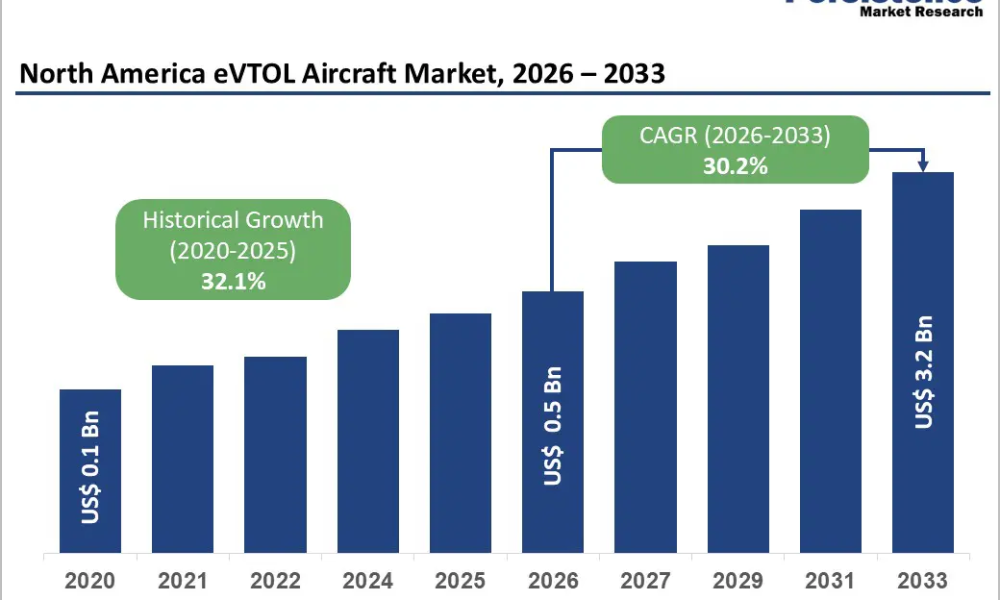
The North America electric vertical take-off and landing (eVTOL) aircraft market is entering a transformative growth phase, reflecting accelerated investments, regulatory support, and expanding commercial applications. According to recent insights published by leading market research firms, the market is estimated to be valued at US$ 0.5 billion in 2026 and is projected to reach US$ 3.2 billion by 2033. This robust expansion represents a compound annual growth rate (CAGR) of 30.2% during the forecast period from 2026 to 2033.
The surge in market growth is fundamentally driven by the Federal Aviation Administration’s formal launch of the eVTOL Integration Pilot Program. This initiative establishes collaborative public-private partnerships with state, local, and tribal governments alongside U.S.-based developers to accelerate safe deployment and certification pathways for advanced air mobility (AAM) platforms. The structured regulatory framework significantly reduces commercialization risks and fosters investor confidence.
Additionally, North America’s well-established air logistics ecosystem further strengthens the business case for eVTOL deployment. The regional air cargo sector processed approximately 83.83 billion freight ton miles, demonstrating a mature and scalable infrastructure capable of integrating next-generation aerial mobility solutions. Urban congestion, increasing demand for rapid cargo transport, sustainability commitments, and advancements in battery energy density are collectively shaping a high-growth environment for eVTOL aircraft across passenger and cargo segments.
Get Your FREE Sample Report Instantly Click Now: https://www.persistencemarketresearch.com/samples/36201
Key Highlights from the Report
➤ The North America eVTOL aircraft market is projected to grow from US$ 0.5 billion in 2026 to US$ 3.2 billion by 2033, registering a CAGR of 30.2%.
➤ Regulatory support through structured pilot programs is accelerating aircraft certification and commercial deployment timelines.
➤ Urban air mobility (UAM) applications are emerging as the dominant segment due to increasing metropolitan congestion.
➤ Cargo and logistics use cases are witnessing rapid pilot deployments supported by established freight infrastructure.
➤ Advancements in battery propulsion and distributed electric propulsion systems are improving range and efficiency.
➤ Strategic partnerships between aerospace manufacturers and technology firms are intensifying competitive innovation.
Market Segmentation
By Range Outlook
- 0-200 Km
- 200-500 Km
By Maximum Take-off Weight (MTOW)
- <250 Kg
- 250-500 Kg
- 500-1500 Kg
- >1500 Kg
By Propulsion Type
- Battery-Electric
- Hybrid-Electric
- Hydrogen-Electric
By Lift Technology
- Vectored Thrust
- Multirotor
- Lift Plus Cruise
By Mode of Operation
- Piloted
- Autonomous
- Semi-Autonomous
Regional Insights
The United States remains the leading contributor to the North America eVTOL aircraft market, supported by a proactive regulatory framework, strong venture capital activity, and a mature aerospace manufacturing ecosystem. The presence of established aviation infrastructure and federal-level support accelerates aircraft testing and certification procedures.
Canada is emerging as the fastest-growing regional market, driven by investments in sustainable aviation technologies and smart city infrastructure initiatives. Canadian metropolitan areas are actively exploring eVTOL integration for remote connectivity and urban mobility enhancement. Government-backed research programs and environmental sustainability commitments further strengthen market prospects in the region.
Mexico is gradually participating in the regional ecosystem through partnerships and feasibility studies, particularly in tourism-centric urban corridors. Cross-border collaboration within North America enhances supply chain integration and certification alignment.
Customize This Report for Your Exact Requirements: https://www.persistencemarketresearch.com/request-customization/36201
Unique Features and Innovations in the Market
Modern eVTOL aircraft differentiate themselves through distributed electric propulsion systems, fly-by-wire digital controls, and autonomous flight assistance technologies. These features enhance safety, reduce noise levels, and minimize mechanical complexity compared to traditional helicopters.
The integration of artificial intelligence (AI) enables predictive maintenance, optimized route planning, and enhanced battery management systems. AI-driven analytics improve aircraft performance while reducing downtime and operational costs. Internet of Things (IoT) connectivity supports real-time data transmission between aircraft and ground control centers, strengthening situational awareness and fleet coordination.
Furthermore, 5G connectivity plays a crucial role in enabling low-latency communication required for autonomous navigation and air traffic management integration. Advanced avionics systems equipped with redundancy protocols significantly enhance passenger confidence and regulatory compliance.
Noise reduction technology is another defining innovation. Distributed propellers and electric motors significantly lower decibel output, making eVTOL aircraft suitable for densely populated urban environments. Sustainability remains a core differentiator, with zero in-flight emissions positioning eVTOLs as a viable solution for reducing the aviation sector’s carbon footprint.
Market Highlights
Businesses and municipalities are increasingly adopting eVTOL solutions to address urban congestion challenges, reduce travel time, and enhance emergency response capabilities. The ability to bypass ground traffic offers significant time savings, particularly in major metropolitan areas with high commuter density.
Regulatory frameworks are playing a pivotal role in market acceleration. Certification roadmaps, pilot programs, and safety guidelines reduce commercialization uncertainties and provide clarity to manufacturers and investors. Cost reductions in battery systems and electric propulsion components further enhance economic feasibility.
Sustainability objectives remain central to market adoption. With increasing pressure to decarbonize transportation networks, electric aviation presents a compelling alternative to conventional fossil-fuel-powered rotorcraft. The combination of lower operational costs, reduced maintenance requirements, and environmental benefits strengthens long-term adoption prospects.
Key Players and Competitive Landscape
The competitive landscape is characterized by strategic alliances, technological innovation, and early-stage commercialization efforts. Prominent players operating in the North America eVTOL aircraft market include:
✦ Joby Aviation – The company is at the forefront of FAA certification and is actively developing an integrated urban air mobility ecosystem. Its strategy includes building vertiport infrastructure partnerships and scaling manufacturing to support commercial passenger services.
✦ Archer Aviation – Archer is focused on accelerating aircraft production and strengthening airline partnerships to enable urban air taxi services. The company is investing heavily in production facilities and commercialization programs across major U.S. metropolitan regions.
✦ Beta Technologies – Beta Technologies is emphasizing cargo and defense applications while simultaneously developing a nationwide electric charging network. Its integrated approach combining aircraft and infrastructure strengthens its long-term competitive positioning.
✦ Wisk Aero – Wisk Aero is pioneering autonomous eVTOL aircraft with advanced flight automation systems. Its focus on autonomous certification and safety redundancy positions the company as a leader in next-generation pilotless urban mobility.
✦ Lilium – Lilium is advancing high-speed regional air mobility solutions using jet-powered electric propulsion systems. The company’s strategy includes expanding regional connectivity networks and establishing operational hubs across North America.
These companies are investing heavily in R&D, flight testing programs, and production facility expansion. Partnerships with airlines, urban planners, and technology providers are central to commercialization strategies. Early mover advantage in certification and infrastructure integration is emerging as a key competitive differentiator.
Recent Developments
- The Federal Aviation Administration expanded advanced air mobility testing corridors to accelerate certification timelines and operational readiness.
- Multiple eVTOL manufacturers initiated large-scale production facility construction across key U.S. states to support anticipated commercial launches before 2030.
Ready to Dive Deep? Buy Full Report Today: https://www.persistencemarketresearch.com/checkout/36201
Future Opportunities and Growth Prospects
The future of the North America eVTOL aircraft market is closely tied to evolving regulatory frameworks, battery innovation breakthroughs, and urban infrastructure readiness. Vertiport development, smart city integration, and standardized air traffic management systems will determine the pace of commercial scale-up.
Emerging opportunities include medical evacuation services, disaster response applications, and military logistics support. Integration with multimodal transport systems is expected to redefine urban mobility ecosystems. As autonomous capabilities mature, operational costs are likely to decline further, unlocking mass-market adoption potential.
Technological convergence involving AI, advanced sensors, high-density batteries, and digital airspace management platforms will continue to reshape the competitive landscape. With sustained policy support and capital inflows, North America is poised to lead the global eVTOL transformation, positioning the region at the forefront of next-generation aviation innovation.




