
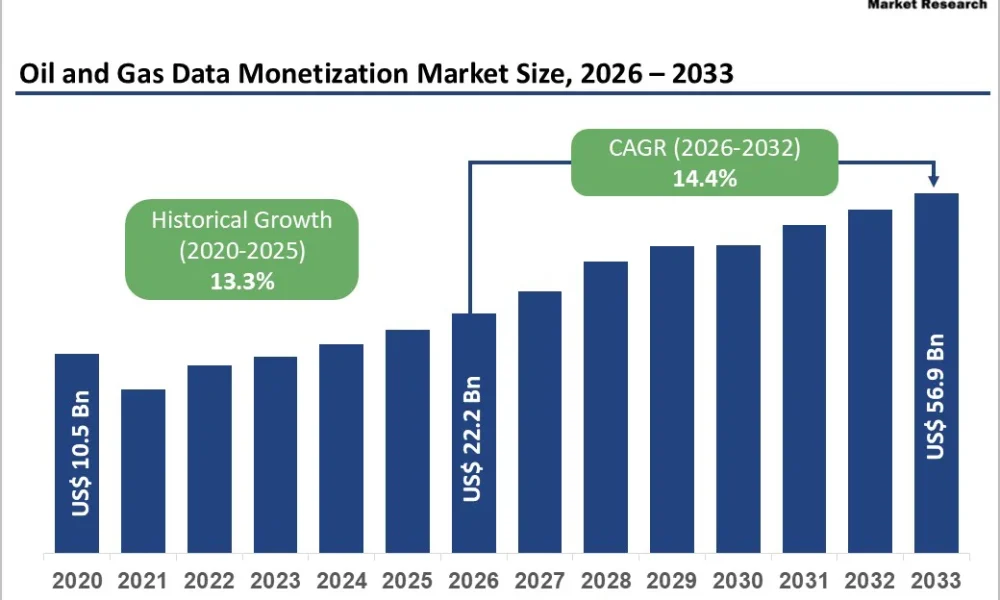
The global oil and gas data monetization market is entering a high-growth phase as energy companies increasingly recognize data as a strategic and revenue-generating asset. The market is expected to be valued at US$ 22.2 billion in 2026 and is projected to reach US$ 56.9 billion by 2033, expanding at a CAGR of 14.4% between 2026 and 2033. Historically, the market grew at a CAGR of 13.3% from 2020 to 2025, highlighting strong digital transformation momentum across upstream, midstream, and downstream operations.
The expansion is primarily fueled by exponential growth in operational data generated from drilling, seismic exploration, IoT-enabled equipment, and digital oilfield technologies. As advanced analytics, artificial intelligence (AI), and cloud-based platforms mature, oil and gas companies are transforming raw data into actionable insights and commercial value streams.
Market Overview and Key Highlights
- Market Size (2026E): US$ 22.2 Billion
- Market Forecast (2033F): US$ 56.9 Billion
- Projected CAGR (2026–2033): 14.4%
- Leading Region: North America (45%+ market share)
- Fastest Growing Region: Asia-Pacific
- Dominant Data Type: Seismic Data (54.7% share)
- Fastest Growing Component: Data-as-a-Service (DaaS)
A major transformation underway is the shift from traditional in-house data management to monetizable, platform-driven data ecosystems supported by initiatives such as Open Subsurface Data Universe (OSDU), which standardizes data interoperability across the energy sector.
Understanding Oil and Gas Data Monetization
Oil and gas data monetization refers to the process of extracting economic value from operational, geological, production, and transactional data. This can include:
- Licensing seismic datasets to third parties
- Offering subscription-based data access
- Providing predictive analytics services
- Enabling AI-powered exploration insights
- Monetizing real-time production optimization data
Traditionally, oil and gas companies treated data as an internal operational tool. Today, it is increasingly viewed as a strategic digital asset capable of generating standalone revenue streams.
Elevate your business strategy with comprehensive market data. Request a sample report now: https://www.persistencemarketresearch.com/samples/33070
Market Growth Drivers
- Explosion of Data from Digital Oilfields
Modern oilfields generate terabytes of data daily through:
- IoT sensors
- SCADA systems
- Drilling equipment
- Reservoir modeling platforms
- Satellite and seismic imaging
With upstream operations becoming more digitally connected, data volumes have grown exponentially. Companies are leveraging advanced analytics to extract insights related to reservoir performance, drilling efficiency, predictive maintenance, and asset lifecycle management.
The integration of AI-driven analytics platforms by companies such as Schlumberger and Halliburton has accelerated the transformation of operational data into actionable business intelligence.
- Adoption of Advanced Analytics and AI
Artificial intelligence and machine learning algorithms are enabling:
- Automated reservoir characterization
- Real-time drilling optimization
- Predictive failure detection
- Production forecasting
- Risk modeling
Cloud-based analytics platforms offered by Microsoft and Amazon Web Services support scalable data processing and enable companies to offer data-as-a-service models to partners and stakeholders.
AI-powered data platforms are not only improving internal efficiency but also enabling energy firms to package insights into monetizable digital services.
- Emergence of Data-as-a-Service (DaaS)
Data-as-a-Service represents the fastest-growing component in the market. Companies are transitioning from capital-intensive software licensing models to subscription-based access to datasets and analytics tools.
DaaS benefits include:
- Reduced upfront costs
- Continuous updates and scalability
- Interoperability across systems
- Cloud-native infrastructure
The adoption of standardized frameworks like OSDU is enabling easier data sharing across partners, joint ventures, and service providers.
Dominant Segment: Seismic Data
Seismic data commands approximately 54.7% of total market share. Its dominance reflects its critical role in:
- Hydrocarbon exploration
- Subsurface imaging
- Reservoir characterization
- Drilling risk mitigation
High-resolution 3D and 4D seismic datasets are among the most valuable digital assets in upstream operations. Companies often monetize historical seismic archives by licensing them to independent explorers or smaller operators entering new basins.
As exploration expands into deeper waters and complex geological formations, demand for high-quality seismic datasets continues to rise.
Regional Analysis
North America: Market Leader
North America accounts for over 45% of the global oil and gas data monetization market. The region benefits from:
- Advanced digital infrastructure
- Mature oilfield digitization
- High IoT sensor deployment
- Strong cloud adoption
The United States leads regional growth due to shale exploration, digital oilfield initiatives, and technology partnerships between energy majors and tech firms.
Collaborations involving companies such as IBM and Google Cloud are accelerating AI-driven analytics deployment in the sector.
The presence of major oilfield service providers and digital solution integrators further strengthens the regional ecosystem.
Asia-Pacific: Fastest Growing Region
Asia-Pacific represents the fastest-expanding regional market, driven by:
- Upstream investment in China and India
- Domestic energy security initiatives
- Offshore exploration expansion
- Rapid cloud infrastructure growth
National oil companies in China, India, and Southeast Asia are investing in digital oilfield platforms to maximize recovery rates and improve operational efficiency.
Growing exploration activity in emerging Asian basins is generating large datasets that can be monetized through partnerships and third-party licensing.
Middle East and Europe
The Middle East is witnessing increased digital transformation initiatives among national oil companies, particularly in the UAE and Saudi Arabia, where smart oilfield programs are accelerating data monetization potential.
Europe, meanwhile, is integrating data monetization into broader energy transition strategies, leveraging offshore wind, geothermal, and carbon capture datasets for cross-sector analytics monetization.
Emerging Market Opportunity: Energy Transition Data Monetization
One of the most compelling growth opportunities lies in monetizing datasets generated from:
- Carbon capture and sequestration (CCS)
- Hydrogen storage projects
- Geothermal exploration
- Renewable integration with oil infrastructure
Subsurface expertise developed in hydrocarbon exploration is now being repurposed for carbon storage and geothermal site evaluation. These datasets have significant commercial value across the broader clean energy ecosystem.
Energy companies are increasingly monetizing legacy subsurface data to support low-carbon projects, opening new revenue channels aligned with sustainability goals.
Market Challenges
Data Silos and Legacy Infrastructure
Many oil and gas companies operate with fragmented IT systems and siloed datasets. Integrating legacy platforms into modern cloud-native architectures can be complex and expensive.
Cybersecurity Risks
As data becomes a monetizable asset, cybersecurity threats increase. Protecting proprietary seismic and operational datasets is critical to maintaining competitive advantage.
Regulatory and Compliance Constraints
Cross-border data sharing, privacy regulations, and intellectual property concerns may limit data commercialization in certain regions.
Competitive Landscape
The oil and gas data monetization market features a mix of:
- Oilfield service providers
- Cloud platform companies
- Analytics software vendors
- National oil companies
- Independent data brokers
Leading players include:
- Schlumberger
- Halliburton
- IBM
- Microsoft
- Amazon Web Services
- Google Cloud
Key competitive strategies include:
- Strategic partnerships between energy and tech firms
- Cloud migration initiatives
- AI-enabled analytics differentiation
- Expansion into energy transition datasets
- Subscription-based revenue models
Future Outlook
The oil and gas industry is transitioning from asset-centric to data-centric value creation. By 2033, digital platforms will likely serve as central hubs connecting exploration, production, logistics, and energy transition initiatives.
Key future trends include:
- AI-powered autonomous drilling optimization
- Real-time subsurface modeling
- Blockchain-enabled data trading platforms
- Cloud-native data lakes
- Monetization of decarbonization datasets
As the market approaches US$ 56.9 billion by 2033, companies that invest in interoperable platforms, AI-driven insights, and subscription-based data ecosystems will secure competitive advantage.
Data is no longer a byproduct of operations—it is becoming a primary revenue engine in the global energy landscape. The oil and gas data monetization market stands at the forefront of this digital transformation, reshaping how energy companies create, share, and commercialize value in the data-driven era.
Related Reports:




