
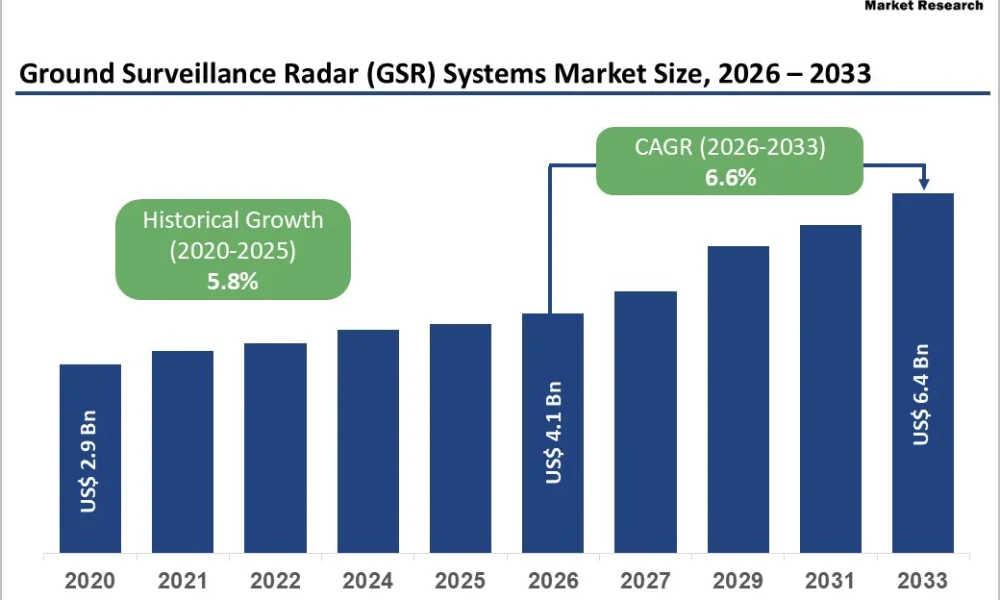
The global Ground Surveillance Radar (GSR) Systems market is entering a phase of sustained expansion, driven by heightened geopolitical tensions, rapid radar technology innovation, and growing mandates for border and infrastructure security. The market is expected to be valued at US$ 4.1 billion in 2026 and is projected to reach US$ 6.4 billion by 2033, growing at a CAGR of 6.6% between 2026 and 2033. Historical growth from 2020 to 2025 stood at 5.8%, indicating accelerating momentum in the forecast period.
As global defense spending surpassed USD 2.4 trillion in 2024, investments in next-generation radar systems have intensified. Advanced technologies such as Active Electronically Scanned Array (AESA), Gallium Nitride (GaN)-based semiconductors, AI-enabled target classification, and multi-sensor fusion architectures are redefining the operational scope of ground surveillance systems.
Market Overview and Key Highlights
- Market Size (2026E): US$ 4.1 Billion
- Market Forecast (2033F): US$ 6.4 Billion
- Projected CAGR (2026–2033): 6.6%
- Leading Region (2025): Asia Pacific – 42% market share
- Fastest Growing Region: Middle East & Africa – 8.1% CAGR
- Dominant Segment: Short-range GSR systems – 46.7% share
- Fastest Growing Segment: Man-portable systems – 7.9% CAGR
Short-range systems lead due to their cost efficiency, rapid deployment capabilities, and precise localized detection performance, particularly in border posts and critical infrastructure zones.
Market Growth Drivers
Escalating Border Security Needs and Geopolitical Tensions
The intensification of border disputes, cross-border infiltration, smuggling activities, and drone incursions has elevated the strategic importance of GSR systems worldwide. Governments are deploying advanced radar systems capable of detecting personnel, vehicles, and UAVs across ranges of 40–200 km depending on configuration.
In March 2025, India signed a USD 330 million contract with Bharat Electronics Limited for 18 Ashwini Low-Level Transportable Radars (LLTR). These AESA-enabled systems offer 200 km detection range and 360-degree coverage optimized for mountainous terrain.
Similarly, Sweden’s procurement of the Ground Master 200 MM/C radar from Thales Group underscores Europe’s continued investment in radar modernization.
Border surveillance remains the dominant application, accounting for 41.9% of market share in 2025, and is forecast to grow at a 6.4% CAGR through 2033.
Technological Advancements in AESA and GaN-Based Systems
The transition from legacy mechanically scanned radars to AESA systems built on GaN semiconductor technology is revolutionizing performance metrics.
Compared to traditional Gallium Arsenide (GaAs) systems, GaN-based AESA radars offer:
- Higher power efficiency
- Extended detection range
- Improved jamming resistance
- Reduced thermal footprint
- Longer operational lifespan
For example, Saab AB is advancing its Giraffe 4A radar platform, enabling simultaneous tracking of multiple aerial and maritime targets with a software-upgradable architecture.
AI-enabled algorithms now support clutter suppression, micro-UAV detection, and autonomous target classification, reducing operator workload while accelerating response cycles.
Market Restraints
High Capital Investment Requirements
Comprehensive GSR deployments can cost between USD 5–15 million per system. Large-scale border monitoring programs demand:
- Multiple radar installations
- Command centers
- Communication networks
- Ongoing maintenance and training
Emerging economies across Latin America, Africa, and South Asia face procurement constraints due to budget limitations, export controls, and technology transfer complexities.
Integration and Technical Complexity
Modern GSR systems must integrate seamlessly with legacy command-and-control infrastructure, surveillance cameras, electro-optical sensors, and cybersecurity frameworks. This demands:
- Specialized technical expertise
- Interoperability testing
- Advanced software development
- Continuous calibration
Institutional resistance and inadequate personnel training can delay capability realization and limit ROI.
Emerging Market Opportunities
Integration with Autonomous Systems and Multi-Sensor Fusion
The future of GSR lies in ecosystem integration. Combining ground radar platforms with UAVs, autonomous ground vehicles, and AI-driven analytics enables comprehensive surveillance networks.
Companies such as Elbit Systems Ltd. and Israel Aerospace Industries Ltd. are investing in multi-layered defense architectures integrating radar, electro-optical systems, and counter-drone technologies.
AI-powered sensor fusion enhances situational awareness and supports real-time decision-making for both military and civilian applications, including:
- Critical infrastructure protection
- Disaster management
- Search-and-rescue operations
- Event security
Expansion of Man-Portable and Lightweight Systems
Man-portable GSR systems represent one of the fastest-growing segments, projected to grow at 7.9% CAGR.
Compact systems such as Thales Ground Observer 12 and Leonardo’s MSTAR series demonstrate increasing demand for lightweight solutions capable of 5-minute deployment. These systems are suitable for:
- Remote border posts
- Tactical battlefield surveillance
- Police forces
- Disaster response teams
Miniaturization, battery innovation, and solid-state electronics are enabling rapid mobility without compromising detection performance.
Elevate your business strategy with comprehensive market data. Request a sample report now: https://www.persistencemarketresearch.com/samples/32840
Segment Analysis
Range Category
Short-range systems dominate with 46.7% share in 2025. Detection ranges between 10–25 km make them ideal for:
- Border checkpoints
- Airports
- Power plants
- Military bases
Their integration with automated alert systems and surveillance cameras enhances perimeter security.
Platform Type
Fixed ground systems account for 52% market share in 2025. These installations provide:
- 24/7 continuous monitoring
- Reliable power infrastructure
- Seamless command-center integration
Fixed platforms are preferred for strategic installations and national border programs.
End-User Analysis
Military and armed forces dominate with 54% share in 2025. Applications include:
- Battlefield intelligence
- Reconnaissance
- Early warning systems
- Air defense integration
High government defense budgets and modernization initiatives sustain demand in this segment.
Regional Insights
Asia Pacific – The Market Leader
Asia Pacific leads with 42% share in 2025 and is projected to grow at 7.2% CAGR through 2033.
Key contributors include India, China, Japan, and Southeast Asian nations investing heavily in indigenous radar programs and border modernization.
India’s radar modernization initiatives and indigenous AESA development reflect accelerating regional competition.
North America – Advanced Technology Ecosystem
North America holds approximately 31% of the market in 2025. The United States remains dominant, driven by border security initiatives and advanced radar innovation.
Lockheed Martin Corporation continues delivering advanced systems under programs such as TPY-4 and 3DELRR.
Raytheon Company successfully conducted first flight testing of its PhantomStrike radar in 2025, marking a milestone in next-generation surveillance technology.
The region is expected to grow at 5.9% CAGR through 2033.
Europe – NATO-Driven Modernization
European nations including Germany, France, and the United Kingdom are prioritizing interoperable surveillance systems aligned with NATO standards.
Radar modernization programs led by companies such as Thales SA and Saab AB are reinforcing regional defense capabilities.
Europe is projected to grow at 6.1% CAGR through 2033.
Middle East & Africa – Fastest Growing Region
The Middle East & Africa region is forecast to grow at 8.1% CAGR between 2026 and 2033, supported by:
- GCC defense modernization
- Expanding surveillance adoption across Africa
- Critical infrastructure protection programs
Rising security challenges are accelerating procurement cycles across the region.
Competitive Landscape
The GSR systems market is moderately consolidated, with major defense contractors accounting for 45–50% of total revenue.
Key players include:
- Thales SA
- Lockheed Martin Corporation
- Saab AB
- Elbit Systems Ltd.
- Raytheon Company
- Israel Aerospace Industries Ltd.
- Kongsberg Gruppen
Strategic initiatives shaping competition include:
- Vertical integration in radar manufacturing
- Expansion into Asia Pacific and Middle East
- AI-enabled differentiation
- Partnerships with command-and-control integrators
- Emerging radar-as-a-service models
Future Outlook
The future of the Ground Surveillance Radar Systems market lies in intelligent, networked, and autonomous surveillance ecosystems. As threats evolve to include micro-drones, low-radar-cross-section vehicles, and asymmetric tactics, radar systems must deliver higher precision and adaptability.
Key future trends include:
- AI-powered autonomous border monitoring
- Integration with space-based surveillance
- Cloud-enabled predictive maintenance
- Edge computing for real-time threat assessment
- Cybersecure multi-domain defense architectures
With defense modernization accelerating worldwide and AI-driven radar innovation reshaping surveillance capabilities, the global GSR systems market is positioned for steady and technology-led growth.
By 2033, the industry will not only expand in value but also transform in operational sophistication, delivering comprehensive situational awareness across military, homeland security, and critical infrastructure environments.
Related Reports:




