
The global telehealth market has emerged as a transformative force in healthcare, reshaping how patients access medical care and how providers deliver services. Telehealth leverages digital communication technologies—including video consultations, remote monitoring, and AI-driven diagnostic tools—to deliver care efficiently. The market’s growth is fueled by increasing demand for convenient, cost-effective healthcare solutions, as well as physicians’ growing recognition of telehealth’s role in chronic disease management, mental health, and specialty care.
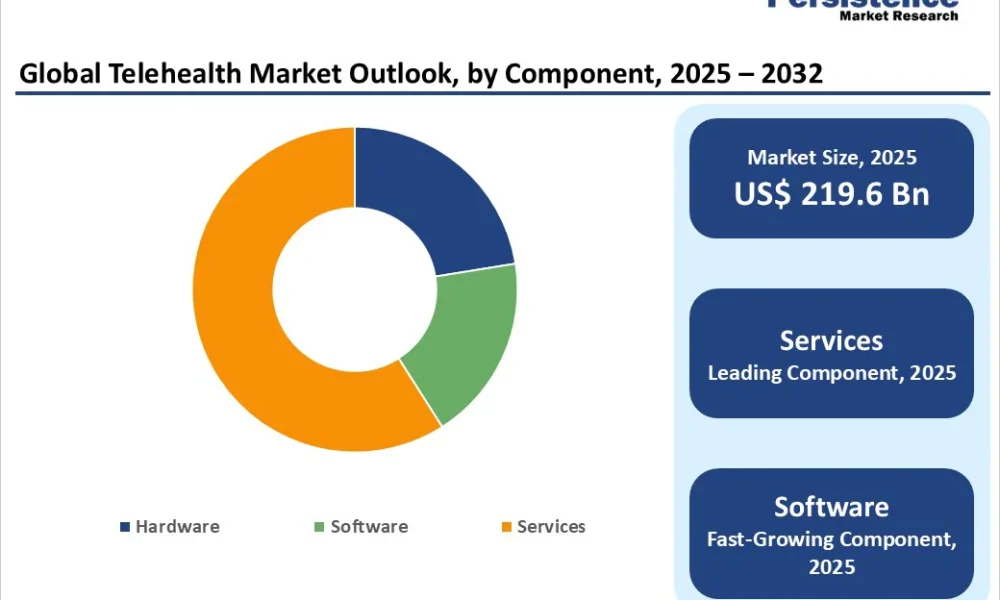
The market is projected to reach US$219.6 billion by 2025 and is expected to surge to US$1,027.3 billion by 2032, growing at a CAGR of 24.5%. Services are the dominant component, and North America leads the market due to advanced digital infrastructure, favorable reimbursement policies, and strong technology adoption. Meanwhile, Asia Pacific is the fastest-growing region, driven by rising internet penetration, government-backed digital health initiatives, and rapidly expanding patient populations in countries like China, India, and South Korea.
Download Your Free Sample & Explore Key Insights: https://www.persistencemarketresearch.com/samples/34664
Key Highlights from the Report
• The global telehealth market is expected to reach US$1,027.3 billion by 2032.
• Services dominate the market, capturing nearly 59% of overall revenue.
• North America holds the largest regional share, approximately 38.9% in 2025.
• Teleradiology is the leading application, accounting for over 21.3% of market revenue.
• Asia Pacific is the fastest-growing region due to digital health adoption and population expansion.
• Telehealth adoption is supported by strong physician and patient satisfaction, with high continued usage rates.
Market Segmentation
The telehealth market is segmented based on component, mode of delivery, and end-user. By component, services dominate the market due to the demand for remote consultations, chronic disease management, and AI-enabled analytics. Services include virtual visits, remote patient monitoring, and teleconsultations, which form the foundation of digital healthcare delivery.
By mode of action, web-based platforms are most widely used because they offer accessibility, real-time interaction, and integration with electronic health records. These platforms support a broad range of applications, including general consultations, specialist follow-ups, and mental health therapy. Hardware-based solutions, such as telemonitoring devices, complement these platforms by enabling remote physiological tracking and data collection. Key end-users include hospitals, specialty clinics, diagnostic centers, and home care patients, with hospitals showing the highest adoption due to their ability to implement technology at scale.
Regional Insights
North America is the largest telehealth market, primarily led by the U.S., where adoption surged during the COVID-19 pandemic. Medicare telehealth visits rose from 840,000 in 2019 to 52.7 million in 2020, demonstrating rapid acceptance. Telehealth continues to support chronic disease management and specialty care, with high adoption in the Northeast and West regions.
Europe holds a 26.8% market share, with Germany and the UK leading adoption. In the UK, digital appointments increased from 15% in January 2020 to 41% in January 2021. Across Europe, teleradiology, telemedicine, and telepsychiatry services are widely used, supported by regulatory frameworks and cross-border digital health initiatives.
Asia Pacific is the fastest-growing market, driven by large populations, rising digital literacy, and strong government support. China, with over 1,600 Internet hospitals, and India, through platforms like eSanjeevani handling over 90,000 daily consultations, highlight the region’s potential. Private-sector investment, smartphone penetration, and government-backed programs are key growth factors.
Get Custom Insights Designed for Your Business: https://www.persistencemarketresearch.com/request-customization/34664
Market Drivers
Telehealth adoption is driven by strong physician and patient support. Physicians recognize telehealth as a vital tool for specialty care, chronic disease management, and mental health services. According to the American Medical Association, 85% of physicians use telehealth, with nearly 70% planning to continue its integration. Patients also value convenience and accessibility, with 79% reporting satisfaction with telehealth visits and 73% intending to continue usage. The combination of provider support, patient acceptance, and technology infrastructure ensures sustained market growth.
Market Restraints
Despite rapid adoption, telehealth faces financial and coverage-related challenges. Inconsistent insurance policies and reimbursement hurdles hinder widespread access. Temporary waivers during the COVID-19 pandemic increased coverage, but their rollback has created uncertainty. Complex reimbursement procedures and administrative burdens limit adoption, particularly for smaller healthcare organizations. Cost concerns, coverage disparities, and potential overuse remain key barriers to mainstream integration.
Market Opportunities
Telehealth offers opportunities to enhance healthcare equity and accessibility. Building trust between healthcare organizations and communities can address disparities in care delivery. Programs like Health Equity Accreditation Plus and culturally competent care grants demonstrate the value of engaging diverse populations and incorporating patient feedback. Expanding telehealth in underserved regions, integrating AI-driven predictive tools, and offering personalized remote care solutions represent significant growth potential.
Checkout Now & Download Complete Market Report: https://www.persistencemarketresearch.com/checkout/34664
Company Insights
Key players in the telehealth market include:
• Teladoc Health, Inc.
• American Well
• Honeywell International Inc.
• AMD Global Telemedicine Inc.
• GE Healthcare
• Oracle Cerner
• Siemens Healthineers
• MDLIVE
• Global Med
• MeMD (Walmart Health)
• Medtronic
• Koninklijke Philips N.V.
• GoMeyra
• Included Health, Inc.
• BRIGHT.MD
• Sesame, Inc.
• PlushCare
Recent Developments:
In August 2025, Teladoc Health acquired Telecare, expanding access to specialist and allied healthcare services across Australia.
In April 2025, Teladoc Health acquired UpLift, enhancing its mental health service offerings and accessibility through insurance-covered benefits.
Conclusion
The telehealth market is poised to transform global healthcare delivery, expected to exceed US$1 trillion by 2032. Strong physician and patient adoption, growing digital infrastructure, and favorable regulatory frameworks continue to drive growth. Despite challenges like reimbursement complexities, opportunities exist to expand services, bridge health equity gaps, and leverage AI-driven innovations. With North America leading adoption, Europe focusing on digital integration, and Asia Pacific as the fastest-growing market, telehealth is set to remain a central pillar of modern healthcare systems.




