
The global Single-use Cystoscope market is experiencing remarkable growth, reflecting a transformative shift in urological diagnostics and infection-control practices. Single-use cystoscopes, designed for one-time patient use, eliminate the need for complex reprocessing associated with traditional reusable endoscopes, significantly reducing the risk of healthcare-associated infections (HAIs). Hospitals, outpatient centers, and ambulatory surgical centers (ASCs) are increasingly adopting disposable cystoscopes to streamline workflows, ensure patient safety, and optimize operational efficiency. This evolution is further accelerated by the rising prevalence of urological disorders, a growing emphasis on minimally invasive procedures, and innovations in endoscopic imaging technology.
Market statistics underline the strong trajectory of this sector. In 2026, the global market size is projected to reach approximately US$ 96.6 million, expanding to US$ 171.0 million by 2033, representing a CAGR of 8.5% from 2026 to 2033. Historically, the market has grown at a rate of 7.1% between 2020 and 2025, reflecting steady adoption of single-use systems. Among product types, flexible video cystoscopes dominate, anticipated to capture around 72% of total revenues due to their versatility and superior clinical outcomes. Geographically, North America leads the market with roughly 38% of global revenues in 2025, driven by high procedure volumes, advanced urology infrastructure, and strong infection-prevention mandates.
Key growth drivers include the rising burden of bladder cancer and urinary incontinence, the demand for sterile, off-the-shelf devices, and increasing procedure migration from inpatient hospitals to outpatient clinics. Meanwhile, Asia Pacific is emerging as the fastest-growing region, fueled by expanding healthcare infrastructure in China, India, and ASEAN nations, rising disease prevalence, and cost-effective local manufacturing. Together, these dynamics indicate robust market expansion and attractive investment potential for medical device manufacturers.
Download Your Free Sample & Explore Key Insights: https://www.persistencemarketresearch.com/samples/22912
Key Highlights from the Report
• The global single-use cystoscope market is expected to reach US$ 171.0 million by 2033.
• Flexible video cystoscopes dominate the product segment with roughly 72% market share.
• North America is the leading regional market, holding 38% of global revenues.
• Asia Pacific is the fastest-growing market due to rising disease burden and infrastructure expansion.
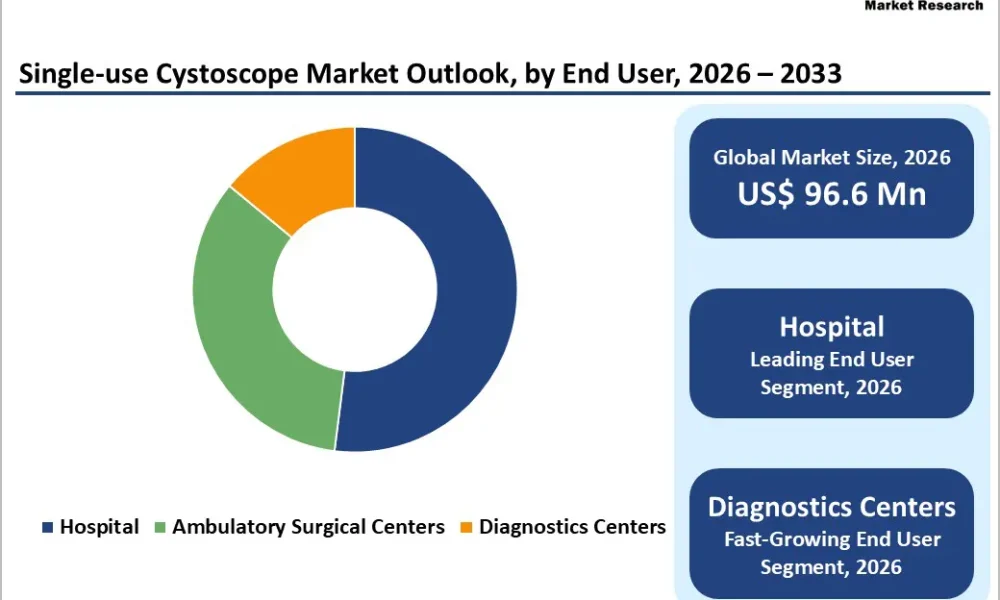
• Diagnostic centers and ASCs are the fastest-growing end-user segments.
• Technological innovations in HD imaging and portable visualization platforms present strong growth opportunities.
Market Segmentation
The Single-use Cystoscope Market can be segmented by product type and end-user.
By product type, the market is dominated by flexible video cystoscopes, which are widely adopted due to their broad clinical applicability, high-definition imaging, and ergonomic designs that facilitate both diagnostic and interventional procedures. Semi-flexible and rigid cystoscopes remain niche products, serving specific patient groups or office-based applications, but their smaller adoption base limits overall market share. Innovations such as enhanced angulation, improved field of view, and integration with portable visualization platforms are further solidifying flexible video cystoscopes as the dominant segment.
By end-user, hospitals currently account for the largest share, estimated at 52% of global revenues in 2025, reflecting the concentration of complex urological procedures, post-operative surveillance, and multi-disciplinary care pathways. However, diagnostic centers and ambulatory surgical centers represent the fastest-growing segment, driven by procedural migration to outpatient settings where single-use cystoscopes enable higher patient throughput, eliminate on-site reprocessing, and reduce infection risks. This shift also provides manufacturers with opportunities to tailor economic models, portable imaging systems, and bundled service offerings specifically for these settings.
Regional Insights
North America continues to dominate the global market due to high cystoscopy volumes, advanced urology care infrastructure, and strong infection-prevention awareness. The United States, in particular, reports nearly one million cystoscopic procedures annually, supported by guidelines from the American Urological Association (AUA) and stringent CDC infection-control recommendations. Reprocessing challenges and documented outbreaks linked to reusable endoscopes have accelerated the adoption of disposable cystoscopes, with vendors such as Ambu A/S, UroViu Corporation, and Boston Scientific actively marketing flexible single-use platforms across hospitals, Veterans Affairs facilities, and outpatient clinics.
In contrast, Asia Pacific is projected to record the highest CAGR between 2025 and 2033. Rapid infrastructure expansion, rising bladder cancer incidence, and growing prevalence of urinary incontinence are primary demand drivers. Regional OEMs, such as Scivita Medical Technology Co., Ltd., are scaling production of cost-effective, high-quality flexible cystoscopes with advanced maneuverability and wide fields of view. Governments in China, India, and ASEAN countries are investing in day-surgery centers, tertiary urology hubs, and infection-prevention programs, further supporting market penetration in this region.
Europe and the Middle East & Africa (MEA) markets are also evolving, with increasing adoption of single-use cystoscopes in tertiary hospitals and private clinics, although environmental regulations and high procurement costs slow broader deployment.
Get Custom Insights Designed for Your Business: https://www.persistencemarketresearch.com/request-customization/22912
Market Drivers
The rising burden of bladder cancer and urological disorders remains a key driver for single-use cystoscopes. Globally, bladder cancer affected more than 573,000 patients in 2020, with an estimated 73% increase in annual cases projected by 2040. Additionally, urinary incontinence and overactive bladder affect over 20% of adult women worldwide, resulting in significant demand for diagnostic and surveillance cystoscopies. Single-use cystoscopes provide a sterile, convenient solution that aligns with growing procedural volumes and outpatient migration.
Intensifying infection-prevention mandates further accelerate adoption. HAIs remain a major concern, with approximately 1 in 10 hospital patients acquiring infections globally. Reusable cystoscopes are frequently linked to contamination incidents, as reported by the CDC and WHO, prompting hospitals and ASCs to transition toward disposable devices to ensure patient safety. Combined with regulatory oversight and public reporting, infection-control priorities continue to drive strong market growth.
Market Restraints
Despite strong clinical advantages, the single-use cystoscope market faces challenges. Environmental concerns related to plastic and electronic waste generation are significant, particularly in European and other sustainability-conscious regions. Hospitals are under pressure to reduce carbon footprints, and life-cycle assessments of disposable devices highlight trade-offs between infection prevention and ecological impact.
Cost and reimbursement pressures also constrain adoption. Although single-use cystoscopes can be cost-effective in office-based and outpatient settings, high-volume hospitals often perceive reusable cystoscopes as more economical per procedure due to existing capital investments. Additionally, procedure codes and reimbursement structures are often aligned with reusable equipment, delaying widespread conversion to disposable systems in some regions.
Market Opportunities
The market offers substantial opportunities in outpatient and ambulatory care expansion, with over four million cystoscopies performed globally each year. As routine diagnostic and surveillance procedures increasingly shift from inpatient to outpatient settings, single-use cystoscopes eliminate the need for complex sterilization infrastructure, enabling higher patient throughput and shorter wait times. Case studies, such as those from Duke University Hospital, demonstrate up to 75% increases in outpatient consult capacity after adopting disposable cystoscopes.
Technological innovation is another growth avenue. Companies are introducing high-definition imaging, portable monitors, and enhanced maneuverability that rival reusable systems. Solutions like Ambu aScope 5 Cysto HD, UroViu Uro-GHD, and Scivita flexible cystoscopes expand clinical indications and support workflow optimization, providing vendors with opportunities to upsell premium platforms and differentiate offerings in a competitive market.
Checkout Now & Download Complete Market Report: https://www.persistencemarketresearch.com/checkout/22912
Company Insights
Key players operating in the Single-use Cystoscope Market include:
• Ambu A/S – A leading provider of flexible single-use cystoscopes and portable endoscopy platforms.
• UroViu Corporation – Specializes in HD sterile single-use cystoscopes for office and ASC settings.
• Scivita Medical Technology Co., Ltd. – Asia Pacific manufacturer of cost-effective flexible cystoscopes.
• Boston Scientific Corporation – Offers disposable endoscopic solutions targeting hospitals and tertiary care centers.
• Zenflow, Inc. – Innovator of the Spring® Scope with an enlarged working channel and improved visualization.
• Olympus Corporation – Expanding single-use cystoscope offerings in selected international markets.
Recent developments:
In September 2025, Zenflow received FDA 510(k) clearance for its Spring® Scope, featuring a 12 French working channel and enhanced visualization capabilities.
In August 2024, Ambu A/S secured FDA clearance for the aScope 5 Cysto HD and accompanying full-HD monitoring systems, enabling superior imaging and workflow efficiency in outpatient and hospital procedures.
Conclusion
The Single-use Cystoscope Market is poised for sustained growth over the coming decade, driven by rising urological disease prevalence, infection-prevention mandates, and expanding adoption in outpatient and ambulatory care settings. Flexible video cystoscopes remain the dominant product segment, while Asia Pacific is emerging as the fastest-growing regional market due to healthcare infrastructure expansion and local manufacturing advantages. Although environmental concerns and cost considerations present challenges, technological innovation, high-definition imaging, and workflow-optimized solutions offer significant market opportunities. Leading players, including Ambu A/S, UroViu Corporation, and Scivita Medical Technology, are actively innovating to capture share, leveraging regulatory approvals, strategic product launches, and tailored solutions to meet the evolving demands of hospitals, diagnostic centers, and ambulatory surgical centers worldwide. As healthcare systems continue to prioritize patient safety, operational efficiency, and minimally invasive diagnostics, the adoption of single-use cystoscopes is expected to accelerate, shaping the future of urological care.




