
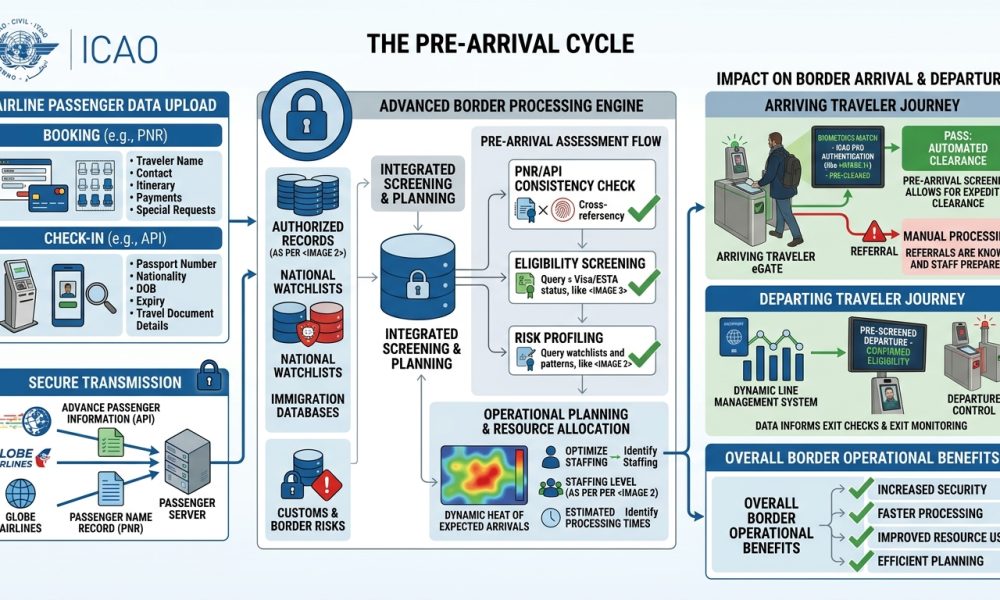
Advance travel data helps authorities prepare for arrivals and departures and assess journey-related Information.
WASHINGTON, DC, October 11, 2026 — Long before international travelers reach an airport passport control checkpoint, government border authorities may have already received identifying Information and journey details electronically from the airline transporting them.
These advance Information systems let authorized immigration, customs, and security agencies prepare for arriving and departing passengers, assess relevant travel documents, and identify circumstances that may require additional examination before a traveler reaches the border.
Two principal categories of airline Information support this process: Advance Passenger Information, commonly known as API, and Passenger Name Record data, referred to as PNR, which originate from different stages of the airline reservation and passenger processing experience.
Although both categories help governments manage international travel, they contain different Information, serve distinct operational purposes, and remain subject to national legislation governing their collection, transmission, use, storage, and disclosure.
As governments expand automated border processing and digital immigration systems, the relationship between airline passenger Information and official border inspection has become an increasingly important component of international aviation security and immigration administration.
Airlines Provide Information Before Passengers Reach the Border
International passenger screening no longer begins exclusively when an immigration officer examines a passport, because many governments require airlines to transmit specified Information before an aircraft arrives or departs.
This advance Information lets border authorities compare relevant details with government records, assess applicable immigration requirements, and prepare for situations that require additional document verification or examination by authorized officers.
The International Civil Aviation Organization’s passenger Information guidelines distinguish between Advance Passenger Information and Passenger Name Record data, explaining how both support border management while originating from different airline systems and operational activities.
API primarily provides structured identity and travel-document Information, while PNR describes booking arrangements and associated journey Information that airlines collect for commercial and passenger-service operations.
These separate Information streams allow governments to perform different assessments before travelers arrive. Still, their availability does not mean every passenger undergoes identical screening or that every government has the same technical capabilities.
What Advance Passenger Information Contains
Advance Passenger Information generally consists of identifying details associated with a traveler and the document being used for an international journey, together with relevant flight and passenger processing Information.
Typical API elements include the traveler’s full name, date of birth, nationality, sex or gender (as specified in the applicable standard), passport number, document-issuing country, and other details required under the receiving government’s rules.
Airlines commonly obtain core identity Information from a passport’s machine-readable zone, which provides standardized text designed to support accurate electronic extraction through compatible document-reading equipment.
Additional Information may identify the flight number, departure airport, arrival airport, scheduled travel times, and other operational characteristics needed to associate the individual with a particular international movement.
Because the Information follows internationally recognized formats, receiving authorities can process large passenger manifests more consistently than they could if every airline transmitted identifying details through unrelated arrangements.
The Passport’s Machine-Readable Zone Supplies Essential Data
The machine-readable zone on a passport’s identity page provides structured Information that airlines and border authorities can use to identify the document and link it to the traveler.
During check-in or another authorized passenger-processing stage, an airline may scan this area to retrieve standardized identifying details and populate the Information fields required by applicable government reporting systems.
The resulting API record can help authorities confirm that the carrier-submitted identifying Information matches the document the traveler intends to present during the international journey.
However, extracting Information from a passport does not independently establish that the physical document is authentic, that its electronic chip contains valid signatures, or that the issuing government continues to recognize it as valid.
Those questions require separate document Authentication and administrative-status procedures, which may run alongside passenger Information screening but should not be confused with submitting API records.
Passenger Name Records Describe Booking Arrangements
Passenger Name Record data primarily originate from airline reservation and departure control systems, where carriers maintain the information needed to organize bookings, issue tickets, manage itineraries, and provide passenger services.
Depending on the circumstances, a PNR may include travel dates, itinerary segments, ticketing Information, contact details, payment Information, baggage arrangements, seat assignments, and records for passengers traveling under a shared reservation.
The Information varies because airline reservations don’t always include the same fields, and some records may contain little more than a passenger name, itinerary, and basic ticketing Information.
Unlike API, which follows a comparatively structured approach to identifying passengers and travel documents, PNR Information reflects commercial booking activity and may contain details that require additional interpretation.
These differences make it important for authorities to distinguish between Information supplied directly from official travel documents and Information that may have originated with passengers, travel agents, or reservation systems.
Why API and PNR Serve Different Purposes
Advance Passenger Information helps authorities establish who is expected to travel on a particular international service. At the same time, Passenger Name Record Information provides additional context about the booking and associated travel arrangements.
An API submission may identify a passenger through passport Information and flight details. In contrast, a PNR may indicate the reservation’s itinerary, relevant booking history, or commercial Information maintained by the carrier.
Government agencies can use these Information categories together where legally authorized, but combining them does not automatically make every field accurate or establish that a traveler presents a security concern.
Reservation Information may change when passengers modify flights, update contact details, or alter bookings, so government systems must account for differences between preliminary travel arrangements and completed journeys.
The distinction also matters for privacy because PNR Information can reveal travel behavior and commercial activity beyond the identity details normally found in a passport.
Canada Uses Passenger Information for Advance Risk Assessment
Canada provides a practical example of how airline Information supports border management through its Advance Passenger Information and Passenger Name Record program administered by the Canada Border Services Agency.
According to the Canada Border Services Agency’s explanation of API and PNR collection, commercial airlines must provide prescribed advance Information and available reservation records for travelers before their flights arrive in Canada.
The agency explains that this Information lets officials assess relevant passenger and crew Information before arrival, supports border security activities, and enables appropriate preparation for individuals requiring further examination.
Canadian API records include identifying Information derived from travel documents and flight-related details, while PNR records may contain available booking Information associated with the itinerary maintained by the airline.
The system illustrates how national authorities can use airline reporting requirements to support advance border assessment without eliminating the need for lawful inspection and admission decisions when passengers arrive.
The United States Also Collects Advance Flight Information
The United States requires relevant international air carriers to provide specified passenger Information through systems administered by U.S. Customs and Border Protection, supporting government inspection responsibilities involving international arrivals and departures.
The Advance Passenger Information System allows carriers to electronically transmit identifying details, providing authorities with Information that can support screening before the passenger reaches a U.S. port of entry.
Depending on the relevant travel arrangement and reporting requirements, passenger Information may be transmitted through established electronic interfaces designed to support government receipt and processing of international passenger manifests.
American authorities also maintain arrangements for receiving Passenger Name Record Information, which can support legally authorized border security and law enforcement activities involving international passenger transportation.
Advance screening does not mean an airline determines immigration admissibility, because government officers retain legal responsibility for assessing whether foreign nationals meet applicable entry requirements.
Interactive Passenger Information Can Support Boarding Decisions
Some governments operate interactive Advance Passenger Information arrangements that allow airlines to submit relevant passenger details and receive a government response before completing specified boarding procedures.
Under these arrangements, the carrier transmits Information through an approved electronic interface, and the receiving government system returns an operational response indicating whether additional action is necessary under the applicable program.
These systems can help airlines meet document verification and government reporting obligations while helping authorities identify certain travel-permission or passenger-processing concerns before an aircraft departs.
Nevertheless, an electronic boarding response should not be interpreted as final immigration admission, because arrival inspection may involve additional circumstances, updated Information, or legal requirements that require government assessment.
The operational distinction remains important because an airline’s compliance with boarding instructions and an immigration authority’s final entry decision reflect different responsibilities within international travel administration.
Advance Screening Can Help Authorities Prepare for Arrivals
Receiving passenger Information before an aircraft lands allows authorized border authorities to organize inspection resources and examine relevant circumstances without relying exclusively on Information collected during the passenger’s arrival interview.
Government systems may use permitted identifying Information to consult immigration records, document status Information, or other authorized databases when determining whether a particular traveler requires additional attention.
Advance Information can also help border agencies identify administrative discrepancies that may require clarification, including questions about travel permissions or document details associated with an arriving passenger.
These checks support preparation rather than replacing the legal assessment required at the border, since governments must still apply the immigration rules and procedural safeguards relevant to each traveler.
For passengers whose Information meets applicable requirements, processing may remain largely invisible, while individuals requiring additional review may face further examination under the destination country’s established procedures.
Passenger Information Can Support Departure Processing
Advance passenger reporting also supports departure administration, allowing governments to obtain Information about individuals leaving their territory via international commercial aviation.
Some countries use carrier-submitted departure Information as part of their electronic travel movement records, while others operate separate immigration exit controls or combine several sources of Information.
The resulting records may help authorities administer authorized periods of stay, understand international passenger movements, or meet reporting and security responsibilities established under domestic legislation.
However, collecting departure Information does not automatically mean every country conducts the same physical exit inspection or applies the same legal restrictions to departing travelers.
Airline data collection, departure recording, and government authorization to restrict travel remain separate matters, and each’s legal significance depends on the applicable national framework.
European Passenger Name Record Rules Establish Specific Purposes
The European Union regulates the collection and use of Passenger Name Record Information through legislation governing specified law enforcement activities connected with terrorism and serious criminal offenses.
Under the EU Passenger Name Record Directive, participating national authorities operate designated Passenger Information Units that receive relevant airline records and process the Information for purposes permitted by European law.
The framework sets out defined passenger assessment activities, relevant Information exchange, and safeguards governing how competent government authorities may process and disclose records.
It also distinguishes legally authorized security screening from unrestricted commercial or administrative use, reflecting the sensitivity of reservation Information and the potential consequences of processing personal travel records.
The European framework shows that passenger Information systems must operate within defined legal limits, rather than letting governments treat airline booking records as unrestricted intelligence sources.
Automated Assessments Require Human Safeguards
Government agencies may use automated systems to compare passenger Information with relevant records or assess it under legally established criteria, helping authorized personnel identify cases warranting additional examination.
However, automated processing can produce inaccurate or misleading results when reservation details are incomplete, identifying Information contains errors, or a traveler shares characteristics with another person recorded in a government database.
The European Union’s PNR framework includes safeguards for adverse decisions, requiring that automated processing not serve as the sole basis for decisions that produce negative legal effects or seriously affect an individual.
This principle recognizes that electronic screening should support authorized assessment rather than replace appropriate verification when a potential match or analytical result could have significant consequences for a traveler.
Human review remains important because government authorities must distinguish reliable evidence from administrative discrepancies, ordinary travel activity, and incomplete Information that does not independently establish misconduct.
A Reservation Record Does Not Establish Criminal Activity
Passenger Name Record Information may describe legitimate travel arrangements without enough context to explain why an individual chose a particular itinerary, payment method, or booking arrangement.
Commercial decisions can reflect personal preferences, employment requirements, family circumstances, flight availability, or changing schedules, making isolated booking characteristics an unreliable basis for conclusions about criminal conduct.
Authorities using PNR Information must therefore apply relevant legal standards and safeguards rather than assuming that unusual itinerary details or incomplete reservation Information independently establish wrongdoing.
The analytical value of passenger records depends on their relationship with reliable additional Information and the specific legally authorized purpose for which the government conducts the assessment.
This distinction is fundamental to responsible border administration because an automated indication that further examination may be appropriate is not equivalent to proof of a security threat or immigration violation.
Airline Passenger Records Are Not Passport Authentication Records
API and PNR data should not be confused with the cryptographic Information used to authenticate electronic passports, because the two systems examine different aspects of international travel and identity verification.
Electronic passport Authentication relies on digitally signed chip Information and trusted verification certificates, allowing compatible inspection equipment to determine whether protected identity records remain unchanged from their authorized issuance.
Airline passenger Information instead provides identity and journey details collected through reservation and check-in processes, allowing government agencies to examine relevant Information before or during international transportation.
A traveler may have a valid electronic passport while an airline record contains a clerical error, and accurate reservation Information alone cannot confirm the passport’s electronic signature is valid.
These separate functions can complement one another within broader border management systems, but neither should be described as an automatic substitute for the other.
Passenger Data and Biometric Information Serve Different Functions
Airline API and PNR Information generally concern biographical identifiers and journey-related details, while biometric border systems analyze physical characteristics used to support identity verification or Identification under applicable laws.
At an automated eGate, a Camera may compare the traveler’s live facial Image with an authenticated passport photograph, creating a verification process that differs from analyzing an airline reservation record.
Government agencies may also maintain separate biometric databases under national immigration and security legislation, but receiving ordinary passenger booking Information does not automatically grant access to those systems.
These distinctions matter because airline data transmission should not be confused with unrestricted biometric surveillance, and the existence of government passenger records does not imply that every airline maintains complete border biometric profiles.
Accurate public understanding requires separating what airlines collect for transportation purposes from the additional identity Information that authorized government agencies may process during border inspections.
Accuracy Problems Can Affect International Travel
Passenger Information systems depend on the accuracy of identifying details submitted by airlines and travelers, creating the possibility of processing complications when names, passport numbers, or other Information contain errors.
A booking completed with an abbreviated name or an outdated travel document number may require correction before the airline can submit Information that matches the document presented at check-in.
Similar problems can arise when travelers replace passports after receiving visas or electronic travel authorizations, particularly when government systems require the new document Information to be linked to an existing permission.
These discrepancies do not automatically establish identity fraud, but they may interrupt routine processing when authorities cannot confidently reconcile the Information received through different administrative systems.
Travelers can reduce avoidable difficulties by reviewing booking details and following official procedures to update travel documents and related digital immigration permissions before departure.
Privacy Rules Govern the Handling of Passenger Information
Advance passenger Information systems exchange personal data between commercial transportation companies and government authorities, making privacy protections and legally defined processing purposes essential to their operation.
The categories of Information collected, the periods for which records may be retained, and the agencies permitted to access them depend on applicable national laws and international arrangements.
European PNR legislation sets retention and Protection requirements, including rules on masking identifying Information after a specified period and restrictions on later disclosure.
Under that framework, records are generally retained for five years, with identifying elements masked after six months and access to full identifying Information later restricted by relevant legal conditions.
These requirements show that authorized government agencies’ access to airline Information does not necessarily permit unlimited retention, unrestricted sharing, or use for purposes unrelated to the governing legislation.
Data Retention Differs Between Jurisdictions
International travelers may encounter substantially different rules on storing and using passenger Information because governments set their own legal frameworks for border management, law enforcement cooperation, and personal data Protection.
Some jurisdictions impose specific retention periods for particular categories of Information, while others apply different administrative rules depending on whether records relate to immigration activity, border security, or authorized investigations.
The European PNR framework offers one approach, but its requirements should not be generalized to countries with different retention periods, disclosure procedures, or individual rights.
Likewise, deleting a record from an airline’s commercial reservation system does not necessarily mean every government copy previously transmitted under legal reporting obligations has also been deleted.
Understanding these differences matters for privacy assessments because airline systems and government Information repositories operate under separate responsibilities, retention policies, and legal authorities.
International Standards Encourage Consistent Information Exchange
The international aviation industry depends on common technical standards that let airlines transmit required passenger Information to multiple countries without designing completely unrelated reporting systems for each destination.
ICAO, the World Customs Organization, and the International Air Transport Association have cooperated on guidance and messaging standards intended to support consistent exchanges of Advance Passenger Information and Passenger Name Record data.
These standards address the structure and transmission of relevant Information while recognizing that governments retain responsibility for determining their own legal requirements and authorized uses of the data.
Adopting common formats can improve interoperability and reduce administrative complexity, although standardized technical transmission does not automatically make every country’s reporting obligations or privacy rules identical.
International cooperation therefore involves both technological compatibility and legal governance, allowing passenger Information to support border processing while preserving national authorities’ separate responsibilities.
Airline Information Supports, Rather Than Replaces, Border Inspection
Although advance passenger Information can help authorities prepare for arrivals and departures, final immigration decisions may require additional examination of travel documents, legal status, personal circumstances, and applicable entry conditions.
A government may receive accurate passenger details before departure while still determining that the individual requires further inspection upon arrival because new Information or additional legal requirements must be considered.
Similarly, a successful airline boarding process does not independently establish that the traveler will satisfy every condition governing admission to the destination country.
Border officers and authorized government systems may review Information unavailable during airline reservation or check-in, including relevant immigration records and circumstances arising during the crossing.
These distinctions explain why advance passenger screening supports international border management rather than serving as a universal preapproval system that guarantees entry.
The Future of Digital Passenger Information
As governments modernize international aviation processing, advance passenger data will likely remain an important resource for coordinating border inspections and supporting increasingly digital immigration systems.
Improved interoperability may help authorities reconcile travel document details with electronic permissions, while secure data exchange arrangements can support more consistent transmission of Information required under national legislation.
However, technological development must also address data accuracy, appropriate access restrictions, privacy protections, and the need for meaningful review when automated systems identify discrepancies affecting legitimate travelers.
The growing use of biometric travel services and digital identity credentials will also require governments to clarify how those technologies interact with existing airline reporting requirements without conflating separate sources of Information.
Maintaining confidence in these systems will depend on clear legal responsibilities and transparent distinctions between airline transportation records, government screening activities, and the decisions made during border inspection.
Passenger Information Is an Important Part of Modern Border Management
Advance Passenger Information and Passenger Name Record systems provide governments with different but complementary sources of Information, allowing authorized authorities to prepare for international arrivals and departures before travelers physically reach immigration checkpoints.
API supplies structured identity and travel document Information, while PNR provides booking and journey details that may support additional assessments when processing occurs under clearly defined legal requirements.
Together, these systems can help border agencies identify administrative discrepancies, prepare appropriate inspection resources, and support legally authorized security activities without independently determining every question about a traveler’s identity or admissibility.
For international travelers, the central distinction is that airline Information can support advance government assessment. Still, authentic passports, valid travel permissions, and final border clearance remain separate components of lawful international movement.
Ultimately, airline passenger Information helps authorities understand who is expected to travel and what journey has been arranged. At the same time, the appropriate government authorities remain legally responsible for evaluating identity, immigration eligibility, and border security.




