
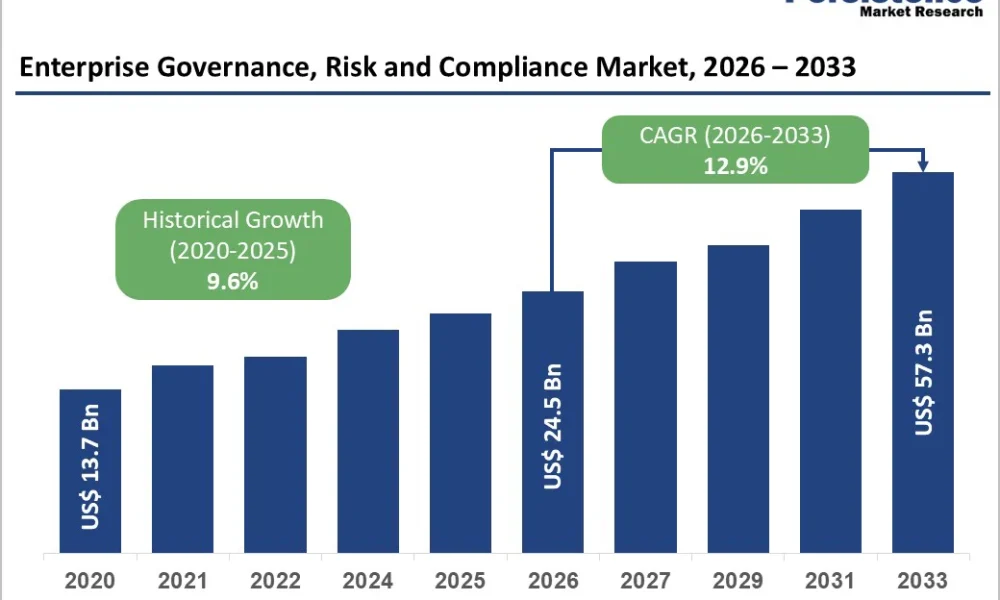
The global Enterprise Governance, Risk, and Compliance (GRC) Market is valued at US$ 24.5 billion in 2026 and is projected to reach US$ 57.3 billion by 2033, expanding at a CAGR of 12.9% between 2026 and 2033. This strong trajectory builds on a historical CAGR of 9.6% from 2020 to 2025, reflecting how regulatory complexity, cybersecurity risks, and ESG accountability have elevated GRC from a back-office function to a boardroom priority.
As organizations confront mounting regulatory mandates, digital transformation risks, third-party vulnerabilities, and reputational exposure, enterprise-wide GRC platforms are becoming essential infrastructure for resilience and sustainable growth.
Market Overview
Key Market Metrics
- Market Size (2026E): US$ 24.5 Billion
- Market Forecast (2033F): US$ 57.3 Billion
- Projected CAGR (2026–2033): 12.9%
- Historical CAGR (2020–2025): 9.6%
Enterprise GRC solutions integrate governance oversight, risk management frameworks, compliance tracking, internal audits, policy management, and real-time risk analytics into unified platforms. The transition from siloed spreadsheets and manual compliance tracking to AI-powered, cloud-native systems is redefining enterprise risk management strategies across industries.
Key Growth Drivers
- Rising Regulatory Complexity
Global enterprises face an expanding web of data protection, financial reporting, operational resilience, ESG, and cybersecurity mandates.
The enforcement of the General Data Protection Regulation (GDPR) continues to drive compliance investments across Europe and beyond. In addition, the European Union’s Digital Operational Resilience Act (DORA) mandates stricter ICT risk management standards for financial institutions.
In the United States, frameworks such as the Sarbanes–Oxley Act (SOX) and evolving SEC cybersecurity disclosure rules require robust audit trails and risk reporting mechanisms.
This regulatory convergence pushes enterprises toward integrated GRC platforms capable of automating reporting, documentation, and continuous compliance monitoring.
- Escalating Cybersecurity and Third-Party Risks
As digital transformation accelerates, organizations face increased exposure to cyberattacks, ransomware, insider threats, and third-party supply chain vulnerabilities.
The growing reliance on cloud providers, SaaS vendors, and global outsourcing partners demands stronger third-party risk management (TPRM) capabilities. Enterprise GRC platforms now incorporate:
- Real-time cyber risk scoring
- Vendor risk assessments
- Automated incident response workflows
- Continuous compliance dashboards
High-profile data breaches have elevated the cost of non-compliance and reputational damage, prompting boards to prioritize proactive risk intelligence.
- ESG and Corporate Governance Pressures
Environmental, Social, and Governance (ESG) reporting requirements are reshaping corporate accountability. Investors increasingly demand transparent sustainability disclosures, ethical supply chains, and climate risk mitigation strategies.
In Europe, sustainability reporting under the Corporate Sustainability Reporting Directive (CSRD) is accelerating enterprise demand for integrated ESG risk modules within GRC systems.
Boards now seek unified platforms that align operational risk, financial compliance, and ESG metrics into a single governance framework.
Market Segmentation Insights
Software Dominates with 65.7% Share in 2026
Software solutions account for 65.7% of the global market in 2026, driven by demand for:
- Automated compliance workflows
- Centralized policy repositories
- Integrated audit management
- Risk heatmaps and analytics dashboards
- AI-based anomaly detection
Leading providers such as SAP, Oracle Corporation, IBM, and ServiceNow continue expanding AI-powered governance suites tailored to enterprise clients.
Cloud Deployment Leads with 55.9% Share
Cloud-based GRC platforms capture 55.9% market share in 2026 and represent the fastest-growing deployment model.
Organizations favor SaaS-based GRC for:
- Lower upfront infrastructure costs
- Automatic regulatory updates
- Scalable global deployment
- Faster implementation cycles
- Integration with cloud-native ERP and CRM systems
The migration to hybrid and multi-cloud environments further strengthens demand for centralized, cloud-enabled compliance management.
BFSI Remains the Largest End-Use Industry (24.6% Share)
The Banking, Financial Services, and Insurance (BFSI) sector accounts for 24.6% of the global market in 2026.
Financial institutions operate under intense regulatory scrutiny, capital adequacy requirements, anti-money laundering (AML) mandates, and digital fraud risks. Real-time risk monitoring, internal control validation, and automated audit trails are essential capabilities in this sector.
The adoption of AI-driven fraud detection and stress-testing analytics reinforces GRC spending across global banks and insurers.
Elevate your business strategy with comprehensive market data. Request a sample report now: https://www.persistencemarketresearch.com/samples/4754
Regional Analysis
North America – 37.8% Market Share
North America dominates the global Enterprise GRC market in 2026 with a 37.8% share.
Factors driving regional leadership include:
- Stringent financial and cybersecurity regulations
- High cost of data breaches
- Mature enterprise IT infrastructure
- Strong cloud adoption rates
Regulatory frameworks such as SOX, HIPAA, and evolving SEC cyber disclosure rules encourage enterprises to adopt comprehensive compliance management platforms.
Large enterprises across the U.S. and Canada increasingly integrate GRC with cybersecurity operations centers (SOCs) to enhance resilience.
Europe – 24.1% Share and Compliance-Driven Growth
Europe holds a 24.1% share of the global market in 2026.
The enforcement of GDPR, implementation of DORA, and rising ESG disclosure requirements are compelling organizations to invest in integrated compliance ecosystems.
European enterprises prioritize privacy-by-design architectures and risk governance transparency. The region’s regulatory intensity continues to drive demand for audit automation and cross-border compliance management tools.
East Asia – 22.1% Share and Rapid Expansion
East Asia captures 22.1% of the market in 2026 and stands among the fastest-growing regional clusters.
Growth drivers include:
- China’s evolving data protection regulations
- Japan’s corporate governance reforms
- South Korea’s digital audit mandates
- Accelerated fintech adoption
Rapid digitalization in manufacturing, telecommunications, and banking sectors is increasing enterprise demand for automated risk oversight systems.
Technology Trends Shaping the Future
AI and Predictive Risk Intelligence
Artificial intelligence is transforming traditional GRC systems into predictive risk engines.
AI capabilities include:
- Real-time anomaly detection
- Automated risk scoring
- Predictive compliance forecasting
- Intelligent policy mapping
- Natural language processing for regulatory interpretation
These features reduce manual workloads and enable dynamic risk mitigation strategies.
Integrated Risk Platforms (IRP)
Organizations are shifting from fragmented compliance tools to Integrated Risk Platforms (IRP) that unify:
- Enterprise risk management (ERM)
- Operational risk
- IT risk
- ESG compliance
- Internal audit
The convergence of cyber, operational, and regulatory risk under a single digital framework enhances executive visibility and decision-making speed.
Third-Party Risk Management (TPRM) Automation
Supply chain disruptions and vendor vulnerabilities have elevated third-party oversight as a strategic priority.
Modern GRC platforms embed automated TPRM modules that:
- Continuously monitor vendor risk
- Evaluate financial stability
- Assess cybersecurity posture
- Trigger compliance alerts
This automation reduces exposure to cascading operational failures.
Competitive Landscape
The Enterprise GRC market remains moderately consolidated, with global technology leaders and specialized compliance vendors competing through innovation, integration depth, and industry-specific customization.
Key players include:
- SAP
- Oracle Corporation
- IBM
- ServiceNow
- MetricStream
- NAVEX
Competition increasingly centers on:
- AI-enabled risk intelligence
- Cloud-native SaaS models
- ESG reporting integration
- Regulatory update automation
- Industry-specific compliance modules
Mergers, acquisitions, and strategic partnerships continue to reshape the competitive ecosystem.
Challenges to Market Expansion
Despite strong growth, certain challenges persist:
- Implementation Complexity – Integrating GRC platforms with legacy ERP, HR, and IT systems requires significant customization.
- Data Silos – Inconsistent enterprise data architecture limits risk visibility.
- Cultural Resistance – Organizational resistance to governance transparency can delay adoption.
- Regulatory Uncertainty – Rapidly evolving global regulations require continuous updates and adaptability.
Vendors that offer simplified deployment models and AI-assisted configuration tools are better positioned to overcome these barriers.
Future Outlook
By 2033, Enterprise GRC platforms will increasingly function as strategic intelligence hubs rather than compliance checklists.
Future trends include:
- Autonomous risk remediation workflows
- Real-time board-level risk dashboards
- Blockchain-based audit trails
- Integrated ESG and carbon reporting modules
- Embedded GRC within enterprise ERP ecosystems
As digital transformation accelerates across industries, governance and risk visibility will become competitive differentiators rather than regulatory obligations.
Conclusion
The global Enterprise Governance, Risk, and Compliance market is on track to grow from US$ 24.5 billion in 2026 to US$ 57.3 billion by 2033, expanding at a CAGR of 12.9%.
Regulatory intensification, cybersecurity threats, ESG accountability, and cloud-driven transformation are reshaping how enterprises manage governance and risk. Software-led, cloud-based GRC platforms now provide unified oversight, predictive analytics, and real-time compliance monitoring.
Organizations that adopt integrated, AI-powered GRC systems will be better equipped to navigate regulatory uncertainty, mitigate operational disruptions, and sustain long-term growth in an increasingly complex global risk environment.
Related Reports:




