
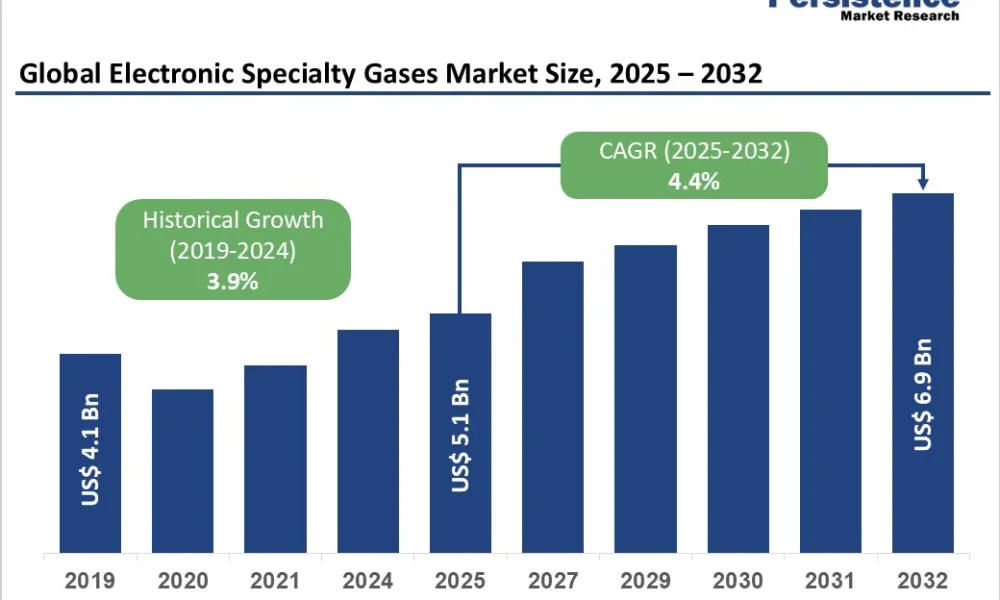
The global Electronic Specialty Gases Market is poised for steady expansion, supported by accelerating innovation in semiconductor fabrication and advanced electronics manufacturing. According to Persistence Market Research, the market is likely to be valued at US$5.1 billion in 2025 and is projected to reach US$6.9 billion by 2032, registering a CAGR of 4.4% between 2025 and 2032. Electronic specialty gases are essential in wafer fabrication, integrated circuit production, flat panel display manufacturing, and photovoltaic cell processing.
Market statistics reflect sustained demand from semiconductor foundries and chip manufacturers that rely on ultra high purity gases for etching, deposition, and cleaning processes. The leading segment remains semiconductor manufacturing due to its high consumption of specialty gases in complex fabrication nodes. Geographically, Asia Pacific dominates the market owing to its strong semiconductor manufacturing ecosystem and large scale electronics production capacity. The combination of advanced chip fabrication facilities and expanding renewable energy infrastructure continues to strengthen regional leadership in electronic specialty gases demand.
Get Your FREE Sample Report Instantly – Click Now : https://www.persistencemarketresearch.com/samples/19678
Key Highlights from the Report
➤ The Electronic Specialty Gases Market is expected to expand from US$5.1 billion in 2025 to US$6.9 billion by 2032 at a CAGR of 4.4%
➤ Rapid semiconductor manufacturing expansion is a primary growth catalyst for high purity specialty gases
➤ Increasing demand for advanced electronic devices is strengthening consumption across fabrication units
➤ Renewable energy technologies are creating new applications for electronic grade gases
➤ Asia Pacific leads the global market due to concentrated electronics and semiconductor production
➤ Continuous technological advancements are increasing the need for ultra high purity gas solutions
Market Segmentation
The Electronic Specialty Gases Market is segmented based on product type, end user, and application areas. Product categories include high purity gases used in deposition, etching, cleaning, and chamber conditioning processes. These gases play a crucial role in ensuring precision during wafer fabrication and advanced chip manufacturing. High purity nitrogen, hydrogen, fluorine based gases, and specialty blends are widely utilized in semiconductor processing. As manufacturing nodes become more complex, demand for advanced specialty gas formulations continues to rise.
From an end user perspective, semiconductor manufacturers represent the dominant segment due to extensive reliance on specialty gases in chip production. The flat panel display industry also accounts for significant demand, particularly for display panels used in consumer electronics. Photovoltaic cell manufacturing and renewable energy component producers are emerging segments contributing to steady consumption growth. Increasing digitalization and clean energy transitions are reshaping segmentation patterns, with innovative applications supporting long term market expansion.
Get a Customized Market View in One Click : https://www.persistencemarketresearch.com/request-customization/19678
Regional Insights
Asia Pacific remains the leading regional market for electronic specialty gases. The presence of major semiconductor fabrication hubs and extensive electronics production facilities drives consistent demand. Strong investments in chip manufacturing infrastructure and renewable energy technologies further enhance the region’s market position. Rapid industrialization and growing domestic consumption of advanced electronic devices continue to sustain regional leadership.
North America and Europe also represent significant markets supported by advanced technology development and established semiconductor research capabilities. These regions benefit from ongoing innovation in microelectronics and clean energy systems. Increasing focus on next generation semiconductor technologies is reinforcing specialty gas requirements. Strategic investments in local manufacturing capacity are also supporting steady regional demand growth.
Market Drivers
The primary driver of the Electronic Specialty Gases Market is the rapid expansion of semiconductor manufacturing. As integrated circuits become more sophisticated, production processes require ultra high purity gases to maintain precision and yield efficiency. Growing demand for advanced consumer electronics, artificial intelligence enabled devices, and data processing systems is fueling semiconductor output. This, in turn, directly increases consumption of electronic specialty gases in fabrication facilities.
Another strong driver is the increasing adoption of renewable energy technologies. Photovoltaic panel manufacturing relies on high purity gases for efficient cell production. As countries focus on clean energy transitions, investments in solar and related technologies are expanding. The integration of renewable energy components into global infrastructure further strengthens long term demand for electronic specialty gases.
Market Restraints
Despite steady growth, the Electronic Specialty Gases Market faces challenges related to high production and purification costs. Manufacturing ultra high purity gases requires advanced infrastructure and strict quality control standards. These factors can elevate operational expenses for producers and limit market entry for smaller players. Cost sensitivity among end users may also impact pricing strategies.
Supply chain complexities and stringent regulatory requirements present additional restraints. Specialty gas transportation and storage demand strict safety compliance and monitoring. Any disruptions in raw material availability or logistics can affect timely supply to semiconductor fabrication plants. Regulatory approvals and environmental compliance measures can also slow expansion in certain regions.
Market Opportunities
Technological advancements in semiconductor nodes present significant opportunities for specialty gas manufacturers. As chip architectures become more complex, demand for customized gas mixtures and higher purity standards will increase. Companies investing in research and innovation can capitalize on evolving fabrication requirements. This trend opens avenues for product differentiation and premium offerings.
Expanding renewable energy infrastructure offers further growth prospects. The rising production of photovoltaic panels and energy storage systems requires advanced material processing solutions. Electronic specialty gas suppliers can benefit from strategic partnerships with renewable energy manufacturers. Emerging markets with growing industrialization also present untapped opportunities for long term expansion.
Exclusive Data Awaits – Continue to Checkout : https://www.persistencemarketresearch.com/checkout/19678
Company Insights
Key players operating in the Electronic Specialty Gases Market include
- Linde Plc
- Air Products and Chemicals Inc.
- Air Liquide
- Showa Denko K K
- Taiyo Nippon Sanso Corporation
- SCI Analytical Laboratories
- Spec Air Specialty Gases
- Merck KGaA
- Messer Group
- Chemix Specialty Gases
- Praxair
- Mitsui Chemicals
- BASF SE
- Matheson Tri-Gas Inc.
- Sumitomo Seika Chemicals Co.
Recent developments in the market include capacity expansion initiatives by major manufacturers in January 2024 to strengthen semiconductor supply chains and new high purity gas product launches in September 2023 to support advanced chip fabrication requirements.
Future Opportunities and Growth Prospects
The Electronic Specialty Gases Market is positioned for consistent growth through 2032, supported by semiconductor innovation and renewable energy adoption. As technology evolves and fabrication processes demand higher precision, specialty gas suppliers are expected to enhance product quality and scalability. Strategic investments in manufacturing capacity, research capabilities, and regional expansion will define competitive advantage. Long term growth prospects remain favorable as digital transformation and clean energy transitions accelerate across global economies.




