
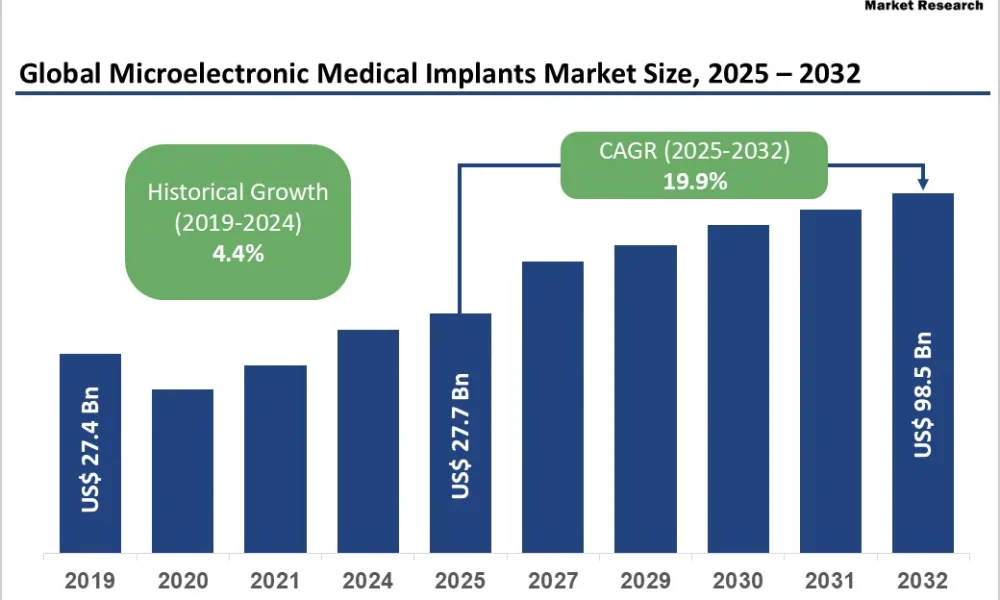
The global microelectronic medical implants market is undergoing a rapid transformation, driven by technological innovations, rising patient demand, and the convergence of digital health solutions with implantable devices. In 2025, the market is projected to reach a value of US$27.7 billion, with forecasts estimating a surge to US$98.5 billion by 2032, reflecting a robust CAGR of 19.9% over the forecast period. This dramatic growth is underpinned by multiple factors, including the aging global population, increasing prevalence of chronic diseases, and growing adoption of minimally invasive and wireless-enabled implantable solutions. The market is also benefiting from an influx of research and development in bioelectronic medicine, as well as advancements in materials and microelectronics that enable smaller, more efficient, and longer-lasting implants.
Among the key drivers of growth are device miniaturization, which allows for less invasive procedures and faster patient recovery, and wireless connectivity, which facilitates real-time remote monitoring and improved patient outcomes. Favorable regulations, particularly in North America and Europe, have accelerated approvals for next-generation implants, while technological breakthroughs in wireless power transfer (WPT) and sensor-based digital health technologies are reshaping post-implant care. Currently, pacemakers and defibrillators dominate the market, capturing an estimated 39% of the revenue share in 2025 due to their widespread clinical use and reimbursement frameworks. Geographically, North America leads the market with a 43% share, owing to strong R&D infrastructure, favorable regulatory pathways, and high adoption of digital and wireless-enabled implants. Conversely, Asia Pacific is projected as the fastest-growing regional market through 2032, propelled by government healthcare reforms, manufacturing capabilities, and rising domestic demand in countries like China and India.
Download Your Free Sample & Explore Key Insights: https://www.persistencemarketresearch.com/samples/33122
Key Highlights from the Report
• The global microelectronic medical implants market is expected to reach US$98.5 billion by 2032.
• Wireless power transfer (WPT) technologies are projected to grow fastest through 2032.
• Pacemakers and defibrillators account for the largest revenue share in 2025.
• North America dominates the market with 43% share due to regulatory agility and R&D leadership.
• Asia Pacific is the fastest-growing regional market owing to manufacturing strength and healthcare reforms.
• Market entry opportunities are strongest in APAC and high-complexity digital implant segments.
Market Segmentation
The microelectronic medical implants market is highly segmented, primarily based on product type, technology, and material. In terms of product types, pacemakers and defibrillators currently lead the market, supported by decades of clinical validation, well-established reimbursement frameworks, and strong procedural adoption in cardiac care. Neurostimulators, by contrast, are emerging as the fastest-growing segment due to expanding indications such as chronic pain management, movement disorders, and treatment-resistant depression. Other implant types include cochlear implants, implantable drug delivery systems, and advanced glucose monitoring devices, all of which benefit from digital connectivity and miniaturization trends.
From a technology perspective, RF communication remains the dominant connectivity standard in 2025, facilitating secure, bidirectional communication between the implant and external monitoring systems. Wireless power transfer (WPT) is rapidly gaining traction, enabling smaller, fully implantable devices with longer lifespans and reduced dependency on battery replacements. In terms of material composition, metals and metal alloys—particularly titanium and platinum—retain leadership due to their biocompatibility and durability. However, medical-grade polymers such as silicone, polyimide, and parylene are expected to experience higher growth rates, supporting flexible, bioresorbable, and next-generation implant designs.
Regional Insights
North America maintains a commanding position in the global market, driven by strong innovation ecosystems, venture capital investments, and efficient regulatory frameworks such as the FDA’s Breakthrough Devices program. High adoption rates of pacemakers, defibrillators, and connected neurostimulators are reinforced by CMS reimbursement policies for remote monitoring. Canada is emerging as a hub for AI-enabled health devices, while Mexico is capturing cross-border manufacturing and supply chain investments. The U.S. remains a testing ground for digital therapeutics-integrated implants, positioning the region for continued leadership.
In Europe, the market growth is moderate but stable, aided by high per capita healthcare expenditure and universal coverage models. Germany, the U.K., and France represent the largest markets, supported by strong R&D incentives and clinical research leadership. The European Union’s Medical Device Regulations (MDR) ensure safety and efficacy but introduce complex approval pathways, particularly for SMEs developing connected or next-gen implants. Europe is also a center for digital health-implant integration, with Nordics and Spain leading initiatives in smart orthopedic, cardiac, and neurostimulator platforms.
Asia Pacific is projected to deliver the fastest growth through 2032, fueled by a combination of manufacturing expertise, favorable healthcare reforms, and rising domestic demand. China is rapidly evolving from a manufacturing base to a market leader, leveraging state-backed biotech investment and regulatory streamlining. India is fostering medtech OEM clusters in Maharashtra and Gujarat, facilitating domestic production and export opportunities. Japan’s PMDA is fast-tracking multifunctional digital implants, while ASEAN economies like Singapore and Malaysia are becoming regional supply chain and co-development hubs. These trends make Asia Pacific a prime region for innovative, high-complexity implant launches.
Get Custom Insights Designed for Your Business: https://www.persistencemarketresearch.com/request-customization/33122
Market Drivers
The microelectronic medical implants market is experiencing significant growth due to several converging factors. A key driver is the aging global population, which is increasing demand for cardiac, neuro, and orthopedic implants. Device miniaturization has allowed for less invasive procedures, reducing recovery times and improving patient compliance. Technological advancements such as wireless power transfer, sensor-enabled monitoring, and cloud-connected neurostimulators are enhancing functionality while enabling remote care. Favorable regulatory frameworks in North America and Europe expedite device approvals, and growing investment in bioelectronic medicine is encouraging development of implants for chronic disease management and neurological disorders. These drivers collectively stimulate market expansion and create new opportunities for both established players and emerging innovators.
Market Restraints
Despite strong growth, the market faces challenges that could restrain adoption. The complex and fragmented regulatory environment across regions imposes significant time and cost burdens on manufacturers, particularly for small and medium enterprises. Regulatory requirements around cybersecurity, data interoperability, and post-market surveillance increase development timelines and reduce agility. Additionally, high costs of advanced implants, limited reimbursement pathways in emerging economies, and technical challenges associated with miniaturized, bioresorbable, or wireless-powered devices may impede rapid commercialization. Such barriers necessitate substantial investment in compliance, clinical validation, and technological development.
Market Opportunities
The market offers substantial opportunities in several emerging areas. Integration with digital therapeutics (DTx) and remote monitoring platforms allows manufacturers to shift from hardware-centric models to service-driven, subscription-based models, increasing patient engagement and reducing hospital readmissions. High-growth potential exists in neurostimulators and wireless implant technologies, particularly in APAC, where government incentives and healthcare infrastructure expansion support adoption. Additionally, the trend toward bioresorbable and flexible polymer implants opens avenues for next-generation devices addressing neurological, cardiac, and chronic disease care, creating opportunities for innovation in materials, form factors, and therapeutic applications.
Checkout Now & Download Complete Market Report: https://www.persistencemarketresearch.com/checkout/33122
Company Insights
Key players in the microelectronic medical implants market include:
• Medtronic plc
• Boston Scientific Corporation
• Abbott Laboratories
• BIOTRONIK SE & Co. KG
• LivaNova PLC
• Stryker Corporation
• Zimmer Biomet Holdings, Inc.
• Cochlear Limited
• MicroPort Scientific Corporation
• Axonics, Inc.
• MicroTransponder, Inc.
• SynCardia Systems, LLC
• Heraeus Holding GmbH
• Nurotron Biotechnology Co., Ltd.
• Second Sight Medical Products, Inc.
Market Segmentation
By Product Type
- Pacemakers & Defibrillators
- Neurostimulators
- Implantable Drug Pumps
- Spinal Fusion Stimulators
- Cochlear Implants
- Ocular Implants
- Others
By Technology
- Radio Frequency (RF)
- Wireless Power Transfer (WPT)
- Sensors
- Advanced Sensing & Communication)
By Material
- Metals & Metal Alloys
- Polymers
- Ceramics & Bioceramics
- Bioresorbable Materials
- Composites
By Region
- North America
- Europe
- East Asia
- South Asia & Oceania
- Latin America
- Middle East & Africa
Recent Developments:
In October 2025, MIT Media Lab developed a grain-of-sand-sized injectable antenna that wirelessly powers deep-tissue implants like pacemakers and neuromodulators, offering battery-free, minimally invasive energy delivery. In September 2025, Vivani Medical spun off Cortigent, its precision neurostimulation subsidiary, to focus on neuromodulation and brain-computer interface therapies, including pivotal trials for arm and hand function recovery in paralysis.
Conclusion
The microelectronic medical implants market is poised for transformative growth, underpinned by technological advancements, supportive regulations, and rising global demand for minimally invasive and digitally integrated healthcare solutions. With North America maintaining leadership in market value and Asia Pacific emerging as the fastest-growing region, manufacturers are increasingly investing in wireless power, bioresorbable materials, and neurostimulation innovations. While regulatory complexity and high development costs present challenges, the integration of digital therapeutics, remote monitoring, and advanced materials offers unprecedented opportunities for revenue expansion and clinical impact. As the market evolves, both established and emerging players are leveraging technology, partnerships, and service-driven models to capture a growing share of this dynamic, high-potential sector.




