
The medicated skincare market has experienced substantial growth in recent years, driven by the increasing prevalence of dermatological conditions such as acne, eczema, rosacea, and the rising awareness of skin health. Medicated skincare products, which blend dermatological science with cosmetic care, are now a crucial part of many individuals’ skincare routines. These products are formulated with active ingredients that are clinically validated for treating specific skin conditions. Medicated skincare items encompass a broad spectrum, including prescription treatments, over-the-counter (OTC) products, and cosmeceuticals designed to address skin concerns ranging from chronic dryness to pigmentation and inflammatory disorders.
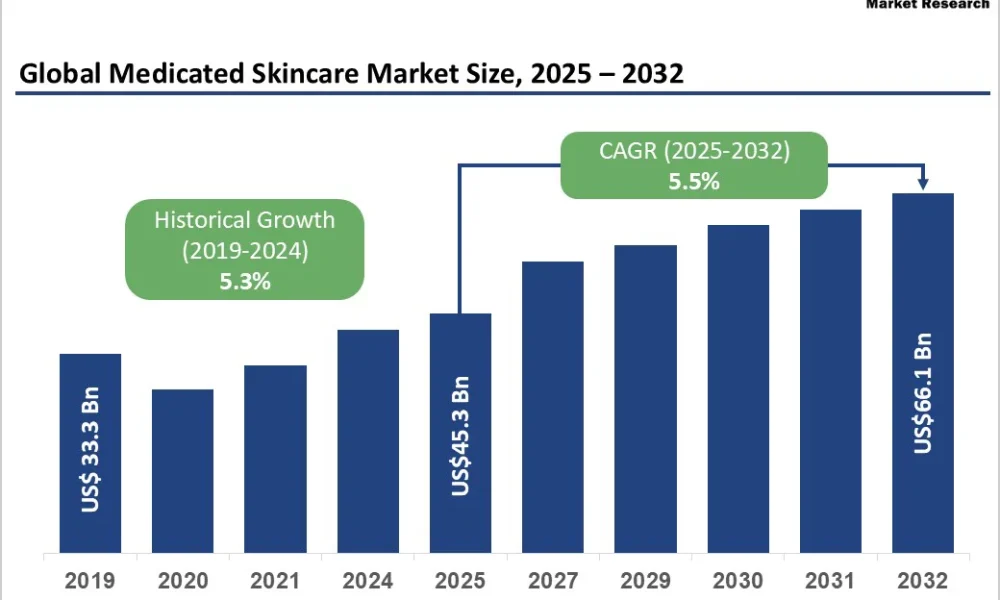
Market statistics indicate that the global medicated skincare market is projected to reach USD 45.3 billion by 2025 and grow at a compound annual growth rate (CAGR) of 5.5%, reaching USD 66.1 billion by 2032. This market expansion is primarily fueled by a combination of factors, including improved access to dermatological care, advances in clinical research, and the increasing popularity of teledermatology and digital healthcare platforms. The growing trend of self-care, paired with rising consumer confidence in dermatology-led products, has also significantly contributed to the market’s growth. Additionally, the availability of active ingredients that target various skin concerns, such as retinoids, benzoyl peroxide, and salicylic acid, has played a pivotal role in attracting consumers to these specialized products.
Download Your Free Sample & Explore Key Insights: https://www.persistencemarketresearch.com/samples/33466
Key Highlights from the Report
• The global medicated skincare market is forecasted to reach USD 66.1 billion by 2032, growing at a CAGR of 5.5%.
• North America dominates the market, holding around 38.3% share due to high healthcare expenditure and consumer trust in dermatologist-led products.
• Asia Pacific is the fastest-growing region, driven by increasing cases of acne and eczema and the expanding digital healthcare landscape.
• Acne-focused products represent the largest market segment, accounting for 31.5% of total market revenue in 2025.
• Dermatology clinics remain the leading distribution channel, capturing approximately 30.7% of the market share.
• Manufacturers are focusing on microbiome-friendly formulations and personalized skincare solutions to cater to changing consumer demands.
Market Segmentation
The medicated skincare market can be segmented based on various factors, including product type, end-user, and geographical regions. These segments help provide a clearer understanding of the factors influencing growth and pinpoint areas for future opportunities.
Product Type
The product type segment of the medicated skincare market is dominated by creams and ointments, which account for approximately 33% of the market. These products are particularly effective for treating conditions like eczema, psoriasis, and acne, as they provide a versatile base for a range of therapeutic actives. Ointments and creams have the added benefit of helping in moisture retention, crucial for treating conditions like eczema and chronic dryness.
Serums and medicated gels have also seen significant growth, especially among consumers seeking fast-absorbing, high-potency treatments. These products are increasingly popular for treating acne scarring, pigmentation issues, and inflammation. The rise of digital platforms offering teleconsultations has boosted the demand for these formats, as they allow dermatologists to recommend specific formulations targeting specific skin conditions with precision.
End-User
The medicated skincare market caters to a variety of end-users, from individuals seeking over-the-counter (OTC) products for mild skin issues to patients requiring prescription-strength solutions for chronic conditions. Prescription treatments, often dispensed by dermatologists, make up a significant portion of the market, particularly for conditions like acne, eczema, and rosacea. OTC solutions, such as acne treatments available in retail pharmacies and online platforms, also contribute to the market’s growth by providing more accessible options for consumers.
The end-user segment is further subdivided into children, adults, and the elderly, each requiring different formulations. For instance, products formulated for pediatric use often focus on gentle, non-irritating ingredients, while solutions for older adults might emphasize anti-aging benefits alongside treatment for skin conditions like rosacea.
Regional Insights
North America
North America remains the largest market for medicated skincare, accounting for approximately 38.3% of global market share in 2025. The region benefits from a well-established healthcare infrastructure and high dermatology visit rates, especially in the U.S., where both prescription and OTC medicated skincare solutions are in high demand. The trust that consumers place in dermatologist-recommended brands and the increasing access to teledermatology platforms have also accelerated market penetration. Furthermore, the growing popularity of aesthetic procedures has led to a parallel increase in demand for post-procedural skincare products.
Europe
Europe, particularly countries like Germany, the U.K., France, and Spain, is a mature market with a strong history of pharmacy-led distribution and a tradition of dermocosmetics. The region’s stringent regulatory frameworks ensure that products undergo extensive testing, further solidifying consumer trust in clinically validated products. Rising pollution-related skin concerns and the aging population are contributing to an uptick in demand for medicated skincare products.
Asia Pacific
Asia Pacific is the fastest-growing region in the medicated skincare market, supported by rapid urbanization, increasing disposable incomes, and heightened awareness of dermatological issues like acne and eczema. China, India, and Japan are key drivers of growth in this region. Additionally, the rise of e-commerce platforms and teledermatology services is expanding access to medicated skincare products, particularly in markets where traditional dermatology care might be less accessible. The region also benefits from competitive manufacturing advantages, making it a hotspot for both local and international brands looking to expand their footprint.
Get Custom Insights Designed for Your Business: https://www.persistencemarketresearch.com/request-customization/33466
Market Drivers
The medicated skincare market is being propelled by a variety of factors. The increasing prevalence of dermatological conditions, such as acne, eczema, and rosacea, is one of the primary drivers of market growth. As skin issues become more prevalent, particularly among younger consumers, the demand for effective and clinically validated treatments rises. The ease of access to dermatology services, including digital consultations and teledermatology platforms, has also contributed to greater awareness and early diagnosis, allowing for more effective and prolonged treatment regimens.
Furthermore, clinical research and product innovation continue to drive the market forward. Advancements in dermatology-focused R&D have led to the development of new formulations incorporating stabilized retinoids, microbiome-friendly actives, and advanced delivery systems, which have enhanced product efficacy and consumer confidence. Digital dermatology and e-commerce channels also support growth by reducing barriers to access, particularly in emerging markets.
Market Restraints
Despite the promising growth prospects, the medicated skincare market faces several challenges. Regulatory complexity remains a significant barrier, as products containing pharmaceutical-grade ingredients are subject to stringent approval processes. This complexity increases the time and cost associated with bringing new products to market, especially for smaller manufacturers. Moreover, the cost of clinical trials and ingredient safety testing often results in higher product prices, which can limit affordability for some consumers.
Ingredient safety concerns, especially regarding active components like retinoids and benzoyl peroxide, also pose risks. Any adverse events or product recalls can damage brand reputations and lead to regulatory scrutiny. Companies must ensure strict quality control measures to avoid compliance issues and ensure safety.
Market Opportunities
There are several promising opportunities within the medicated skincare market. One of the most notable is the growing demand for microbiome-friendly formulations, which are reshaping the way products are developed and marketed. Consumers are increasingly interested in skincare solutions that not only address specific conditions but also support overall skin health and balance. Companies that focus on creating products that support the skin’s microbiome are expected to capture significant market share in the coming years.
Additionally, the rise of personalized skincare regimens offers an exciting opportunity. With the advent of AI-powered analysis and adaptive formulation technologies, brands can now offer personalized treatment plans that are tailored to an individual’s unique skin needs. Subscription models for customized skincare products are gaining traction, offering the potential for increased customer retention and lifetime value.
Checkout Now & Download Complete Market Report: https://www.persistencemarketresearch.com/checkout/33466
Company Insights
Several key players dominate the global medicated skincare market. These companies have leveraged their strong R&D capabilities, clinical credibility, and robust distribution networks to gain a competitive edge.
• Galderma
• L’Oréal Group (Dermo-Cosmetics Division)
• Beiersdorf AG
• Johnson & Johnson
• Procter & Gamble
• Pierre Fabre
• Unilever
• AbbVie (Allergan Aesthetics)
• Kao Corporation
• Perrigo
• Obagi Medical
• SkinCeuticals
• Murad
• PCA Skin
Market Segmentation
By Product Type
- Creams & Ointments
- Lotions
- Serums & Gels
- Medicated Sunscreens
- Medicated Cleansers
By Indication
- Acne
- Psoriasis
- Eczema
- Rosacea
- Hyperpigmentation
- Anti-aging
- Sensitivity
- Others
By Technology
- Anti-Inflammatory Agents
- Antibacterial Agents
- Antifungals
- Retinoids
- Barrier-Repair Actives (Ceramides, Lipids)
- Microbiome-Supportive Actives
By Distribution Channel
- Dermatology Clinics
- Online Pharmacies & Telederm Platforms
- Retail Pharmacies
- E-Commerce Marketplaces
- Hospital/Clinical Sales
By Region
- North America
- Europe
- East Asia
- South Asia & Oceania
- Latin America
- Middle East & Africa
Recent Developments
In June 2025, Novology launched a dermatologist-developed acne solution using a “clinical science” TT2 technology designed specifically for the skin microbiome and targeting Indian skin types.
In December 2024, L’Oréal acquired Dr.G, a Korean dermatologist-founded skincare brand known for its clinically formulated products, including the R.E.D Blemish Clear Soothing Cream.
Conclusion
The medicated skincare market is on a growth trajectory fueled by advancements in clinical research, the increasing prevalence of skin conditions, and the rise of digital healthcare platforms. North America currently leads the market, but Asia Pacific is rapidly emerging as the fastest-growing region. The market’s expansion is further supported by innovations in microbiome-friendly formulations, personalized skincare solutions, and the broadening reach of e-commerce and teledermatology services. As consumers continue to prioritize skincare treatments that are effective, clinically supported, and accessible, the medicated skincare market is poised for continued growth and transformation.




