
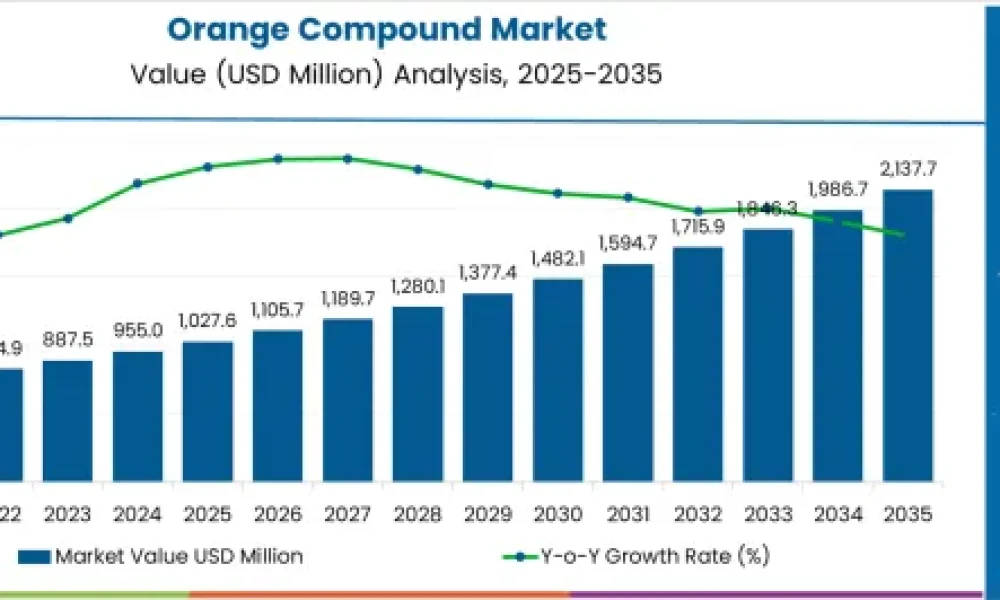
The global orange compound market is valued at USD 1,027.6 million in 2025 and is projected to reach USD 2,137.7 million by 2035, expanding at a 7.6% CAGR over the forecast period. The market is expected to generate USD 1,110.1 million in incremental revenue, supported by rising adoption of citrus-derived molecules across food, beverage, fragrance, and specialty chemical applications.
Growth follows a steady upward trajectory as manufacturers increasingly favor orange compounds for their natural flavor intensity, aromatic freshness, and biodegradable solvent properties. Between 2025 and 2030, the market advances toward USD ~1.40 billion, accounting for nearly 35–38% of total decade growth, driven by clean-label reformulation and increasing citrus integration in beverages, confectionery, and bakery products.
Momentum strengthens further during 2030–2035, reflecting deeper penetration of orange compounds into green solvents, eco-friendly cleaners, premium fragrances, and wellness-oriented personal care products, where citrus notes consistently outperform synthetic alternatives in both consumer appeal and sustainability metrics.
Explore trends before investing – request a sample report today!
D-Limonene Leads Product Demand Across Industries
Product segmentation is led by D-limonene, which holds a 31.2% market share in 2025. Its leadership stems from unmatched versatility, functioning as a natural solvent, flavor enhancer, fragrance ingredient, and degreasing agent. The compound’s low toxicity and biodegradability make it particularly attractive for food-grade and industrial applications alike.
Supporting compounds such as α-pinene, β-pinene, linalool, myrcene, and valencene reinforce market demand across aromatherapy, personal care, and specialty chemical formulations, enabling manufacturers to build complex citrus profiles while meeting regulatory and clean-label expectations.
Food & Beverage Dominates Application Landscape
By application, food and beverage accounts for 48.7% of total demand, positioning it as the market’s largest end-use segment. Orange compounds play a central role in carbonated drinks, juices, confectionery, dairy, bakery, and functional beverages, where they provide consistent citrus notes and help mask off-flavors in fortified products.
Manufacturers continue to favor orange compounds due to their GRAS status, formulation compatibility, and alignment with global clean-label movements, reinforcing sustained adoption across both mass-market and premium product categories.
Rising Role in Clean Beauty and Wellness Products
Beyond food, orange-derived ingredients are gaining strong traction in perfumes, skincare, lotions, soaps, and aromatherapy products. Their perceived freshness, wellness associations, and antioxidant and cleansing properties support usage in natural and botanical-based personal care formulations.
As clean beauty trends accelerate globally, companies are shifting toward plant-based fragrance solutions, positioning orange compounds as essential inputs in premium and sustainable cosmetic portfolios.
Technology Advancements Strengthen Market Performance
Technological innovation continues to reshape the orange compound market. Advances in cold-press extraction, improved steam distillation, and microencapsulation technologies enable higher purity, longer shelf life, and improved formulation stability.
These improvements expand compatibility across pharmaceuticals, nutraceuticals, dietary supplements, and sports nutrition, broadening the commercial relevance of orange compounds beyond traditional flavor and fragrance uses.
Asia-Pacific Drives Growth, Europe Sustains Premium Demand
Regionally, China leads growth at a 10.3% CAGR, supported by rapid expansion of beverage production, confectionery manufacturing, and processed food consumption. India follows at 9.5%, driven by packaged food growth, retail expansion, and modernization of flavor systems.
Europe maintains strong momentum, with Germany growing at 8.7% and France at 8.0%, fueled by premium confectionery, bakery, and beverage demand. Mature markets such as the UK (7.2%) and the U.S. (6.5%) grow steadily through flavor innovation, clean-label adoption, and personal care applications.
Competitive Landscape Remains Quality-Driven
The orange compound market comprises 10–14 major producers, with the top five controlling 57–62% of global share. Competition centers on flavor purity, terpene consistency, sustainable citrus sourcing, and application-specific customization, rather than price alone.
Leading players include Archer Daniels Midland Company (ADM), Berjé Inc., Bell Flavors & Fragrances, Bontoux S.A., Citrosuco, Firmenich SA, Symrise, and Vigon International Inc., all leveraging integrated supply chains and advanced extraction capabilities to maintain competitive advantage.
Key Players in the Orange Compound Market
- Archer Daniels Midland Company (ADM)
- Berjé Inc.
- Bell Flavors & Fragrances
- Bontoux S.A.
- Citrosuco
- Citrus and Allied Essences Ltd.
- Firmenich SA
- Lionel Hitchen (Essential Oils) Ltd.
- MCI Miritz
- Symrise
- Vigon International Inc.
Why FMI: https://www.futuremarketinsights.com/why-fmi
About Future Market Insights (FMI)
Future Market Insights, Inc. (FMI) is an ESOMAR-certified, ISO 9001:2015 market research and consulting organization, trusted by Fortune 500 clients and global enterprises. With operations in the U.S., UK, India, and Dubai, FMI delivers data-driven insights and strategic intelligence across 30+ industries and 1,200+ markets worldwide.



