
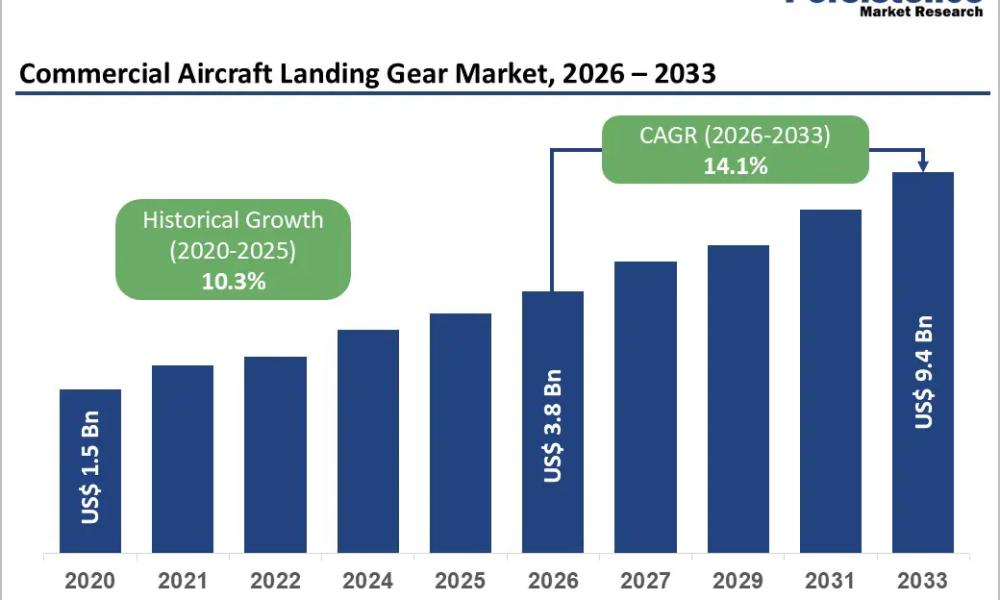
The global commercial aircraft landing gear market is entering a phase of accelerated growth, underpinned by the recovery of the aviation sector, rising aircraft production rates, and increasing investments in next-generation aircraft programs. In 2026, the global commercial aircraft landing gear market size was valued at approximately US$ 3.8 billion, reflecting steady demand from original equipment manufacturers (OEMs) and the aftermarket segment. According to industry-wide projections, the market is expected to expand significantly and reach US$ 9.4 billion by 2033, registering a strong compound annual growth rate (CAGR) of 14.1% during the forecast period from 2026 to 2033.
This robust growth outlook is largely driven by the rapid expansion of global air passenger traffic, which has prompted airlines to modernize fleets and place new aircraft orders. The continued replacement of aging aircraft with fuel-efficient narrow-body and wide-body models has increased the demand for advanced landing gear systems capable of supporting higher utilization rates, heavier loads, and improved safety standards. Additionally, the sustained growth of low-cost carriers, particularly in emerging economies, is generating incremental demand for single-aisle commercial aircraft, directly benefiting landing gear manufacturers.
Technological evolution is another major catalyst shaping market dynamics. Aircraft landing gear systems are increasingly incorporating lightweight materials, advanced alloys, and composite structures to reduce overall aircraft weight and enhance fuel efficiency. Moreover, stringent safety and airworthiness regulations imposed by aviation authorities across regions have compelled OEMs and suppliers to invest in advanced landing gear designs that offer improved reliability, durability, and lifecycle performance. These combined factors are expected to maintain strong momentum in the global commercial aircraft landing gear market throughout the forecast period.
Get Your FREE Sample Report Instantly Click Now: https://www.persistencemarketresearch.com/samples/34903
Segmentation Analysis
By Type
By type, the commercial aircraft landing gear market is segmented into main landing gear and nose landing gear systems. The main landing gear segment currently accounts for the largest share of the market, owing to its structural complexity, higher material requirements, and critical role in supporting aircraft weight during landing, taxiing, and takeoff operations. Main landing gear assemblies are designed to absorb significant impact loads and stresses, which necessitates the use of advanced engineering, precision manufacturing, and high-strength materials. As a result, they contribute substantially to overall system costs and value generation.
The nose landing gear segment, while smaller in market share, is projected to experience steady growth over the forecast period. The increasing focus on enhanced maneuverability, steering control, and integration with advanced avionics systems has driven innovation in nose landing gear designs. Furthermore, the growing adoption of digital sensors and health monitoring solutions in nose landing gear assemblies is improving operational efficiency and reducing maintenance downtime, thereby supporting market expansion in this segment.
By Vehicle/Product/Service Type
Based on vehicle or product type, the market is broadly categorized into narrow-body aircraft, wide-body aircraft, and regional aircraft. The narrow-body aircraft segment dominates the global commercial aircraft landing gear market, primarily due to the high production volumes of single-aisle aircraft used by low-cost and full-service carriers alike. Aircraft families such as short- and medium-haul jets require landing gear systems capable of handling frequent takeoff and landing cycles, which drives recurring demand from both OEM and aftermarket channels.
Wide-body aircraft represent a significant revenue-generating segment, particularly due to the complexity and scale of their landing gear systems. These aircraft require multiple-wheel bogies, higher load-bearing capacity, and advanced braking and steering mechanisms, making landing gear systems more technologically sophisticated and capital-intensive. Meanwhile, the regional aircraft segment is expected to witness moderate growth, supported by increasing regional connectivity initiatives and investments in short-haul aviation infrastructure, especially in developing economies.
From a service perspective, the aftermarket segment, which includes maintenance, repair, and overhaul (MRO) services, is gaining prominence. Airlines are increasingly focusing on extending the operational life of landing gear systems through predictive maintenance and performance-based service agreements, contributing to sustained aftermarket revenue growth.
By Propulsion, Technology, or Channel
From a technology standpoint, the market is witnessing a gradual transition toward electrically actuated landing gear components, advanced braking systems, and digital health monitoring solutions. While traditional hydraulic systems continue to dominate, the integration of electro-hydraulic and fully electric subsystems is gaining traction as part of broader aircraft electrification trends. These technologies improve system responsiveness, reduce weight, and enhance overall operational efficiency.
In terms of distribution channels, OEM installations remain the primary revenue contributor, supported by rising aircraft deliveries. However, the aftermarket channel is emerging as a key growth area due to increasing fleet sizes and the growing emphasis on cost-effective maintenance solutions throughout the aircraft lifecycle.
Regional Insights
Regionally, North America holds a leading position in the global commercial aircraft landing gear market. The region benefits from the presence of major aircraft manufacturers, established landing gear suppliers, and a large in-service commercial aircraft fleet. Continuous investments in research and development, along with strong defense and civil aviation ecosystems, further reinforce North America’s dominance in the market.
Europe represents another significant market, supported by a robust aerospace manufacturing base and the presence of leading aircraft OEMs and tier-one suppliers. The region’s focus on sustainable aviation, lightweight materials, and advanced manufacturing processes has driven innovation in landing gear systems, contributing to steady market growth.
The Asia-Pacific region is expected to be the fastest-growing market during the forecast period. Rapid urbanization, rising disposable incomes, and expanding middle-class populations have led to a surge in air travel demand across countries such as China, India, and Southeast Asian nations. Large-scale aircraft procurement programs by regional airlines, coupled with government-led aviation infrastructure development initiatives, are fueling demand for commercial aircraft and associated landing gear systems. Additionally, the gradual localization of aerospace manufacturing and MRO capabilities in Asia-Pacific is expected to further accelerate market growth.
Customize This Report for Your Exact Requirements: https://www.persistencemarketresearch.com/request-customization/34903
Unique Features and Innovations in the Market
Modern commercial aircraft landing gear systems are increasingly differentiated by their focus on lightweight design, digital integration, and enhanced durability. Manufacturers are leveraging advanced materials such as titanium alloys, high-strength steel, and composite components to reduce system weight without compromising structural integrity. Weight reduction directly contributes to improved fuel efficiency and lower operating costs, which are key priorities for airlines.
The integration of artificial intelligence (AI) and Internet of Things (IoT) technologies is transforming landing gear maintenance and performance management. Smart sensors embedded within landing gear assemblies continuously monitor parameters such as load, vibration, temperature, and wear. This real-time data enables predictive maintenance strategies, allowing operators to identify potential issues before they lead to failures or unscheduled downtime. In parallel, advancements in data analytics and digital twins are helping manufacturers and airlines optimize design, testing, and lifecycle management processes.
While 5G adoption in aviation is still in its early stages, enhanced connectivity capabilities are expected to further support real-time data transmission and system diagnostics, particularly in ground operations and MRO environments.
Market Highlights
The adoption of advanced commercial aircraft landing gear solutions is being driven by several key factors. Airlines and leasing companies are prioritizing operational reliability, safety compliance, and cost efficiency, all of which are directly influenced by landing gear performance. Enhanced system durability and predictive maintenance capabilities reduce aircraft ground time and lower long-term maintenance expenses.
Regulatory frameworks play a critical role in shaping market demand. Stringent certification and airworthiness standards enforced by aviation authorities require landing gear systems to meet rigorous safety and performance benchmarks. Compliance with these regulations has encouraged continuous innovation and investment in testing and validation processes.
Sustainability considerations are also gaining importance. Lightweight landing gear designs and improved braking systems contribute to reduced fuel consumption and lower carbon emissions, aligning with the aviation industry’s broader environmental objectives.
Key Players and Competitive Landscape
The global commercial aircraft landing gear market is characterized by the presence of several established players with strong technological capabilities and long-term relationships with aircraft OEMs. Leading companies are focusing on product innovation, strategic partnerships, and regional expansion to strengthen their market positions.
✦ Safran Landing Systems is a prominent market leader, known for its advanced landing gear and braking systems. The company emphasizes lightweight materials, digital solutions, and lifecycle support services to enhance customer value.
✦ Collins Aerospace leverages its extensive aerospace portfolio and integrated systems approach to deliver technologically advanced landing gear solutions. Its focus on smart systems and predictive maintenance tools supports airline operational efficiency.
✦ Liebherr-Aerospace is recognized for its engineering expertise and customized landing gear solutions for a wide range of commercial aircraft platforms. The company continues to invest in automation and digital manufacturing technologies.
✦ Heroux-Devtek specializes in the design and production of landing gear components and assemblies, with a strong emphasis on precision manufacturing and long-term OEM contracts.
✦ Triumph Group provides comprehensive landing gear systems and aftermarket services, focusing on performance-based support agreements and operational reliability.
Competition in the market is intensifying as suppliers seek to differentiate themselves through technological innovation, cost competitiveness, and expanded aftermarket offerings.
Recent Developments
- Recent years have witnessed increased investment by leading manufacturers in digital landing gear health monitoring systems, aimed at improving predictive maintenance accuracy and reducing lifecycle costs for airlines.
- Several key players have announced capacity expansion and facility modernization initiativesto support rising aircraft production rates and meet growing OEM demand across North America and Asia-Pacific.
Ready to Dive Deep? Buy Full Report Today: https://www.persistencemarketresearch.com/checkout/34903
Future Opportunities and Growth Prospects
Looking ahead, the commercial aircraft landing gear market is expected to benefit from sustained growth in global air travel, continued fleet renewal programs, and increasing adoption of advanced aviation technologies. Opportunities are emerging in the development of next-generation electric and hybrid aircraft, which will require innovative landing gear architectures tailored to new propulsion and weight distribution requirements.
Evolving regulatory standards related to safety, noise reduction, and environmental performance will continue to shape product development strategies. Manufacturers that successfully align technological innovation with regulatory compliance and sustainability objectives are likely to gain a competitive advantage.
Overall, the global commercial aircraft landing gear market is poised for strong long-term growth, supported by technological advancements, expanding aircraft fleets, and the aviation industry’s ongoing commitment to safety, efficiency, and sustainability.




