
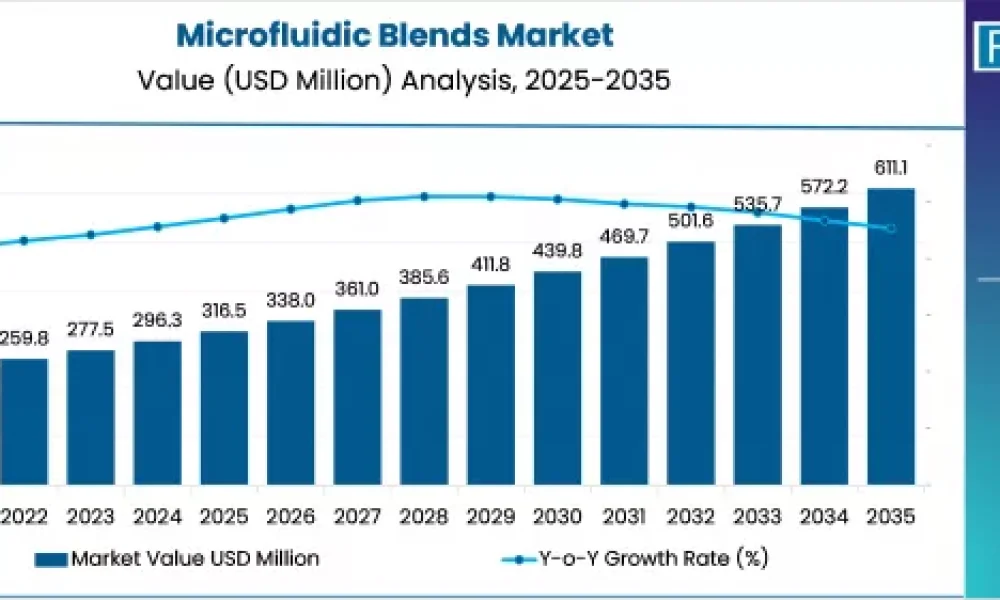
The global microfluidics blends market, specifically the segment encompassing microfluidic blends and chip solutions, is entering a period of aggressive industrial scaling. New market intelligence projects the sector to reach a valuation of $26.90 billion by the end of 2026. Propelled by a compound annual growth rate (CAGR) of 11.4%, the market is on a trajectory to exceed $105 billion by 2033, fueled by the convergence of decentralized diagnostics, AI-driven drug discovery, and a global transition toward “smart” biocompatible materials.
As of early 2026, the medical landscape has shifted from bespoke laboratory prototypes to productized, high-volume platforms. This evolution is driven by the rise of Point-of-Care (POC) testing, which now accounts for over 50% of the market, reflecting a worldwide mandate to move complex diagnostic capabilities from centralized labs directly to the patient’s side.
Request for Sample Report | Customize Report |purchase Full Report – https://www.factmr.com/connectus/sample?flag=S&rep_id=10834
The Miniaturization Mandate: Who, What, and Why
The surge in microfluidic blend adoption is led by pharmaceutical giants and diagnostic innovators seeking to reduce reagent consumption while increasing analytical speed.
- Who: Market leadership is dominated by established med-tech and life science leaders including Illumina Inc., Abbott Laboratories, Bio-Rad Laboratories, Thermo Fisher Scientific, Danaher Corporation, and Agilent Technologies, alongside rapid-growth specialists like Dolomite Microfluidics and Fluidigm.
- What: Microfluidic blends involve the precise formulation of polymers (such as PDMS and cyclic olefin copolymers), glass, and silicon to create miniaturized channels that manipulate microliter-to-picoliter fluid volumes for high-throughput screening and diagnostics.
- Why: The industry is responding to a 23% increase in the demand for single-cell assays and the “Immunization Agenda 2030.” Microfluidics offer the precision required for nanoparticle synthesis in mRNA vaccines and the rapid detection of infectious diseases, significantly lowering drug discovery costs by as much as 70% via AI integration.
Strategic Market Dynamics and 2026 Technology Trends
The 2026 landscape is defined by “Material Sophistication”—a shift away from one-size-fits-all substrates toward nuanced blends that balance optical clarity with chemical resistance.
The Rise of Polymer-Based Microfluidics
The Polymer and PDMS (Polydimethylsiloxane) segment currently holds the largest revenue share at approximately 35%.
- Cost-Effective Scaling: Unlike glass or silicon, advanced polymers support high-volume injection molding and roll-to-roll processes, making them the preferred choice for disposable, single-use diagnostic cartridges.
- Biocompatibility: New “smart” polymer blends feature gas permeability and flexible mechanical properties, making them essential for Organ-on-Chip (OoC) applications, which are projected to see a 20% CAGR as they begin to replace animal testing in preclinical trials.
AI and “Digital” Microfluidics
A key trend for 2026 is the integration of Artificial Intelligence with droplet microfluidics.
- Smart Automation: AI-powered microreactors now monitor and adjust fluidic reactions in real time, enabling the screening of millions of single cells for antibody discovery in just 1–2 days—a process that previously took months.
- Liquid Biopsy Expansion: The ability to isolate rare circulating tumor cells (CTCs) from small blood samples is driving a 14% growth in the oncology diagnostic sub-segment, offering a non-invasive alternative to traditional tissue biopsies.
Regional Leadership and Global Outlook
- North America: Remains the dominant market, holding a 42.8% share. Growth is anchored by a mature healthcare infrastructure and significant R&D investments, including recent billion-dollar biotech funding rounds focused on precision medicine.
- Asia-Pacific: Positioned as the fastest-growing region. Accelerated by government initiatives like India’s Ayushman Bharat, which prioritizes affordable diagnostics for over 500 million people, the region is seeing a massive surge in the production of low-cost, paper-based, and polymer microfluidic chips.
- Europe: Continues to lead in regulatory standards and the development of “Green Microfluidics,” focusing on SF6-free manufacturing and sustainable, biodegradable substrates to meet EU climate mandates.
Challenges: Manufacturing Complexity and Regulatory Hurdles
Despite the bullish outlook, the sector faces structural headwinds. The high initial setup costs and the multidisciplinary expertise required—spanning engineering, biology, and chemistry—remain barriers for smaller laboratories. Furthermore, manufacturers are navigating increasingly complex regulatory environments, particularly the EU’s IVDR and China’s NMPA, which have extended device approval timelines and increased the complexity of bringing new lab-on-a-chip systems to market.
About the Microfluidic Blends Market
The microfluidic blends market involves the development and application of specialized materials and fluid-control systems at the micrometer scale. As a cornerstone of the modern $40 billion broader microfluidics industry, this segment represents the “semiconductors of biology,” providing the essential infrastructure for the next generation of personalized medicine, environmental monitoring, and rapid global disease response.
About Fact.MR
Fact.MR is a global market research and consulting firm, trusted by Fortune 500 companies and emerging businesses for reliable insights and strategic intelligence. With a presence across the U.S., UK, India, and Dubai, we deliver data-driven research and tailored consulting solutions across 30+ industries and 1,000+ markets. Backed by deep expertise and advanced analytics, Fact.MR helps organizations uncover opportunities, reduce risks, and make informed decisions for sustainable growth.



