
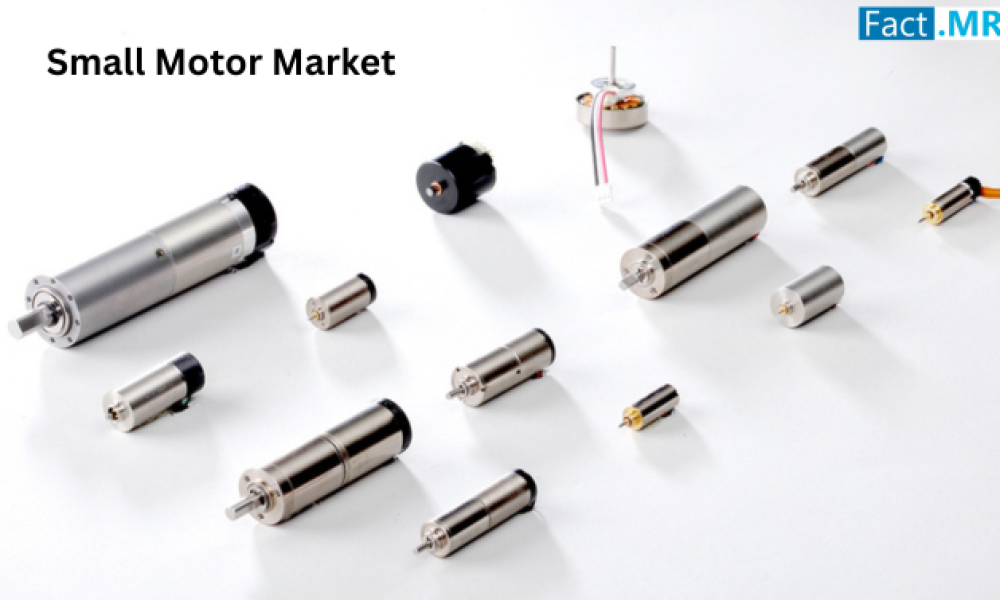
The global small motor market is entering a decisive phase of industrial evolution, with new sector data projecting the market to reach a valuation of $14.39 billion by 2033. According to latest analysis, the industry is expanding from a 2025 base of $11.90 billion at a steady compound annual growth rate (CAGR) of 2.4%.
This growth trajectory reflects a fundamental shift in the global industrial landscape, driven by the “miniaturization” of technology. Following the rapid digital transformation of 2024–2025, the market in 2026 is characterized by a surge in high-efficiency Brushless DC (BLDC) motors, which are increasingly replacing traditional brushed models across automotive, healthcare, and smart-home applications.
Request for Sample Report | Customize Report |purchase Full Report – https://www.factmr.com/connectus/sample?flag=S&rep_id=323
The Precision Pivot: Who, What, and Why
The resurgence of small motor demand is being driven by the convergence of automotive electrification and the mainstreaming of service robotics.
- Who: Market leadership is anchored by global precision engineering giants including Nidec Corporation, Mabuchi Motor Co., Ltd., Johnson Electric, ABB Ltd., Siemens AG, and Maxon Group.
- What: Small motors (often categorized by voltages such as 3V, 12V, and 24V) are compact electromagnetic devices that convert electrical energy into precise mechanical motion.
- Why: As vehicles transition to EV and 48V mild-hybrid architectures, the number of motors per vehicle is skyrocketing—powering everything from battery cooling fans to automated seat adjustments. Concurrently, the rise of “cobots” (collaborative robots) in manufacturing requires highly responsive, compact actuators.
Market Context: The Shift to “Smart” Motion
The 2026 landscape marks a shift from simple motion to “intelligent” actuation.
- BLDC Dominance: Brushless DC technology is the fastest-growing segment, projected to reach $24.95 billion globally across all size classes by the end of 2026. Their maintenance-free operation and high power density make them the preferred choice for drones, medical pumps, and HVAC systems.
- Miniaturization: In 2026, the demand for micro motors (sub-11V) is surging, particularly in the medical sector for insulin pumps and surgical tools, where compact size and extreme reliability are non-negotiable.
Regional Leadership and Growth Corridors
- Asia-Pacific: Remains the global manufacturing and consumption hub, holding the largest market share. China continues to lead in production volume, while India is emerging as a strategic growth node, supported by new manufacturing plants from players like Nidec in Neemrana and Belrise in Pune.
- North America: A key driver of high-value innovation, focusing on ADAS (Advanced Driver-Assistance Systems) and smart manufacturing. The U.S. market is prioritizing motors with integrated IoT sensors for real-time performance monitoring.
- Europe: Leading the “Green Motor” transition, with a heavy emphasis on IE4 and IE5 energy efficiency standards to comply with strict EU climate mandates.
Key Industry Trends and Disruptors
Automotive Electrification
The automotive segment remains the primary engine of growth. In 2026, the average premium vehicle contains over 100 small motors, regulating thermal management systems, electric power steering (EPS), and “hidden” comfort features like haptic feedback steering wheels and automated charging port covers.
Robotics and Industry 4.0
The manufacturing sector accounted for nearly 35% of the small motor market share in 2025. In 2026, the focus has shifted to high-speed motors (above 10,000 RPM) used in high-precision spindles and automated sortation systems, supporting the move toward fully autonomous “dark factories.”
Challenges: Material Scarcity and Efficiency Mandates
Despite the optimistic outlook, the industry faces structural pressures. The transition to high-efficiency motors has increased the demand for rare-earth magnets, leading to supply chain volatility. Furthermore, manufacturers are navigating a “cooling challenge,” where higher power densities in smaller frames require advanced thermal interface materials and integrated cooling architectures to prevent degradation.
About the Small Motor Market
The small motor market encompasses the design, manufacture, and distribution of fractional horsepower motors used in consumer electronics, automotive subsystems, industrial automation, and medical devices. As a vital component of the modern “connected” world, small motors serve as the mechanical muscle behind the global transition toward automation, electrification, and precise digital control.
About Fact.MR
Fact.MR is a global market research and consulting firm, trusted by Fortune 500 companies and emerging businesses for reliable insights and strategic intelligence. With a presence across the U.S., UK, India, and Dubai, we deliver data-driven research and tailored consulting solutions across 30+ industries and 1,000+ markets. Backed by deep expertise and advanced analytics, Fact.MR helps organizations uncover opportunities, reduce risks, and make informed decisions for sustainable growth.



