
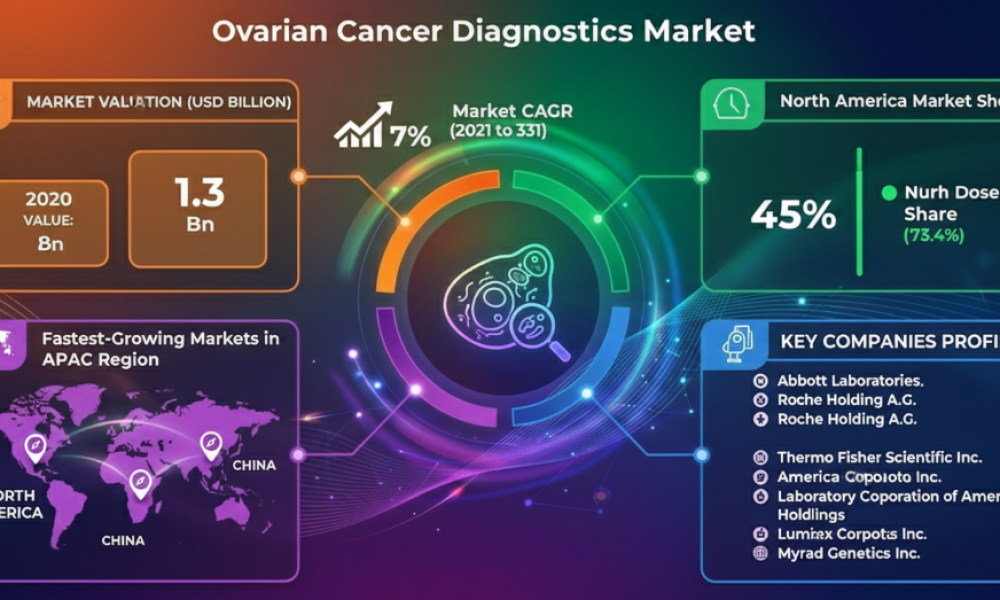
The global ovarian cancer diagnostics market is entering a transformative era of precision medicine, with new industry data projecting the sector to reach a valuation of $3.2 billion by 2035. According to the latest market analysis, the industry is expanding from a 2025 base of $2.33 billion at a compound annual growth rate (CAGR) of 6.2%, as healthcare systems pivot from reactive treatment to proactive, multi-modal screening strategies.
The surge in demand is increasingly defined by the “early-detection imperative.” With ovarian cancer often dubbed the “silent killer” due to its vague early symptoms, 2026 marks a strategic shift toward liquid biopsy and AI-augmented imaging. These technologies are designed to bridge the diagnostic gap that currently sees the majority of cases identified only at advanced stages, where five-year survival rates drop significantly.
Request for Sample Report | Customize Report |purchase Full Report – https://www.factmr.com/connectus/sample?flag=S&rep_id=51
The Precision Pivot: Who, What, and Why
The market expansion is being steered by rising disease incidence and a massive influx of federal and private research funding.
- Who: Market leadership is anchored by global diagnostic powerhouses including F. Hoffmann-La Roche AG, Abbott, Siemens Healthineers AG, Thermo Fisher Scientific Inc., and AstraZeneca PLC, alongside specialized genomic innovators like Illumina, Inc. and Quest Diagnostics.
- What: Ovarian cancer diagnostics encompass a spectrum of clinical tools, including biomarker tests (CA-125, HE4), advanced imaging (transvaginal ultrasound, MRI, CT), and genetic testing (BRCA1/2 mutations) used to detect, stage, and monitor epithelial and germ cell tumors.
- Why: The growth is driven by a global rise in new cases—estimated at over 325,000 annually—and a critical need for higher specificity in testing to reduce false positives that often lead to unnecessary surgical interventions.
Strategic Market Dynamics and 2026 Technology Drivers
The current landscape is defined by the convergence of molecular biology and digital health, moving the industry toward a “genomics-first” model of care.
Dominance of Biomarker Tests and the Rise of Liquid Biopsy
Biomarker tests remain the largest segment, but the technology within them is evolving rapidly:
- The “CA-125 Plus” Era: While the CA-125 blood test remains the clinical standard, 2026 has seen a surge in multi-marker panels. Combining CA-125 with the HE4 (Human Epidermis Protein 4) biomarker has demonstrated a 30% improvement in specificity for early-stage detection.
- Liquid Biopsy Integration: The fastest-growing sub-segment is liquid biopsy, which detects circulating tumor DNA (ctDNA). This non-invasive method is increasingly utilized for real-time monitoring of treatment response and the early detection of recurrence, often identifying relapse months before conventional imaging.
AI-Augmented Imaging and Diagnostics
Artificial Intelligence is transforming the “Imaging” segment, which currently holds a 35.7% market share.
- Enhanced Sensitivity: AI algorithms are now being integrated into ultrasound and CT workflows to identify subtle textural patterns in ovarian masses that are invisible to the human eye.
- Predictive Analytics: AI-driven tools are helping clinicians stratify patient risk by synthesizing genetic data with imaging results, enabling personalized “intensified surveillance” for high-risk populations.
Regional Leadership and Infrastructure Spending
- North America: Retains its status as the market leader, holding a 36.8% revenue share. Growth is fueled by a robust R&D pipeline and significant federal support, such as the U.S. Department of Defense’s $650 million allocation for ovarian cancer research in FY2025.
- Asia-Pacific: Emerged as the fastest-growing region. Rapidly improving healthcare infrastructure in China and India, coupled with an aging female demographic, is driving a surge in the adoption of next-generation sequencing (NGS) and specialized cancer diagnostic centers.
- Europe: Continues to lead in the implementation of “Targeted Screening” programs, with a focus on expanding genetic testing access for women with a family history of breast or ovarian cancers.
Challenges: Testing Disparities and Diagnostic Accuracy
Despite the bullish outlook, the sector faces significant hurdles. A recent 2025 report revealed that nearly 50% of eligible women are still not receiving recommended genetic testing due to systemic disparities in healthcare access, particularly among women over 65. Furthermore, the high cost of advanced genomic assays remains a barrier in low-and-middle-income countries, forcing a market push toward “Value-Based Diagnostics” that prioritize cost-effectiveness alongside clinical accuracy.
About the Ovarian Cancer Diagnostics Market
The ovarian cancer diagnostics market encompasses the development, manufacturing, and clinical application of tests designed to identify malignant ovarian tumors. As a cornerstone of the broader $170 billion oncology market, this segment represents the frontline of women’s health, driving the transition from a “one-size-fits-all” diagnostic approach to a precision-driven model that prioritizes early intervention and individualized patient pathways.
About Fact.MR
Fact.MR is a global market research and consulting firm, trusted by Fortune 500 companies and emerging businesses for reliable insights and strategic intelligence. With a presence across the U.S., UK, India, and Dubai, we deliver data-driven research and tailored consulting solutions across 30+ industries and 1,000+ markets. Backed by deep expertise and advanced analytics, Fact.MR helps organizations uncover opportunities, reduce risks, and make informed decisions for sustainable growth.



