
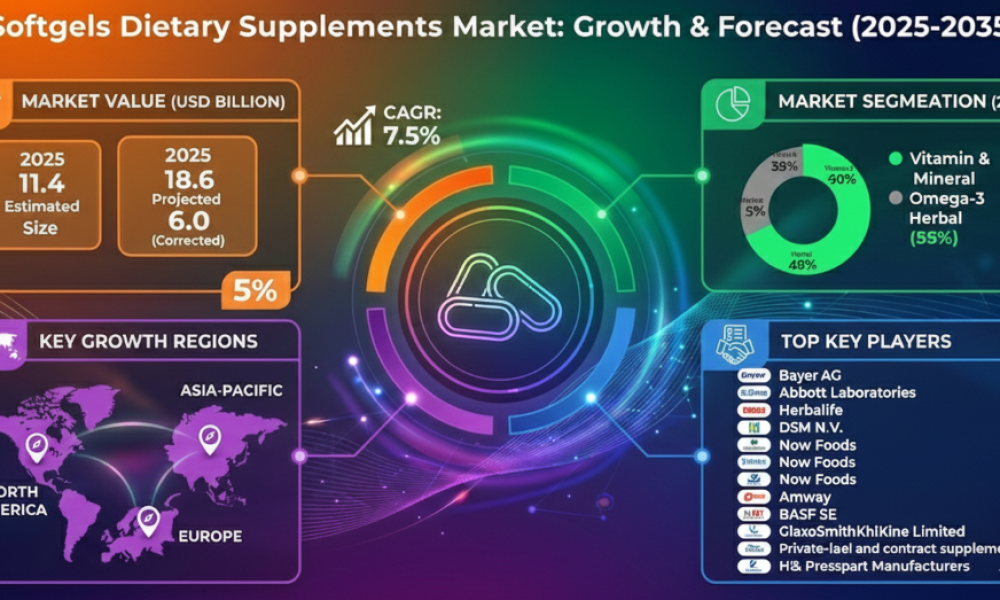
The global softgels dietary supplements market is undergoing a significant industrial expansion, with latest data projecting the sector to reach a valuation of $21.02 billion by 2035. According to recent market analysis, the industry is expanding from a 2025 base of $13.67 billion at a robust compound annual growth rate (CAGR) of 9.2%, fueled by a global shift toward preventive healthcare and high-absorption delivery formats.
As of early 2026, softgels have emerged as the preferred delivery system for liquid-based nutrients, such as Omega-3 fish oils, Vitamin D, and botanical extracts. Their rise is increasingly defined by the “bioavailability era,” where consumers are moving beyond simple supplementation toward formats that ensure efficient nutrient uptake and superior ease of use.
Request for Sample Report | Customize Report |purchase Full Report – https://www.factmr.com/connectus/sample?flag=S&rep_id=41
The Nutritional Pivot: Who, What, and Why
The industry’s expansion is being steered by an aging global population and the rapid adoption of “pill-free” wellness rituals among younger demographics.
- Who: Market leadership is anchored by global health giants and specialized manufacturers, including Nestlé Health Science, Abbott Laboratories, Amway Corp, Catalent Inc., Aenova Group, and Nature’s Bounty Co.
- What: Softgels—hermetically sealed one-piece capsules—are being utilized to deliver a wide array of bioactive compounds, including vitamins, minerals, amino acids, and herbal oils, encapsulated in both traditional gelatin and emerging vegan-friendly shells.
- Why: The surge is driven by a 9.1% rise in chronic disease awareness and a consumer preference for “odor-masked” and “easy-to-swallow” formats. Softgels protect sensitive ingredients from light and oxidation, extending shelf life while providing precisely metered dosages.
Key Market Dynamics and Strategic Sector Performance
The 2026 landscape is bifurcated between the demand for traditional animal-based gelatin and a high-growth pivot toward plant-based alternatives.
The Rise of Vegan and Plant-Based Softgels
While bovine and porcine gelatin still account for nearly 85% of market volume, the non-animal based segment is the fastest-growing sub-sector:
- Vegetarian Innovation: Materials such as HPMC (Hypromellose) and Pullulan are expanding at an 11.2% CAGR, meeting the demands of vegan, Halal, and Kosher-conscious consumers.
- Clean Label Movement: Approximately 55% of Gen Z supplement users now prioritize non-GMO and “clean label” ingredients, forcing manufacturers to innovate in plant-based shell integrity and stability.
Bioavailability and Advanced Delivery
Technology is transforming how softgels function within the body:
- Enteric Coatings: These allow supplements to bypass the stomach and dissolve in the small intestine, reducing “fishy aftertaste” and improving the absorption of sensitive oils.
- Liposomal Encapsulation: Emerging as a major trend in 2026, this technology uses lipid bilayers to mimic cell membranes, potentially increasing the absorption rate of Vitamin C and Curcumin by up to 5x compared to standard tablets.
Regional Leadership and Global Outlook
- North America: Retains its status as the largest market, holding a 35.6% global share. The U.S. market is being reshaped by a surge in personalized nutrition subscriptions, where consumers receive monthly batches of custom-formulated softgels based on blood work or DNA data.
- Asia-Pacific: Forecasted to record the highest growth rate through 2035. Rising disposable incomes in China and India, coupled with a 15% annual increase in urban fitness center memberships, are driving a boom in sports nutrition and immune-support softgels.
- Europe: Remains a hub for regulatory and material innovation, leading the transition toward eco-friendly, sustainable sourcing for marine-based Omega-3 oils.
Challenges: Raw Material Volatility and Sustainability
The industry faces persistent headwinds from fluctuating raw material costs. In early 2026, the cost of pharmaceutical-grade gelatin has risen by 12% due to supply chain tightening. Furthermore, the industry is under pressure to address the environmental impact of marine oil harvesting. In response, leading players are investing in Algal Oil (algae-based DHA/EPA), which is projected to capture 10% of the Omega-3 softgel market by 2030 as a sustainable alternative to fish oil.
About the Softgels Dietary Supplements Market
The softgels dietary supplements market encompasses the production, encapsulation, and distribution of nutrients in a soft-shell format. Serving as a critical bridge between pharmaceutical precision and consumer wellness, softgels provide a versatile platform for the delivery of complex, lipid-soluble ingredients. The market remains a vital pillar of the global $172 billion dietary supplement industry, driving innovation in patient compliance and nutrient efficiency.
About Fact.MR
Fact.MR is a global market research and consulting firm, trusted by Fortune 500 companies and emerging businesses for reliable insights and strategic intelligence. With a presence across the U.S., UK, India, and Dubai, we deliver data-driven research and tailored consulting solutions across 30+ industries and 1,000+ markets. Backed by deep expertise and advanced analytics, Fact.MR helps organizations uncover opportunities, reduce risks, and make informed decisions for sustainable growth.



