
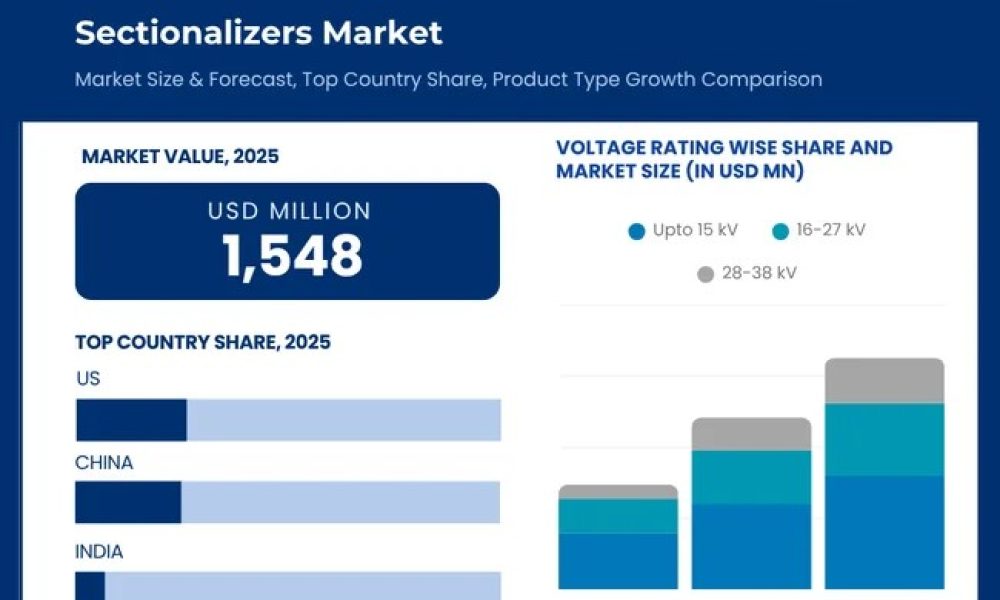
The global sectionalizers market is entering a decisive growth phase, with new industry projections valuing the sector at $2.74 billion by 2035. According to the latest market data, the industry is expanding at a steady compound annual growth rate (CAGR) of 5.9% from 2025 to 2035. This surge is primarily fueled by the global imperative to modernize aging electrical infrastructure and the rapid integration of decentralized renewable energy sources like solar and wind into existing power grids.
In 2026, the market is witnessing a transition from traditional electromechanical devices to smart, IoT-enabled sectionalizers. These advanced systems are now critical for maintaining grid stability, allowing utilities to automatically isolate faulty line segments and restore power to unaffected areas within seconds—effectively minimizing the duration and scale of service disruptions for residential and industrial consumers alike.
Request for Sample Report | Customize Report |purchase Full Report – https://www.factmr.com/connectus/sample?flag=S&rep_id=274
The Power Shift: Who, What, and Why
The resurgence in sectionalizer demand is driven by the convergence of urbanization and the push for “self-healing” grid technologies.
- Who: Market leadership is anchored by global engineering titans including ABB Ltd., Eaton Corporation plc, Schneider Electric SE, Siemens AG, G&W Electric, and S&C Electric Company.
- What: A sectionalizer is an automatic protective device installed on distribution feeders. It detects fault conditions (such as short circuits) and coordinates with upstream reclosers to isolate problematic sections of the line without triggering a total blackout.
- Why: With global electricity consumption projected to grow by 3.4% annually through 2026, utilities are under intense pressure to improve reliability. Sectionalizers offer a cost-effective solution for fault management, reducing operational downtime and maintenance costs.
Strategic Market Dynamics and Data-Backed Insights
The 2026 landscape is defined by the rise of Distribution Automation (DA), where sectionalizers serve as the primary execution point for grid intelligence.
Dominance of Three-Phase and Electronic Control
The market is currently bifurcated between traditional and digital technologies:
- Three-Phase Dominance: Accounting for over 64% of the market, three-phase sectionalizers are the standard for industrial and high-demand urban networks, where balanced power delivery is essential.
- Resettable Electronic Segment: This technology holds a dominant 76% share in 2026. Unlike older hydraulic models, electronic sectionalizers offer greater accuracy, remote programmability, and seamless integration with SCADA systems.
- Voltage Leadership: The Up-to-15 kV segment remains the largest, driven by rural electrification projects and residential distribution upgrades in emerging economies.
AI-Powered Predictive Maintenance
A key trend for 2026 is the deployment of AI-driven diagnostics within sectionalizer modules. These “smart” units can now analyze line harmonics to predict equipment failure before it occurs. This shift from reactive to proactive maintenance is expected to save utility operators an estimated 15% in annual O&M (Operations & Maintenance) costs over the next decade.
Regional Leadership and Infrastructure Spending
- North America: Holds a leading 24.9% market share. The U.S. and Canada are focused on “hardening” the grid against extreme weather events, with federal incentives driving the adoption of automated fault isolation in both urban and rural corridors.
- Asia-Pacific: Identified as the fastest-growing region. Rapid industrialization in China and India is fueling massive investments in power reliability. In the past year alone, India deployed dozens of smart sectionalizer units specifically for renewable energy stabilization projects.
- Europe: Driven by the EU Green Deal, European utilities are leading in the adoption of SF6-free, eco-friendly designs to align with strict carbon neutrality goals and environmental regulations.
Challenges: Capital Intensity and Integration Hurdles
Despite the bullish outlook, the market faces structural headwinds. The high initial capital cost of smart sectionalizers can be a barrier for smaller, rural utility cooperatives. Additionally, retrofitting legacy infrastructure with IoT-enabled devices requires specialized labor and complex system coordination. However, the long-term ROI—measured in avoided outage minutes and improved customer satisfaction indices—continues to justify these upgrades for major tier-1 utilities.
About the Sectionalizers Market
The sectionalizers market encompasses the development and deployment of automatic protective switches used in medium-voltage power distribution. As a cornerstone of the broader smart grid ecosystem, sectionalizers are vital for enhancing the resilience of the world’s energy networks, ensuring that the transition to a high-voltage, renewable-heavy future is both stable and efficient.
About Fact.MR
Fact.MR is a global market research and consulting firm, trusted by Fortune 500 companies and emerging businesses for reliable insights and strategic intelligence. With a presence across the U.S., UK, India, and Dubai, we deliver data-driven research and tailored consulting solutions across 30+ industries and 1,000+ markets. Backed by deep expertise and advanced analytics, Fact.MR helps organizations uncover opportunities, reduce risks, and make informed decisions for sustainable growth.



