
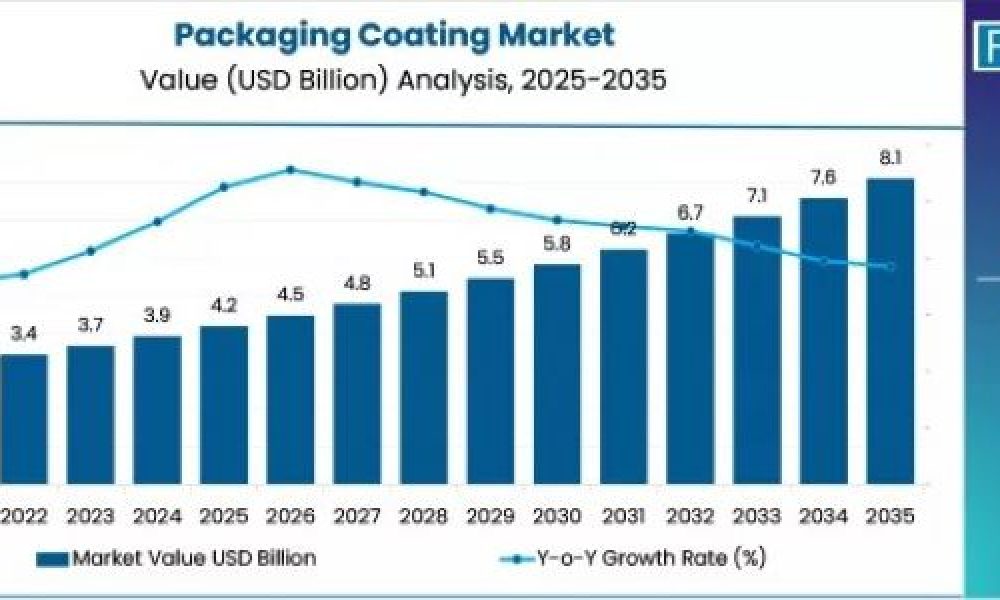
The global packaging coating market is entering a pivotal phase of industrial transformation, with new valuations projecting the sector to reach $7.44 billion by 2033. According to latest industry analysis, the market is expanding from a 2025 base of $5.08 billion at a compound annual growth rate (CAGR) of 4.9%.
Driven by a 2026 manufacturing landscape that prioritizes “trust at the container level,” the industry is pivoting toward high-performance, water-based, and PFAS-free formulations. This shift is fueled by a convergence of tightening global safety regulations and a massive retail transition toward fiber-based and mono-material packaging formats that require advanced barrier protection to maintain shelf-life integrity.
Request for Sample Report | Customize Report |purchase Full Report – https://www.factmr.com/connectus/sample?flag=S&rep_id=262
The Barrier Evolution: Who, What, and Why
The resurgence of the packaging coating sector is dictated by the need to bridge the gap between recyclability and product preservation.
- Who: Market leadership is anchored by global chemical and coating innovators including PPG Industries Inc., Akzo Nobel N.V., The Sherwin-Williams Company, BASF SE, and Axalta Coating Systems, alongside specialized barrier pioneers like Solenis and Michelman.
- What: Packaging coatings are specialized thin-film layers applied to metal, plastic, and paper substrates to provide resistance against moisture, oxygen, and grease, while ensuring food safety and visual appeal.
- Why: The surge is driven by a 41% increase in demand for packaged food and beverages in emerging markets and a global corporate mandate to eliminate non-recyclable multi-layer plastics.
Key Market Dynamics and 2026 Technology Trends
The current landscape is defined by “Functional Sustainability”—the ability of a coating to enable recycling without compromising the rigorous safety standards of the pharmaceutical and food sectors.
The Rise of Water-Based and Bio-Polymer Solutions
Water-based coatings now lead the technology segment with over 41% of the market share in 2026.
- Low-VOC Compliance: As environmental regulations tighten in Europe and North America, solvent-based systems are being phased out in favor of water-borne dispersions that offer lower volatile organic compound (VOC) emissions.
- PFAS-Free Mandate: With major QSR brands like McDonald’s and Starbucks committing to eliminate “forever chemicals,” the market for PFAS-free grease-resistant coatings is projected to grow at a specific 6.1% CAGR, reaching $707 million by 2035.
Metal Packaging and the Beverage Boom
Metal substrates, particularly for beverage and food cans, remain a dominant segment, contributing nearly 39% of global revenue in 2026.
- Epoxy Dominance: Epoxy resins continue to hold a 41.9% share of the resin segment due to their unmatched durability and chemical resistance in high-acid food applications.
- Aseptic Innovation: The rise of plant-based milks and premium juices is driving demand for internal coatings that support aseptic, long-life packaging without the need for refrigeration.
Regional Insights and the Asia-Pacific Growth Engine
- Asia-Pacific: Retains its status as the largest and fastest-growing regional market, holding a 31.7% share. Growth is propelled by rapid urbanization in China and India, where the e-commerce and retail sectors are expanding by 9% annually, requiring massive volumes of protective and aesthetic coatings.
- North America: Accounts for a significant 36% of the packaging inks and coatings segment, driven by a mature pharmaceutical sector and a high consumer preference for “grab-and-go” convenience foods.
- Europe: Leads the world in “Green Coating” innovation, with German and French manufacturers focusing on dispersion-barrier boards that allow paper packaging to be fully repulped in standard recycling streams.
Challenges: Processing Complexity and Cost Pressures
Despite robust growth, the industry faces structural hurdles. Advanced barrier chemistries, such as EVOH and nano-coatings, often involve higher raw material costs, typically increasing per-pack expenses by 5% to 20%. Furthermore, as manufacturers move toward “smart packaging” featuring freshness indicators and anti-counterfeit sensors, the complexity of maintaining coating compatibility with electronic components has become a primary R&D focus for 2026.
About the Packaging Coating Market
The packaging coating market encompasses the development and application of protective and functional layers for the global packaging industry. From the internal lining of soda cans to the moisture barriers on pharmaceutical blisters, these coatings are essential for ensuring product efficacy, reducing food waste, and supporting the global transition toward a sustainable, circular economy.
About Fact.MR
Fact.MR is a global market research and consulting firm, trusted by Fortune 500 companies and emerging businesses for reliable insights and strategic intelligence. With a presence across the U.S., UK, India, and Dubai, we deliver data-driven research and tailored consulting solutions across 30+ industries and 1,000+ markets. Backed by deep expertise and advanced analytics, Fact.MR helps organizations uncover opportunities, reduce risks, and make informed decisions for sustainable growth.



