
The pathogen identification and treatment market sits at the core of modern healthcare, playing a decisive role in how infectious diseases are detected, managed, and ultimately controlled. As global health systems confront an increasing burden of bacterial, viral, fungal, and parasitic infections, the ability to rapidly identify causative pathogens and deliver targeted treatments has become a clinical and economic priority. Pathogen identification encompasses a wide range of diagnostic technologies, including molecular diagnostics, immunoassays, mass spectrometry, and next-generation sequencing (NGS), while treatment spans antimicrobial therapies, antivirals, antifungals, and supportive clinical protocols. Together, these solutions form an integrated ecosystem that supports early diagnosis, accurate treatment decisions, and improved patient outcomes across hospitals, laboratories, and research settings.
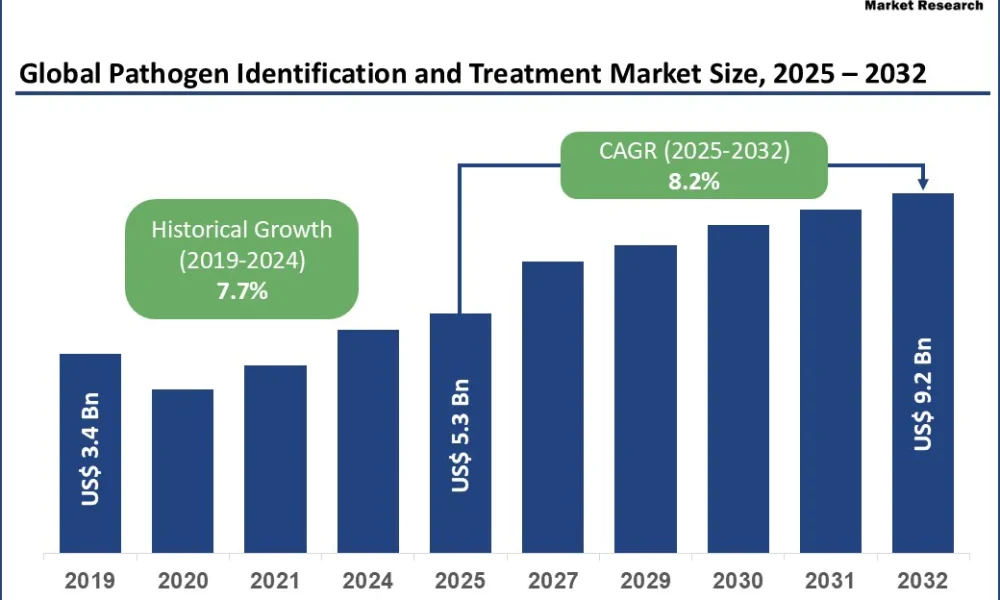
From a market perspective, the global pathogen identification and treatment market is projected to reach approximately US$5.3 billion in 2025 and is expected to grow steadily to around US$9.2 billion by 2032, registering a compound annual growth rate (CAGR) of 8.2% during the forecast period. This growth trajectory reflects rising awareness of infectious disease management, increased healthcare spending, and significant advancements in diagnostic accuracy and speed. Among the key growth drivers are the escalating prevalence of infectious diseases worldwide, the growing threat of antimicrobial resistance (AMR), and the demand for rapid diagnostic tools capable of guiding precise therapies. Molecular diagnostics currently represent the leading segment due to their high sensitivity and fast turnaround times, while hospitals dominate the end-use landscape, accounting for more than 45% of total market revenue. Geographically, North America leads the market with a 41% share, supported by advanced healthcare infrastructure and strong R&D investments, while the Asia Pacific region stands out as the fastest-growing market due to rising healthcare expenditure and increasing disease burden in countries such as China and India.
Download Your Free Sample & Explore Key Insights: https://www.persistencemarketresearch.com/samples/8866
Key Highlights from the Report
• The global pathogen identification and treatment market is projected to grow at a CAGR of 8.2% between 2025 and 2032.
• North America leads the market with a 41% share, driven by advanced diagnostic infrastructure and high healthcare spending.
• Asia Pacific is the fastest-growing region due to rising infectious disease prevalence and expanding healthcare systems.
• Molecular diagnostics hold the largest share at 38%, owing to their precision and rapid detection capabilities.
• Hospitals account for over 45% of total market revenue, reflecting high diagnostic testing volumes.
• Increasing antimicrobial resistance is accelerating the adoption of advanced pathogen identification technologies worldwide.
Market Segmentation Analysis
The pathogen identification and treatment market is segmented across multiple dimensions, including test type, pathogen type, end user, and application, each contributing uniquely to overall market dynamics. By test type, molecular diagnostics represent the dominant segment, largely due to their ability to detect pathogens with high sensitivity and specificity within a short timeframe. Polymerase chain reaction (PCR) and real-time PCR technologies are widely used for identifying bacterial and viral infections such as tuberculosis and COVID-19, making them indispensable in hospital and laboratory settings. Alongside molecular diagnostics, immunological assays and culture-based methods continue to play a role, particularly in routine testing and resource-limited environments.
Next-generation sequencing is emerging as a high-growth segment within pathogen identification, offering comprehensive genomic insights that support complex infection analysis and antimicrobial resistance profiling. Its ability to identify novel and emerging pathogens has positioned NGS as a critical tool in research institutions, pharmaceutical companies, and advanced clinical laboratories. By pathogen type, bacterial pathogens account for the largest share, driven by the global rise in antibiotic-resistant infections such as methicillin-resistant Staphylococcus aureus (MRSA). Viral pathogens, however, represent the fastest-growing segment, fueled by recurrent viral outbreaks and increased focus on pandemic preparedness. Fungal and parasitic pathogens occupy smaller but steadily expanding segments, particularly in immunocompromised patient populations.
From an end-user perspective, hospitals remain the primary consumers of pathogen identification and treatment solutions due to the high volume of inpatient and outpatient diagnostic tests conducted daily. Diagnostic laboratories are gaining momentum as hospitals increasingly outsource specialized testing services, while research institutes and pharmaceutical companies rely on advanced platforms for drug development, epidemiological surveillance, and clinical trials. This diverse segmentation highlights the market’s complexity and underscores the importance of tailored diagnostic and treatment approaches across different healthcare settings.
Get Custom Insights Designed for Your Business: https://www.persistencemarketresearch.com/request-customization/8866
Regional Insights and Market Trends
Regional dynamics play a crucial role in shaping the pathogen identification and treatment market, with significant variations in adoption rates, technology penetration, and healthcare investment. North America continues to dominate the global market, supported by well-established healthcare infrastructure, strong reimbursement frameworks, and a high concentration of leading diagnostic and biotechnology companies. The United States, in particular, benefits from robust federal funding for infectious disease research, widespread adoption of molecular diagnostics, and rapid integration of innovative technologies such as mass spectrometry and NGS into clinical workflows. The region’s proactive approach to antimicrobial stewardship and disease surveillance further reinforces its leadership position.
Europe represents another major market, characterized by strong public healthcare systems and a growing emphasis on precision medicine. Countries such as Germany, the United Kingdom, and France are investing heavily in advanced diagnostic platforms to address antimicrobial resistance and improve outbreak preparedness. Pan-European initiatives focused on pathogen surveillance and data sharing have also accelerated the adoption of innovative identification technologies. Meanwhile, Asia Pacific is emerging as the fastest-growing region, driven by rapid urbanization, expanding healthcare infrastructure, and a rising burden of infectious diseases. Government-led healthcare reforms in China and India, combined with increasing public awareness and private-sector investment, are creating fertile ground for market expansion. Other regions, including Latin America and the Middle East & Africa, are gradually adopting pathogen identification solutions as healthcare access improves, although cost and infrastructure constraints continue to influence growth rates.
Market Drivers
The primary driver of the pathogen identification and treatment market is the rising prevalence of infectious diseases worldwide, coupled with the growing threat of antimicrobial resistance. Infectious diseases continue to account for a significant proportion of global mortality, placing immense pressure on healthcare systems to improve diagnostic accuracy and treatment efficiency. The emergence of drug-resistant pathogens has further amplified the need for rapid and precise identification tools that can guide targeted therapy and reduce the misuse of broad-spectrum antimicrobials. Technological advancements, particularly in molecular diagnostics, mass spectrometry, and next-generation sequencing, have transformed diagnostic workflows by significantly reducing turnaround times and improving sensitivity. Additionally, increased healthcare spending, government funding for infectious disease control, and heightened awareness following global health crises have collectively fueled market growth.
Market Restraints
Despite its strong growth potential, the pathogen identification and treatment market faces notable restraints, primarily related to the high cost of advanced diagnostic technologies. Platforms such as NGS and MALDI-TOF mass spectrometry require substantial upfront investment, along with ongoing expenses for reagents, maintenance, and software upgrades. These costs can be prohibitive for smaller hospitals and laboratories, particularly in developing regions. Moreover, the operation of sophisticated diagnostic systems demands highly skilled personnel with expertise in molecular biology and bioinformatics, creating additional barriers to adoption. Limited infrastructure and workforce shortages in emerging markets further constrain the widespread implementation of advanced pathogen identification solutions.
Market Opportunities
The growing adoption of point-of-care diagnostics presents a significant opportunity within the pathogen identification and treatment market. Point-of-care testing enables rapid, on-site diagnosis, reducing reliance on centralized laboratories and enabling faster clinical decision-making. This is particularly valuable in emergency settings, rural healthcare facilities, and low-resource environments. Technological innovations such as miniaturization, biosensors, and digital integration are enhancing the accuracy and affordability of point-of-care devices, expanding their application across infectious disease testing. Additionally, the increasing focus on personalized medicine and telehealth solutions is creating new avenues for market expansion, as rapid diagnostics become integral to patient-centric care models.
Checkout Now & Download Complete Market Report: https://www.persistencemarketresearch.com/checkout/8866
Company Insights
The pathogen identification and treatment market is characterized by intense competition and continuous innovation, with major players investing heavily in research, product development, and strategic partnerships to strengthen their market positions.
• Thermo Fisher Scientific
• Roche Diagnostics
• Abbott Laboratories
• bioMérieux SA
• Danaher Corporation
Recent developments highlight the pace of innovation in this space. In December 2023, Thermo Fisher Scientific launched the KingFisher Apex Dx automated nucleic acid purification instrument along with the MagMAX Dx Viral/Pathogen NA Isolation Kit, aimed at streamlining respiratory pathogen diagnostics. In September 2024, Roche Diagnostics introduced its TAGS (Temperature-Activated Generation of Signal) technology, enabling multiplex detection of 12 to 15 respiratory viruses, significantly enhancing diagnostic efficiency and accuracy.
Market Segmentation
By Test Type
- Molecular Diagnostics
- Culture-Based Techniques
- Immunological Techniques
- Mass Spectrometry
- Next-Generation Sequencing
By Pathogen Type
- Bacterial Pathogens
- Viral Pathogens
- Fungal Pathogens
- Parasitic Pathogens
- Prions
By End-use
- Hospitals
- Diagnostic Laboratories
- Research Institutes
- Pharmaceutical Companies
- Clinical Laboratories
By Region
- North America
- Europe
- East Asia
- South Asia and Oceania
- Latin America
- Middle East and Africa
Conclusion
The pathogen identification and treatment market is poised for sustained growth as healthcare systems worldwide prioritize early diagnosis, targeted therapy, and effective infection control. Driven by rising infectious disease prevalence, technological advancements, and increased awareness of antimicrobial resistance, the market continues to evolve toward faster, more precise, and patient-centric solutions. While challenges such as high costs and workforce limitations persist, emerging opportunities in point-of-care diagnostics, digital health integration, and personalized medicine are reshaping the competitive landscape. As leading regions like North America maintain technological leadership and fast-growing markets in Asia Pacific expand access and infrastructure, the global pathogen identification and treatment market is set to play an increasingly vital role in safeguarding public health and advancing modern medical care.




