
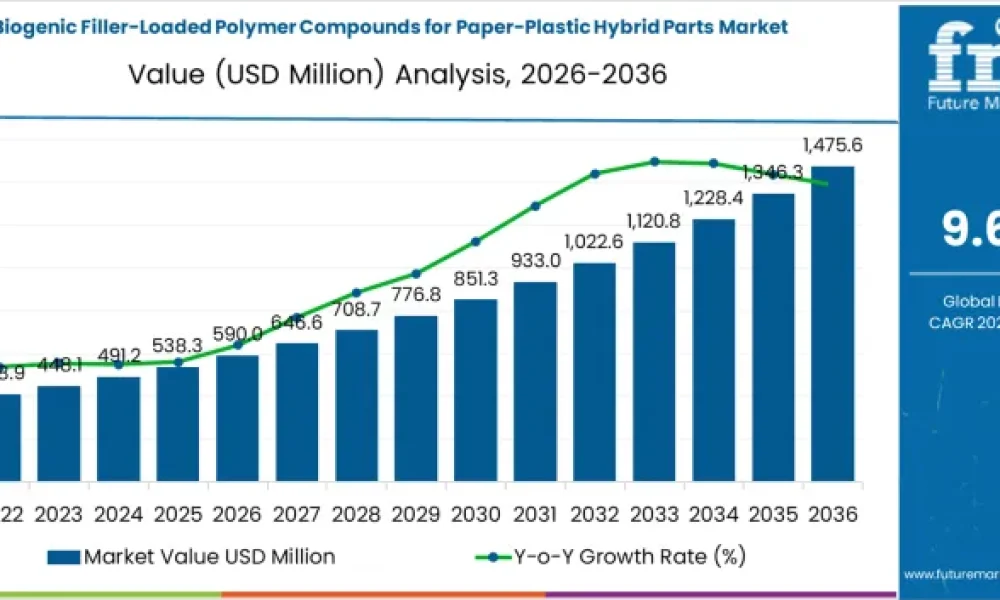
The global biogenic filler-loaded polymer compounds for paper-plastic hybrid parts market is estimated at USD 590.0 million in 2026 and is forecast to expand to approximately USD 1,475.6 million by 2036, registering a robust compound annual growth rate (CAGR) of 9.6 % over the forecast period as manufacturers and OEMs pursue material substitution and sustainability goals without compromising performance. This growth trajectory reflects increased adoption of renewable filler integrations that improve stiffness, weight reduction, and eco-credentials across multiple industries.
Driven by rising demand for lightweight, high-performance hybrid components in automotive, packaging, consumer goods, and construction, this market growth is rooted in engineering-led material innovation and regulatory pressures targeting reduced virgin polymer use. Biogenic fillers — such as cellulose, lignin, starch, and agricultural residues — are increasingly blended with thermoplastic polymers to meet carbon reduction targets and lifecycle optimization without extensive tooling redesign.
Key Market Insights at a Glance
The market’s expansion is underpinned by measurable gains in sustainability adoption coupled with application-driven performance. Cellulose-filled thermoplastic compounds hold the largest share of global demand at around 36 %, reflecting strong performance balance and established processing familiarity, while starch and bio-ash blends (28 %), lignin systems (22 %), and multi-biogenic filler hybrids (14 %) complement the opportunity spectrum. Cellulose remains the dominant biogenic filler source with approximately 38 % share due to supply stability and processing compatibility.
Lightweight structural parts command the highest application demand at roughly 34 %, where enhanced stiffness and reduced weight deliver tangible benefits. Packaging and disposable components represent 28 % of the market, propelled by sustainability targets and regulatory action to limit traditional plastics, while automotive interior substrates (22 %) and consumer appliance components (16 %) capture additional growth through material innovation.
Segment Overview
The biogenic filler-loaded polymer compounds landscape is structured across key segments:
- Compound Type: Cellulose-filled thermoplastics, starch and bio-ash blends, lignin-reinforced systems, and multi-biogenic hybrids.
- Biogenic Filler Source: Wood and pulp-derived cellulose, agricultural residue-based fillers, lignin and bio-refinery byproducts, and emerging algae-derived options.
- Application: Lightweight structural parts, packaging and disposable components, automotive interiors, and consumer appliance parts.
- Region: Asia Pacific, Europe, North America, Latin America, and Middle East & Africa, supported by extensive country-level analysis.
This segmentation reveals that Asia Pacific and North America are pivotal growth zones driven by industrialization, sustainability mandates, and advanced manufacturing ecosystems, while Europe benefits from stringent environmental regulations and established automotive and packaging sectors integrating biogenic materials.
To access the complete data tables and in-depth insights — Request Your Sample Report Now
Regional Overview
Regional adoption patterns underscore why China leads with the highest projected CAGR of 10.1 %, supported by large-scale substitution efforts and policy incentives encouraging reduced virgin plastic reliance. India follows closely with a 9.8 % CAGR as cost-efficient sustainability approaches gain traction, especially in high-volume packaging and consumer segments. Germany’s 9.6 % CAGR reflects engineering-driven adoption in precision components and regulated markets, while the USA (9.3 % CAGR) and Japan (9.1 % CAGR) illustrate brand-led sustainability commitments and rigorous material qualification standards, respectively.
Across these regions, regulatory frameworks such as extended producer responsibility, recycled content mandates, and lifecycle assessment requirements are amplifying demand for biogenic filler compounds — especially in automotive, electronics, and consumer goods sectors where performance and sustainability criteria converge.
Competitive Landscape
The competitive environment is characterized by strategic technology development and partnerships aimed at scaling performance-oriented, bio-enhanced polymer compounds. Established material innovators like Avient Corporation, BASF SE, LyondellBasell, Borealis, and Covestro lead product development and market penetration with tailored compound portfolios that prioritize filler-polymer compatibility, mechanical performance consistency, and production reliability. Their competitive positioning is strengthened by advanced compounding technologies that ensure uniform filler dispersion, controlled rheology, and high manufacturing throughput.
Emergent players are increasingly focusing on niche applications and specialized hybrid compounds that address sector-specific performance requirements, including improved surface finish, thermal stability, and recyclability attributes that align with circular economy objectives. Investment in R&D and supply chain traceability are key differentiators in the rapidly evolving biogenic filler compounds space.
Market Outlook: Powering the Next Decade
Looking ahead, the biogenic filler-loaded polymer compounds market is poised to harness a decade of sustained innovation and growth. Forecasts position this segment as a critical enabler of material transformation across traditional manufacturing ecosystems, driven by increasing commitments to decarbonization and circularity. As global sustainability frameworks evolve and OEM procurement standards tighten around environmental performance, hybrid compound solutions that balance renewable content with functional excellence will unlock new application domains.
Corporate environmental commitments and consumer preferences for eco-aligned products will continue to elevate interest in biogenic filler materials, while advances in compatibilization chemistry, process optimization, and hybrid design will broaden their utility across evolving product portfolios. Strategic investments in scalable compounding infrastructure and harmonized sustainability standards will be pivotal to capturing the full potential of this expanding market.
Key Players of Sustainable Label Industry
Leading organizations shaping the sustainable materials agenda include Avient Corporation, BASF SE, LyondellBasell, Borealis, and Covestro, each spearheading innovations that merge renewable performance with industrial scalability. Their efforts support broader sustainability goals, driving hybrid material adoption across automotive, packaging, and consumer goods sectors where environmental and functional excellence are equally valued.
Have a specific Requirements and Need Assistant on Report Pricing or Limited Budget please contact us – [email protected]
About Future Market Insights (FMI)
Future Market Insights, Inc. (FMI) is an ESOMAR-certified, ISO 9001:2015 market research and consulting organization, trusted by Fortune 500 clients and global enterprises. With operations in the U.S., UK, India, and Dubai, FMI provides data-backed insights and strategic intelligence across 30+ industries and 1200 markets worldwide.
Why Choose FMI: https://www.futuremarketinsights.com/why-fmi



