
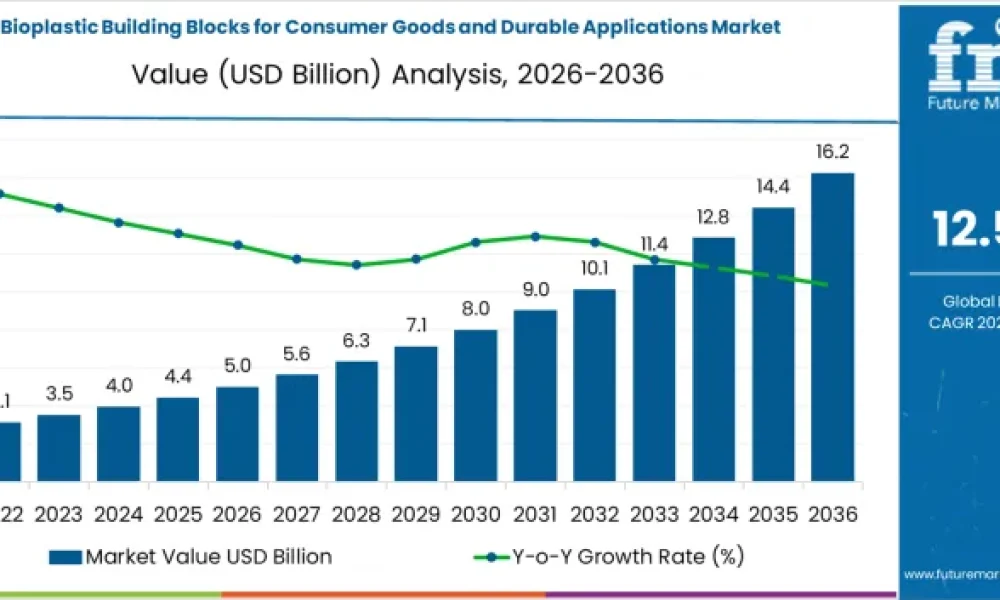
The global bioplastic building blocks for consumer goods and durable applications market is poised for rapid expansion, with the industry expected to grow from approximately USD 5.0 billion in 2026 to an estimated USD 16.2 billion by 2036, reflecting a robust compound annual growth rate of 12.5% through the forecast period. This surge is propelled by intensifying demand for eco-friendly materials that reduce reliance on petroleum-based plastics and align with corporate sustainability goals and regulatory mandates for reduced environmental impact. As industries across electronics, automotive, textiles, and durable consumer goods increasingly adopt renewable alternatives, bioplastic intermediates are becoming vital components of next-generation manufacturing ecosystems.
Key Market Insights at a Glance
The bioplastic building blocks market is transforming materials supply chains, driven by technological innovation, sustainability regulations, and consumer demand for greener products. Building block types such as PLA & lactic acid derivatives dominate market share, owing to their versatility and biodegradability, followed by bio-PET & bio-polyester precursors and specialty biopolymers that meet performance needs across durable goods. The consumer goods & electronics segment captures the largest share by end-use sector, underscoring how demand for environmentally responsible materials is reshaping product portfolios in sectors once dominated by traditional plastics.
In the early years of the forecast period, growth is expected to accelerate as manufacturers scale production capacity and integrate bioplastic monomers into broader applications. As adoption matures toward 2036, the market will stabilize into sustained expansion, supported by economies of scale, wider regulatory acceptance, and improved performance and cost profiles of bio-based intermediates.
Segment Overview
The market is segmented by building block type and end-use sector. Among building block types, PLA & lactic acid derivatives lead with a significant share, reflecting widespread utilization in producing bioplastics for durable applications such as electronics housings and consumer goods components. Other renewable monomers, including bio-PA & bio-polyamide intermediates, expand the material palette available to manufacturers seeking both biodegradability and performance parity with conventional plastics.
From an end-use perspective, consumer goods & electronics account for the largest slice of demand, by virtue of rising consumer awareness and brand commitments to sustainable products. Automotive & transportation, durable textiles & fibers, and housewares also present growth avenues as sustainability criteria become embedded in product design and procurement strategies.
Regional Overview
North America, particularly the United States, stands out as a high-growth region, supported by innovation leadership, consumer demand for sustainable products, and supportive regulatory frameworks that encourage reduction of plastic waste. Other developed markets, including Germany and Japan, also demonstrate steady expansion as environmental policies integrate renewable material mandates into industrial strategies. Emerging markets such as China and South Korea are rapidly adopting bioplastics, driven by government incentives and increasing awareness of environmental impact across manufacturing sectors.
Overall, the Asia-Pacific region is expected to contribute significantly to market growth, leveraging vast manufacturing bases and expanding end-use industries that seek sustainable alternatives to traditional polymers.
To access the complete data tables and in-depth insights — Request Your Sample Report Now
Competitive Landscape
The competitive environment is marked by established chemical and material science leaders alongside innovative biotechnology firms. Key players shaping the market include NatureWorks LLC, TotalEnergies Corbion, Braskem S.A., DuPont de Nemours, Inc., BASF SE, Corbion N.V., Mitsubishi Chemical Corporation, Arkema S.A., Genomatica, Inc., and Danimer Scientific. These companies are investing heavily in research and development to enhance the performance, cost-effectiveness, and sustainability of bioplastic building blocks.
Competition focuses on expanding product portfolios that meet diverse application requirements — from high-strength, heat-resistant materials for automotive components to highly biodegradable polymers for consumer goods packaging. Strategic investments and alliances aimed at improving feedstock supply, fermentation and conversion technologies, and large-scale production capacity are defining competitive advantage.
Market Outlook: Powering the Next Decade
Looking ahead, the bioplastic building blocks market is positioned to play a pivotal role in the global transition toward sustainable materials. Continued emphasis on carbon footprint reduction, circular economy principles, and regulatory pressures to curb traditional plastic use will catalyze further adoption. Technological advances that reduce production costs and improve performance traits will expand use cases, driving demand across existing and new end-use sectors.
As industries refine their sustainability roadmaps, bioplastic intermediates are expected to move from niche substitutes to integral components of mainstream manufacturing — enabling durable, high-performance products that meet contemporary environmental standards.
Key Players of Sustainable Label Industry
Innovators such as NatureWorks LLC are advancing high-performance, renewable bioplastic building blocks, while major chemical conglomerates like BASF SE and Mitsubishi Chemical Corporation enhance competitive dynamics through broader product offerings and global reach. Strategic collaborations and ongoing investment in sustainable material technologies reinforce market momentum, positioning the industry at the forefront of the sustainable materials revolution.
For further information on the Bioplastic Building Blocks for Consumer Goods and Durable Applications Market Outlook and competitive dynamics, industry stakeholders are encouraged to engage with analyst insights and strategic forecasts that support investment and innovation planning.
Have a specific Requirements and Need Assistant on Report Pricing or Limited Budget please contact us – [email protected]
About Future Market Insights (FMI)
Future Market Insights, Inc. (FMI) is an ESOMAR-certified, ISO 9001:2015 market research and consulting organization, trusted by Fortune 500 clients and global enterprises. With operations in the U.S., UK, India, and Dubai, FMI provides data-backed insights and strategic intelligence across 30+ industries and 1200 markets worldwide.
Why Choose FMI: https://www.futuremarketinsights.com/why-fmi



