
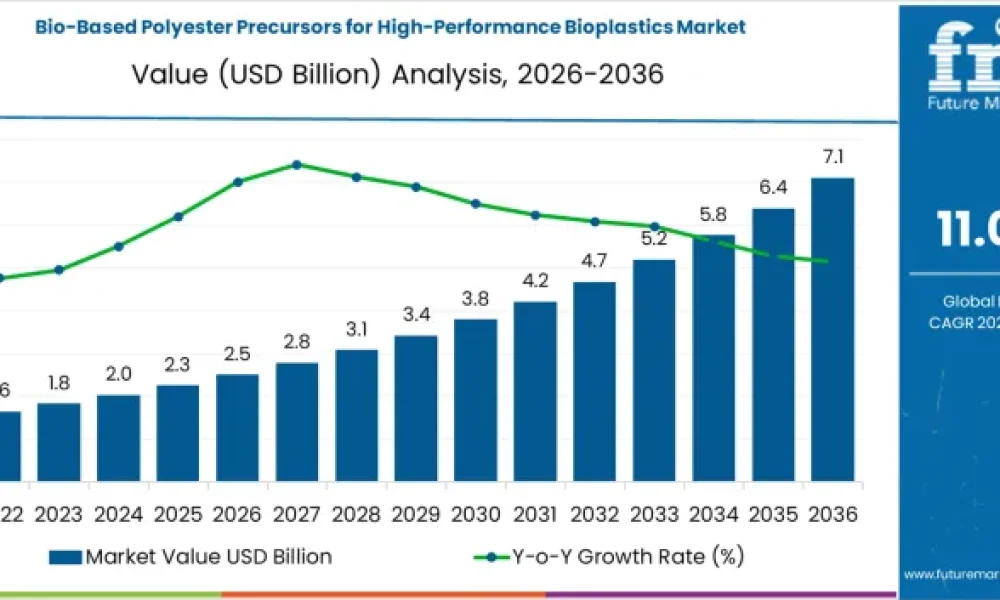
The global Bio-Based Polyester Precursors for High-Performance Bioplastics Market is projected to grow from USD 2.5 billion in 2026 to USD 7.1 billion by 2036, registering a compound annual growth rate (CAGR) of 11 percent over the forecast decade as industries increasingly shift toward sustainable materials and renewable feedstocks. This robust growth underscores the expanding role of bio-based polyester intermediates in high-performance applications across packaging, automotive, textiles, and electronics sectors, driven by regulatory mandates, corporate sustainability commitments, and shifting consumer preferences toward eco-friendly solutions.
For businesses seeking to align with environmental goals without compromising material performance, bio-based polyester precursors — derived from renewable sources like plant sugars, biomass, and fermentation-based monomers — are now critical components in the next generation of bioplastics. As demand for biodegradable, high-functioning plastics intensifies, market participants are investing in advanced production technologies to improve yields, expand feedstock diversity, and scale operations efficiently.
Key Market Insights at a Glance
The market’s impressive forecast trajectory reflects a combination of technological advancements and strategic investments in sustainable manufacturing. From an end-use perspective, packaging and bottles dominate demand, capturing nearly half of the global share in 2026 due to the food and beverage industry’s push for compostable packaging alternatives. Key precursor types such as lactic acid or PLA precursors lead adoption, supported by their strong performance balance between renewability and application versatility.
Regulatory frameworks aimed at reducing dependence on petroleum-based plastics, alongside incentives for carbon-reduction strategies, have strengthened the case for bio-based polyester applications. As governments tighten environmental policies and promote circular economy initiatives, corporate players across sectors are embedding sustainable materials into their supply chains, accelerating market uptake of bio-based polyester precursors.
Segment Overview
In terms of precursor types, the bio-based market is diversified among lactic acid or PLA precursors, FDCA & PEF monomers, bio-ethylene glycol (Bio-EG), other bio-diacids or biopolyols, and specialty polyester precursors. Lactic acid or PLA precursors currently hold a leading position due to their extensive use in biodegradable polyester production. End-use segmentation reveals that packaging & bottles will continue to spearhead market growth through 2036, followed by textiles & fibers, automotive & transportation, consumer electronics & durables, and other industrial applications.
Across regions, North America, led by the United States, is emerging as a significant growth hub, driven by strong sustainability policies and high adoption rates of renewable materials in consumer goods. Western Europe and East Asia, including Germany, China, and Japan, are also key markets, supported by stringent environmental regulations and substantial investments in bioplastic technologies.
Regional Overview
North America’s bio-based polyester precursors market outlook is poised for strong performance in the next decade, with the United States leading growth due to favorable regulatory frameworks and rising demand for sustainable materials. Similarly, Europe’s markets in Germany and neighboring nations are supported by progressive environmental targets and industrial commitment to reduce plastic waste. The Asia Pacific region, particularly China, Japan, and South Korea, is experiencing rapid adoption as manufacturers pivot toward green technologies to address pollution and resource inefficiencies. Across these regions, the average projected CAGR ranges from approximately 10.9 percent to 12.2 percent, highlighting widespread global growth momentum.
To access the complete data tables and in-depth insights — Request Your Sample Report Now
Competitive Landscape
The competitive arena in the bio-based polyester precursors segment features a mix of established chemical majors and emerging innovators focused on renewable solutions. Industry leaders such as Avantium N.V., Cargill Incorporated, Corbion N.V., Braskem S.A., DuPont de Nemours, Inc., Royal DSM N.V., BASF SE, Genomatica, Inc., Novozymes A/S, and Roquette Frères are actively advancing their product portfolios to align with sustainability goals and capture growing market demand. These players differentiate through strategic partnerships, technology licensing, and R&D investments that enhance production scalability and precursor performance.
Market Outlook: Powering the Next Decade
Looking ahead, the bio-based polyester precursors market is expected to play a pivotal role in transforming global material ecosystems. As companies integrate renewable precursors into conventional manufacturing processes, the ability to deliver high-performance, lower-carbon materials will become a key competitive advantage. Continued innovation in biotechnology, process optimization, and supply-chain resilience will drive broader adoption across industrial sectors, ensuring that bio-based polyester precursors remain at the forefront of sustainable materials growth.
Key Players of Sustainable Label Industry
The movement toward sustainability is also reshaping how companies position their brands. Key market participants are leveraging sustainable labelling and environmental certifications to appeal to eco-conscious consumers and institutional buyers. These trends not only enhance brand equity but also influence purchasing decisions, reinforcing the commercial viability of bio-based precursors.
Recent Strategic Developments
Strategic developments across the industry include capacity expansions, mergers and acquisitions to secure feedstock access, and collaborative ventures to co-develop next-generation bioplastic solutions. These initiatives are not just expanding product offerings but are accelerating the global transition to a circular bioeconomy. With increasing investment flows and policy support, the bio-based polyester precursors market is set to deliver sustainable innovation and measurable environmental impact through the next decade.
Have a specific Requirements and Need Assistant on Report Pricing or Limited Budget please contact us – [email protected]
About Future Market Insights (FMI)
Future Market Insights, Inc. (FMI) is an ESOMAR-certified, ISO 9001:2015 market research and consulting organization, trusted by Fortune 500 clients and global enterprises. With operations in the U.S., UK, India, and Dubai, FMI provides data-backed insights and strategic intelligence across 30+ industries and 1200 markets worldwide.
Why Choose FMI: https://www.futuremarketinsights.com/why-fmi



