
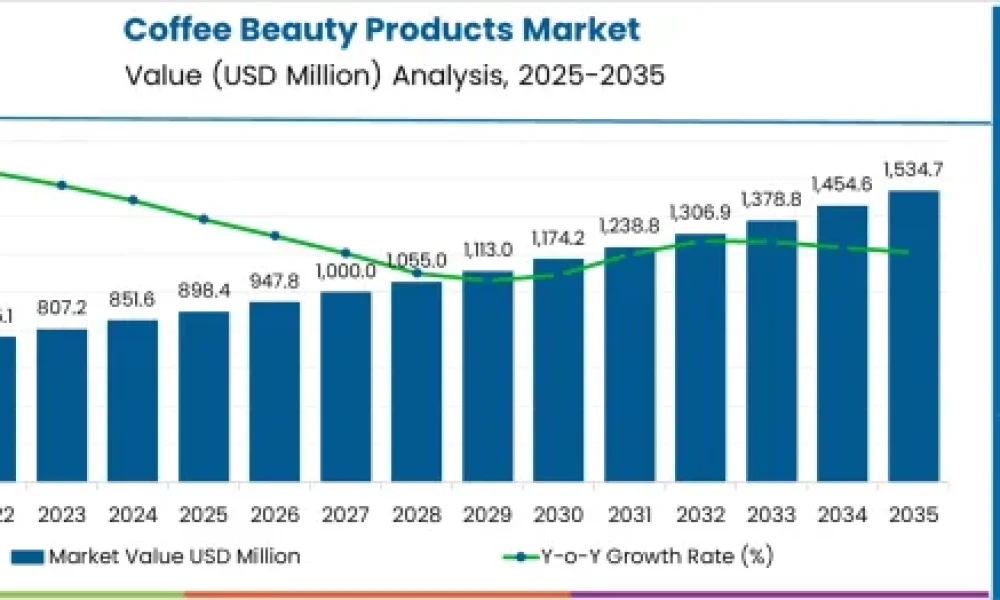
The global Coffee Beauty Products Market is positioned for steady long-term expansion, with market value forecast to rise from USD 898.4 million in 2025 to USD 1,534.7 million by 2035, . The market is projected to register a compound annual growth rate (CAGR) of 5.5% over the forecast period, reflecting sustained consumer interest in natural, effective, and multifunctional beauty solutions.
The growth outlook underscores how coffee-derived ingredients—widely recognized for their antioxidant, exfoliating, and revitalizing properties—are becoming embedded across skincare, haircare, and body care formulations. Over the full assessment horizon, the market represents an absolute dollar opportunity of approximately USD 847.3 million, signaling meaningful potential for manufacturers, ingredient suppliers, and retailers operating within the global beauty and personal care ecosystem.
Access detailed data tables and actionable market insights — Request Your Sample Report Now
Market Context: Natural Ingredients Reshape Beauty Formulations
From 2020 to 2025, the coffee beauty products market expanded from USD 687.4 million to USD 898.4 million, supported by rising awareness of caffeine’s benefits for skin texture improvement, circulation stimulation, and puffiness reduction. This initial growth phase laid the foundation for broader adoption, as clean-label cosmetics and botanical-based actives gained traction across developed and emerging markets.
Between 2025 and 2035, the market is expected to add more than USD 636 million in new value, driven by increasing integration of coffee extracts into daily-use products and the normalization of ingredient transparency in beauty purchasing decisions. Consumers are increasingly seeking non-invasive, wellness-oriented approaches to appearance enhancement, reinforcing demand for coffee-infused formulations positioned at the intersection of efficacy and natural origin.
Skincare Leads Product Adoption Across Global Markets
By product type, skincare products are expected to account for 56.3% of total market revenue in 2025, making them the leading segment in the coffee beauty products market. Coffee extracts are widely used in face masks, scrubs, serums, creams, and eye treatments, particularly for applications targeting under-eye puffiness, skin brightening, cellulite reduction, and firmness.
The segment’s dominance reflects consumer preference for natural exfoliants and antioxidants that deliver visible results without harsh chemicals. Continued product innovation, ingredient transparency, and dermatologist-backed positioning are supporting sustained adoption across age groups and gender demographics.
Mid-Priced Products and Household Use Drive Volume
- In terms of pricing, the medium price range segment is projected to contribute 61.4% of market revenue in 2025. Products in this tier balance affordability with perceived premium quality, offering enhanced textures, improved packaging, and clinically supported benefits. Their broad availability across online platforms and specialty retail channels has reinforced repeat purchasing behavior.
- By end user, the household segment is forecast to capture 58.2% of total revenue, reflecting the ongoing shift toward at-home beauty routines. Coffee-based products are well suited to household use due to their multifunctional nature, safety for frequent application, and alignment with wellness-focused self-care trends. The expansion of e-commerce and subscription models continues to improve access and product variety for consumers globally.
Regional Outlook: Asia-Pacific Shows Strong Momentum
- Regionally, North America, Europe, and Asia-Pacific represent the key growth markets. While North America and Western Europe maintain leadership due to established retail networks and high consumer awareness, Asia-Pacific is emerging as the fastest-growing region.
- At the country level, China leads with a CAGR of 7.4%, supported by rising disposable incomes, expanding e-commerce penetration, and growing demand for innovative skincare solutions.
- India follows at 6.9%, driven by a strong preference for herbal and natural cosmetics. Among OECD economies, Germany records 6.3% growth, reflecting consumer emphasis on certified natural ingredients and sustainability.
- The United States, a more mature market, is projected to grow at 7%, shaped by high competition and diverse consumer preferences.
Competitive Landscape and Industry Strategies
The competitive landscape includes established multinational players such as L’Oréal S.A., Unilever PLC, The Estée Lauder Companies Inc., Procter & Gamble, Beiersdorf AG, and The Body Shop, alongside digitally native and sustainability-focused brands such as Frank Body. Across the industry, competitive strategies increasingly focus on natural sourcing, upcycling of coffee byproducts, transparent labeling, and agile digital marketing.
As regulatory compliance, ingredient quality control, and sustainability certifications become more influential in purchasing decisions, companies investing in robust formulation standards and clear communication are expected to strengthen market positioning.
Outlook Through 2035
With rising demand for clean-label cosmetics, expanding online retail, and growing awareness of coffee’s functional benefits, the coffee beauty products market is set to remain a stable and attractive segment within the global beauty industry. Over the next decade, continued innovation and regional expansion are expected to reinforce coffee’s role as a mainstream cosmetic ingredient rather than a niche differentiator.
Have a specific Requirements and Need Assistant on Report Pricing or Limited Budget please contact us – [email protected]
About Future Market Insights (FMI)
Future Market Insights, Inc. (FMI) is an ESOMAR-certified, ISO 9001:2015 market research and consulting organization, trusted by Fortune 500 clients and global enterprises. With operations in the U.S., UK, India, and Dubai, FMI provides data-backed insights and strategic intelligence across 30+ industries and 1200 markets worldwide
Why Choose FMI: https://www.futuremarketinsights.com/why-fmi



