
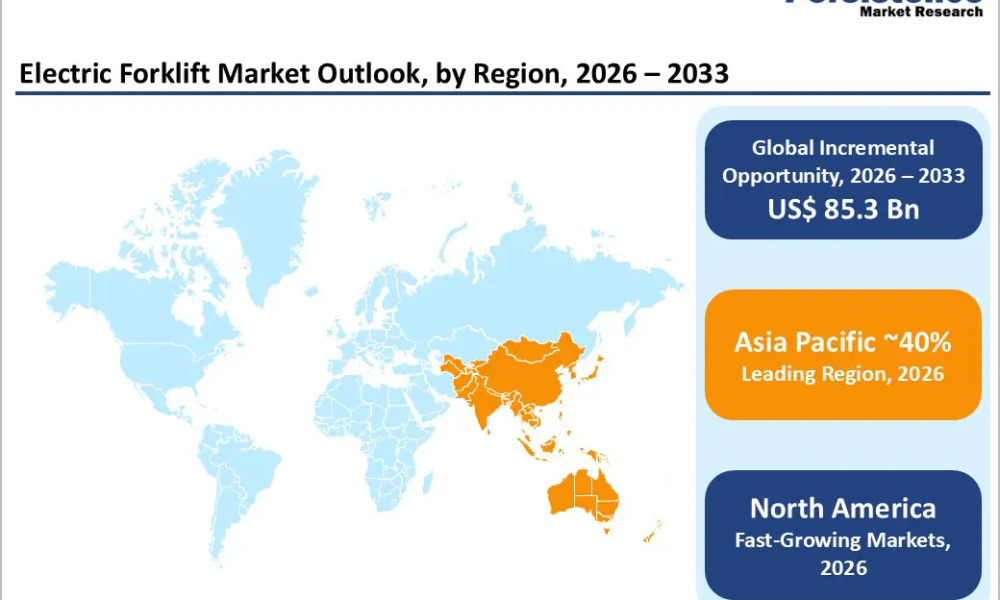
The global electric forklift market is undergoing a significant structural transformation, driven by accelerating electrification across industrial operations, rising environmental compliance requirements, and rapid advancements in warehouse automation. According to consolidated insights from leading market research firms, the global electric forklift market size is estimated to be valued at US$54.2 billion in 2026 and is projected to reach US$139.5 billion by 2033, expanding at a robust compound annual growth rate (CAGR) of 14.46% during the forecast period from 2026 to 2033.
Electric forklifts, powered primarily by lithium-ion, lead-acid, and emerging solid-state battery technologies, are increasingly replacing internal combustion engine (ICE) forklifts across warehouses, manufacturing plants, logistics hubs, ports, and retail distribution centers. Their ability to deliver zero-emission operations, lower total cost of ownership, reduced maintenance requirements, and superior indoor usability positions them as a preferred material handling solution in modern industrial ecosystems.
Market growth is being fueled by several converging factors. These include the rapid expansion of e-commerce and omnichannel retail, increased adoption of automated storage and retrieval systems (AS/RS), rising labor costs that encourage operational efficiency, and growing investments in smart factories under Industry 4.0 initiatives. Additionally, stringent emission regulations, carbon neutrality targets, and corporate sustainability mandates are accelerating the shift toward electric-powered material handling equipment globally.
Get Your FREE Sample Report Instantly Click Now: https://www.persistencemarketresearch.com/request-customization/34692
Market Segmentation
By Product Type
- Counterbalanced Forklift
- Pallet Truck
- Stacker
- Reach Truck
- Order Picker & Others
By Battery Type
- Lithium-Ion
- Lead Acid
- Hydrogen Fuel-Cell
By Lift Capacity
- Up to 5 Ton
- 5.1 to 10 Ton
- Above 10 Ton
By Industry
- Logistics & Warehousing
- Manufacturing
- Chemicals & Pharmaceuticals
- Food & Beverage
- Retail & E-Commerce
- Construction
- Misc.
By Region
- North America
- Europe
- East Asia
- South Asia and Oceania
- Latin America
- Middle East and Africa
Regional Insights
Regionally, Asia-Pacific holds the largest share of the global electric forklift market, led by China, Japan, and South Korea. The region’s dominance is supported by strong manufacturing output, extensive logistics infrastructure, rapid urbanization, and aggressive electrification policies. China, in particular, benefits from large-scale battery production capabilities, government subsidies for electric industrial equipment, and widespread automation across warehouses and ports.
North America represents a mature yet steadily expanding market, driven by the rapid growth of e-commerce fulfillment centers, adoption of advanced warehouse automation, and strict workplace safety and emission standards. The United States continues to see strong demand for lithium-ion forklifts and autonomous material handling solutions.
Europe is characterized by strong regulatory support for electrification and sustainability, with countries such as Germany, the United Kingdom, France, and the Netherlands leading adoption. Stringent emission norms, high energy costs, and robust investments in green logistics are accelerating the replacement of ICE forklifts across the region.
The Middle East and Africa, along with Latin America, are expected to be the fastest-growing regions during the forecast period. Growth in these regions is driven by infrastructure development, expansion of ports and free trade zones, increasing foreign direct investment, and modernization of supply chain operations. Government-led smart city initiatives and logistics digitization programs further support market expansion.
Customize This Report for Your Exact Requirements: https://www.persistencemarketresearch.com/samples/34692
Unique Features and Innovations in the Market
Modern electric forklifts are increasingly differentiated by their integration of advanced digital and intelligent technologies. Manufacturers are embedding AI-powered load optimization, collision avoidance systems, real-time diagnostics, and operator behavior analytics to enhance safety, productivity, and equipment longevity.
The integration of IoT and telematics enables real-time monitoring of battery health, energy consumption, utilization rates, and predictive maintenance schedules. This allows fleet managers to minimize downtime, optimize charging cycles, and extend asset life. Cloud-connected platforms further facilitate centralized fleet management across geographically distributed operations.
Emerging 5G connectivity is enhancing low-latency communication between forklifts, automated guided vehicles, and warehouse control systems. This supports synchronized material movement, improved navigation accuracy, and scalable deployment of autonomous forklifts in complex environments.
Additionally, advancements in modular battery systems, fast-charging infrastructure, and energy recovery technologies are reducing operational bottlenecks and improving overall efficiency. Ergonomic design enhancements, including improved visibility, noise reduction, and operator-assist features, are further elevating user experience.
Market Highlights
The adoption of electric forklifts is being driven by a combination of economic, regulatory, and operational factors. Businesses are increasingly prioritizing lower total cost of ownership, as electric forklifts offer reduced fuel costs, fewer moving parts, and lower maintenance expenses compared to ICE alternatives.
Regulatory frameworks focused on emission reduction, indoor air quality, and workplace safety are playing a critical role in accelerating market adoption. Many governments and local authorities are introducing incentives, subsidies, and tax benefits to encourage electrification of industrial equipment.
Sustainability initiatives and corporate ESG commitments are further reinforcing demand, as electric forklifts align with carbon neutrality goals and green supply chain strategies. Additionally, the shift toward 24/7 warehouse operations and high-throughput logistics environments favors electric forklifts due to their consistent performance and compatibility with automation technologies.
Key Players and Competitive Landscape
The electric forklift market is moderately consolidated, with global OEMs competing alongside regional manufacturers and emerging technology-focused entrants. Leading companies are actively investing in R&D, expanding lithium-ion portfolios, and strengthening after-sales service capabilities.
Key players operating in the market include:
- Toyota Industries Corporation: Focuses on advanced electric counterbalance forklifts and automation-ready solutions, leveraging strong global distribution and continuous product innovation.
- KION Group AG: Emphasizes lithium-ion integration, digital fleet management, and autonomous material handling through its multi-brand portfolio.
- Jungheinrich AG: Known for warehouse-centric electric forklifts, energy-efficient designs, and strong emphasis on Industry 4.0 integration.
- Hyster-Yale Materials Handling: Expands its electric and hydrogen-powered forklift offerings while strengthening presence in high-capacity segments.
- Crown Equipment Corporation: Differentiates through proprietary technology, ergonomic design, and vertically integrated manufacturing processes.
- Mitsubishi Logisnext: Focuses on smart electric forklifts with enhanced safety features and global expansion in emerging markets.
- Hangcha Group: Rapidly expanding its lithium-ion forklift portfolio and leveraging cost-competitive manufacturing to gain international market share.
Recent Developments
- Major forklift manufacturers have accelerated the rollout of next-generation lithium-ion electric forklifts with fast-charging and modular battery systems, targeting high-intensity logistics and manufacturing environments.
- Strategic partnerships between OEMs and technology providers have led to the commercial deployment of AI-enabled autonomous electric forklifts in large-scale distribution centers and ports.
Ready to Dive Deep? Buy Full Report Today: https://www.persistencemarketresearch.com/checkout/34692
Future Opportunities and Growth Prospects
The future of the electric forklift market is closely aligned with the evolution of smart logistics, automation, and sustainable industrial practices. Significant growth opportunities exist in the deployment of fully autonomous electric forklifts, particularly in large warehouses, ports, and manufacturing plants seeking to minimize labor dependency and improve operational resilience.
Emerging markets present substantial untapped potential as governments invest in logistics infrastructure and modernize supply chains. The expansion of battery recycling ecosystems, second-life battery applications, and energy storage integration is expected to further enhance the economic and environmental viability of electric forklifts.
Evolving regulations related to emissions, energy efficiency, and workplace safety will continue to shape product development and procurement decisions. At the same time, advancements in AI, IoT, and connectivity technologies will drive greater intelligence, interoperability, and scalability across electric forklift fleets.
Overall, the global electric forklift market is positioned for sustained, high-growth expansion through 2033, supported by technological innovation, regulatory alignment, and the ongoing transformation of global supply chain and material handling operations.




