
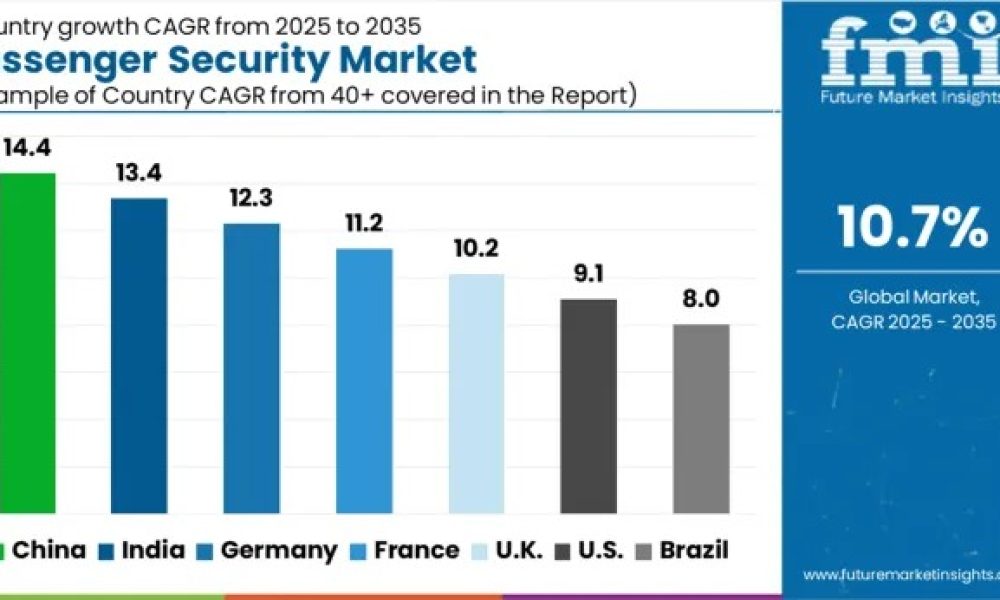
The global passenger security market is entering a decade of accelerated transformation, supported by sustained investments in advanced screening technologies, biometric identification, and intelligent surveillance systems across transportation hubs worldwide. Valued at USD 19.2 billion in 2025, the market is projected to reach USD 52.9 billion by 2035, expanding at a compound annual growth rate (CAGR) of 10.7% over the forecast period. This growth trajectory underscores the increasing strategic importance of passenger security within aviation, rail, metro, and intermodal transport ecosystems.
Passenger security has evolved from a compliance-driven function into a technology-led operational priority. Transportation authorities and infrastructure operators are increasingly adopting high-performance security systems that balance stringent safety requirements with efficiency, scalability, and passenger convenience. As global passenger volumes continue to rise and threat profiles become more complex, demand is shifting toward intelligent, automated, and interoperable security solutions capable of supporting real-time risk mitigation.
Advanced Screening Technologies Anchor Market Expansion
Advanced screening technologies represent the largest and most influential component of the passenger security market. Automated X-ray scanners, millimeter-wave body scanners, and explosive trace detection systems are being widely deployed due to their ability to process high passenger volumes without compromising detection accuracy. These systems enable faster throughput, reduce manual intervention, and improve consistency in threat identification, making them essential for modern airport and terminal operations.
Get access to comprehensive data tables and detailed market insights — request your sample report today!
https://www.futuremarketinsights.com/reports/sample/rep-gb-24640
Baggage inspection systems stand out as a critical growth driver, accounting for an estimated 36.0% of market revenue in 2025. Advances in computed tomography (CT) imaging and automated threat recognition software have significantly enhanced detection precision while minimizing false alarms. Regulatory mandates across aviation and public transport sectors continue to reinforce the necessity of deploying certified, next-generation inspection systems, particularly in newly developed and upgraded facilities.
Biometric Authentication and AI-Driven Surveillance Gain Momentum
Biometric technologies are reshaping passenger verification and access control across transport terminals. Facial recognition, fingerprint scanning, and iris recognition solutions are increasingly integrated into boarding gates, security checkpoints, and restricted areas, enabling contactless and rapid identity verification. These systems improve operational efficiency, reduce congestion during peak travel periods, and support integration with digital identity and travel management platforms.
Software-driven surveillance has emerged as a high-impact growth segment within passenger security. AI-enabled video analytics, behavior detection platforms, and predictive threat monitoring tools are enhancing situational awareness across airports, railway stations, and urban transit hubs. These solutions support real-time alerts, automated incident detection, and centralized monitoring, enabling proactive security responses while optimizing staffing and operational costs. The growing adoption of intelligent surveillance reflects a broader shift toward data-driven security management.
Hardware Segment Maintains Leadership Position
Within the solution landscape, hardware accounts for approximately 62.5% of total market revenue in 2025, reinforcing its foundational role in passenger security infrastructure. Scanners, surveillance cameras, access control devices, and perimeter detection systems remain essential investments for ensuring regulatory compliance and operational reliability. Importantly, modern hardware platforms are increasingly designed for seamless integration with software analytics, AI modules, and biometric systems, extending asset lifecycles and enhancing return on investment.
Domestic transportation hubs represent the dominant airport type segment, capturing an estimated 57% of market revenue. High-frequency domestic travel, combined with government-led modernization programs, has driven significant investment in security upgrades at regional and metropolitan terminals. These facilities prioritize high-throughput screening, integrated surveillance networks, and biometric access control to support growing passenger flows.
Regional Dynamics Highlight Emerging Growth Centers
Regionally, North America, Europe, and Asia-Pacific remain the primary growth engines of the passenger security market. North America and Europe continue to benefit from stringent regulatory frameworks, continuous technology upgrades, and mature aviation infrastructure. Meanwhile, Asia-Pacific is witnessing rapid expansion due to rising air travel, urbanization, and large-scale investments in transport infrastructure.
Country-level analysis highlights particularly strong momentum in emerging and industrialized economies. China leads with a projected CAGR of 14.4%, driven by extensive deployment across airports, railways, and urban transit systems. India follows at 13.4%, supported by expanding public transportation networks and increased adoption of integrated surveillance and screening technologies. Germany, France, the UK, and the United States continue to demonstrate steady growth through modernization initiatives and advanced security deployments aligned with regulatory standards.
Drive Your Business Growth Strategy: Checkout the Report for Key Insights
https://www.futuremarketinsights.com/checkout/24640
Competitive Landscape Driven by Integration and Innovation
The competitive landscape of the passenger security market is defined by providers delivering end-to-end screening, detection, and monitoring solutions. Leading companies such as Smiths Detection, Rapiscan Systems, Leidos, Thales, and Honeywell are advancing integrated platforms that combine hardware reliability with software intelligence. Strategic partnerships with airports, transit authorities, and technology providers are accelerating deployment of centralized monitoring systems, AI-enabled analytics, and interoperable security architectures.
Market participants are increasingly focused on improving passenger throughput, predictive threat detection, and lifecycle performance, while ensuring compliance with privacy, data protection, and safety standards. Continuous innovation in sensor technology, analytics, and remote monitoring is strengthening the role of passenger security as a critical enabler of safe, efficient, and resilient transportation networks.
Outlook
As global mobility expands and security expectations intensify, the passenger security market is positioned for sustained, technology-driven growth. Investments in automation, biometrics, and intelligent surveillance are redefining how transportation hubs manage safety, efficiency, and passenger experience. With strong regional momentum, evolving regulatory landscapes, and accelerating innovation, the market presents a compelling outlook for stakeholders seeking deeper insights into its long-term dynamics and opportunities.
Why Choose FMI: Empowering Decisions that Drive Real-World Outcomes: https://www.futuremarketinsights.com/why-fmi
About Future Market Insights (FMI)
Future Market Insights, Inc. (FMI) is an ESOMAR-certified, ISO 9001:2015 market research and consulting organization, trusted by Fortune 500 clients and global enterprises. With operations in the U.S., UK, India, and Dubai, FMI provides data-backed insights and strategic intelligence across 30+ industries and 1200 markets worldwide.



