
The fibroblast growth factors market represents a critical segment of the global life sciences and biotechnology industry, rooted in the expanding understanding of cell signaling, tissue regeneration, and molecular biology. Fibroblast growth factors (FGFs) are a family of multifunctional proteins that play a central role in cell proliferation, differentiation, angiogenesis, wound healing, and metabolic regulation. Their ability to regulate complex biological processes has made them indispensable in regenerative medicine, oncology research, stem cell biology, and biopharmaceutical development. As healthcare systems increasingly focus on precision medicine and tissue engineering solutions, FGFs have transitioned from being primarily research tools to becoming essential components in therapeutic pipelines.
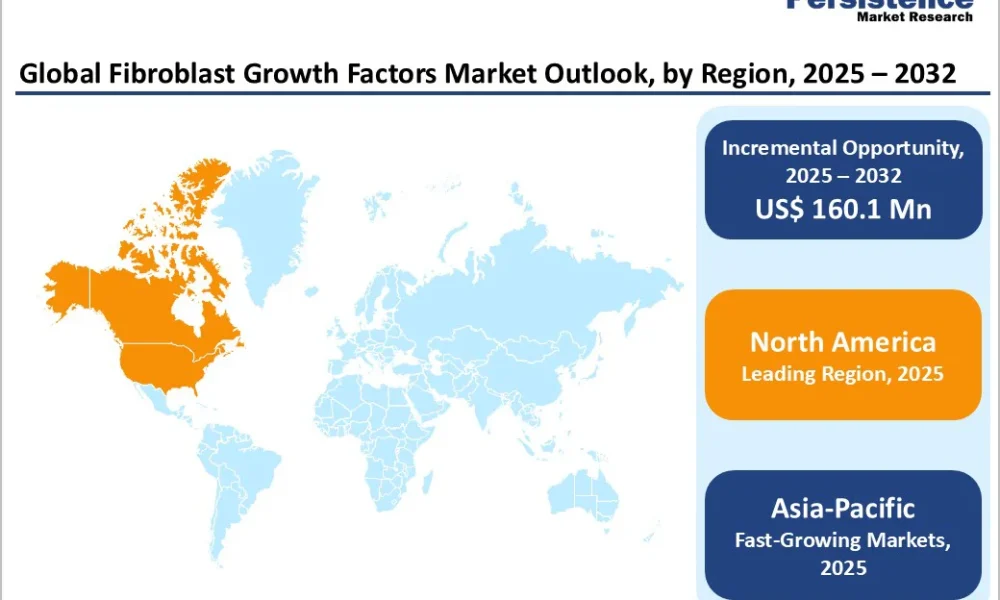
From a market size perspective, the global fibroblast growth factors market is estimated to grow from US$301.9 million in 2025 to US$462.0 million by 2032, registering a steady compound annual growth rate (CAGR) of 6.3% during the forecast period. This expansion builds on a historical CAGR of 5.3% between 2019 and 2024, reflecting both rising scientific adoption and accelerating translational research. Key growth drivers include the rapid expansion of regenerative medicine, increasing prevalence of chronic wounds and metabolic disorders, and rising investment in biopharmaceutical R&D. Among product segments, FGF2 (basic fibroblast growth factor) leads the market with approximately 35.4% share due to its broad biological activity and widespread application in cell culture and tissue repair studies. Geographically, North America dominates with around 38.1% of global revenue, supported by advanced biotech infrastructure, high R&D spending, and a dense concentration of recombinant protein manufacturers, while Asia-Pacific emerges as the fastest-growing region owing to government-backed stem cell programs and expanding biomanufacturing capacity.
Download Your Free Sample & Explore Key Insights: https://www.persistencemarketresearch.com/samples/28315
Key Highlights from the Report
• The global fibroblast growth factors market is projected to grow at a CAGR of 6.3% from 2025 to 2032, reaching US$462.0 million by the end of the forecast period.
• FGF2 remains the dominant product type, driven by its extensive use in regenerative medicine, wound healing, and stem cell research.
• Research-grade FGFs account for the largest share due to widespread adoption in academic laboratories and preclinical drug discovery.
• North America leads the market, supported by robust biotechnology ecosystems, strong funding, and active clinical trial pipelines.
• Asia-Pacific is the fastest-growing region, propelled by expanding biomanufacturing infrastructure and government support for life sciences.
• Therapeutic development of FGF21 and FGF19 analogs represents a high-value opportunity with strong late-stage clinical momentum.
Market Segmentation Analysis
The fibroblast growth factors market can be segmented based on product type, product form, end user, and application, each contributing uniquely to overall demand dynamics. By product type, the market includes FGF1, FGF2, FGF7, FGF10, FGF19, FGF21, and other specialized FGFs. Among these, FGF2 holds a dominant position due to its relatively simple molecular structure, well-characterized signaling pathways, and extensive validation across biological studies. Its versatility in promoting cell proliferation, angiogenesis, and tissue repair has made it a preferred choice for both research-grade and clinical-grade applications, especially in wound healing and stem cell expansion protocols.
By product form, the market is broadly divided into research-grade FGFs and GMP-grade or clinical-grade FGFs. Research-grade FGFs represent the leading segment, accounting for more than half of the total market share. Their dominance is attributed to extensive use in academic research, contract research organizations (CROs), and early-stage biopharmaceutical discovery programs. High reproducibility, relatively lower cost, and easy availability make research-grade FGFs indispensable for cell culture, differentiation studies, and regenerative biology experiments. In contrast, GMP-grade FGFs cater to clinical trials and therapeutic manufacturing, forming a smaller but strategically significant segment driven by the rise of cell and gene therapies.
In terms of end users, academic and research institutes form a major customer base, followed closely by biotechnology and pharmaceutical companies. Academic institutions drive volume demand through large-scale research projects, while biopharmaceutical companies contribute higher-value demand through clinical-grade requirements and long-term supply agreements. Hospitals and specialized clinics represent an emerging segment, particularly in regions where FGF-based regenerative therapies and advanced wound care products are entering clinical practice.
Regional Insights and Market Trends
North America continues to dominate the global fibroblast growth factors market, supported by a mature biotechnology ecosystem, strong government and private funding, and a high concentration of life science companies. The United States plays a central role in this dominance, accounting for a substantial share of global biotechnology revenue and hosting thousands of ongoing biomedical research projects involving FGFs. Rising incidence of cancer and chronic diseases has further intensified the use of FGFs and cytokines in oncology research and regenerative therapies. Strong regulatory frameworks and active FDA support for innovative biologics also encourage rapid translation of FGF research into clinical applications, reinforcing North America’s leadership position.
Europe stands as another major contributor to the fibroblast growth factors market, underpinned by high R&D spending and coordinated research initiatives across the European Union. Countries such as Germany, the United Kingdom, and France are at the forefront of regenerative medicine and tissue engineering research. Germany, in particular, has emerged as a hub for FGF-based innovations targeting chronic wounds, musculoskeletal disorders, and neurological conditions. Supportive government programs and close collaboration between academia and industry enable efficient commercialization of research outcomes, sustaining Europe’s strong presence in the global market.
Asia-Pacific represents the fastest-growing regional market for fibroblast growth factors, driven by rapid expansion of healthcare infrastructure, rising healthcare expenditure, and increasing focus on biotechnology innovation. China leads regional growth through significant investment in biopharmaceutical manufacturing and active research on FGFs as therapeutic targets in oncology and metabolic disorders. Japan and South Korea also contribute through advanced stem cell research and regenerative medicine programs. The region’s growth is further supported by collaborations between domestic biotech firms and global protein suppliers, positioning Asia-Pacific as a key engine of future market expansion.
Get Custom Insights Designed for Your Business: https://www.persistencemarketresearch.com/request-customization/28315
Market Drivers
The primary driver of the fibroblast growth factors market is the growing focus on regenerative medicine and advanced wound healing solutions. A deeper understanding of wound healing mechanisms, supported by advancements in molecular science, has highlighted the critical role of FGFs in coordinating cellular responses during tissue repair. FGFs regulate angiogenesis, fibroblast migration, and epithelial regeneration, making them indispensable in managing chronic wounds, burns, and post-surgical healing. As the global burden of diabetes, cardiovascular disease, and aging-related conditions increases, the demand for effective wound care and tissue regeneration therapies continues to rise.
Another significant driver is the expansion of biopharmaceutical research and development. FGFs are widely used as recombinant proteins in cell culture systems for drug discovery, toxicity testing, and biologics production. Their role in maintaining stem cell pluripotency and promoting controlled differentiation has made them essential reagents in cell-based assays and regenerative studies. Increasing investment from pharmaceutical companies, coupled with rising numbers of active research projects referencing FGFs, sustains consistent demand across both academic and industrial settings.
Market Restraints
Despite strong growth prospects, the fibroblast growth factors market faces notable restraints, primarily related to the high cost associated with development and production. Producing recombinant FGFs requires sophisticated expression systems, stringent purification processes, and rigorous quality control measures, all of which contribute to elevated manufacturing costs. These challenges are particularly pronounced for GMP-grade FGFs intended for clinical use, where regulatory compliance and batch-to-batch consistency are critical.
The financial burden extends beyond manufacturing to include extensive preclinical and clinical testing. Evaluating the safety and efficacy of FGF-based therapies involves multi-phase clinical trials, significant patient recruitment efforts, and complex regulatory submissions. The risk of trial failure or unexpected adverse outcomes further amplifies investment uncertainty, potentially limiting participation from smaller biotech firms and slowing market expansion in certain therapeutic areas.
Market Opportunities
The therapeutic development of FGF21 and FGF19 analogs represents one of the most promising opportunities within the fibroblast growth factors market. Engineered analogs of these FGFs have demonstrated meaningful clinical benefits in metabolic liver diseases, including reductions in liver fat content and improvements in fibrosis markers. Late-stage clinical progress, including Breakthrough Therapy designations and initiation of Phase III programs, highlights strong regulatory momentum and commercial potential.
Beyond metabolic disorders, opportunities also exist in the integration of FGFs into advanced biomaterials and tissue engineering scaffolds. Combining FGFs with hydrogels, 3D-printed matrices, and implantable devices can enhance localized tissue regeneration and improve therapeutic outcomes. Expansion into emerging markets, supported by government investment in biotechnology and translational research, further broadens the addressable market and creates long-term growth avenues for established and emerging players alike.
Checkout Now & Download Complete Market Report: https://www.persistencemarketresearch.com/checkout/28315
Company Insights
The fibroblast growth factors market is moderately competitive, with a mix of global life science giants and specialized recombinant protein manufacturers. Leading companies focus on product innovation, protein engineering, and strategic collaborations to strengthen their market positions and expand application portfolios.
• Thermo Fisher Scientific, Inc.
• Merck KGaA
• Bio-Rad Laboratories, Inc.
• Lonza Group AG
• F. Hoffmann-La Roche Ltd.
• Bio-Techne Corporation
• Abcam PLC (Danaher)
• Cell Signaling Technology, Inc.
• Creative Bioarray
• Proteintech Group, Inc.
• Sartorius CellGenix GmbH
• GenScript
• Miltenyi Biotec
• Sino Biological Inc.
• ACROBiosystems
• Applied Biological Materials (abm) Inc.
• Meridian Bioscience Inc.
• Aviva Systems Biology Corporation (GenWay Biotech)
• Leadgene Biomedical, Inc.
• Boster Bio
• Prospec-Tany Technogene Ltd.
• AJINOMOTO CO., INC.
• STEMCELL Technologies
• Akron Biotech
Fibroblast Growth Factors Market Segmentation
By Product
- FGF1
- FGF2
- FGF7
- FGF10
- FGF19
- FGF21
- FGF23
- Others
By Product Form
- Research Grade
- GMP Grade
- Finished Formulations
- Kits & Diagnostic Reagents
By Application
- Oncology
- Hematology
- Wound Healing
- Dermatology
- Cardiovascular Disease & Diabetes
- Cell Therapy
- Others
By End User
- Pharmaceutical & Biotechnology Companies
- Research Centers & Academic Institutes
- Contract Research & Manufacturing Organizations
By Region
- North America
- Europe
- East Asia
- South Asia & Oceania
- Latin America
- Middle East and Africa
Recent developments highlight the market’s innovation-driven nature. In January 2025, Bio-Techne launched AI-engineered designer proteins, including heat-stable FGF basic variants for both research and GMP applications, enhancing protein stability and usability. In August 2024, Leadgene Biomedical expanded its R&D and cell line development capabilities in Taiwan, strengthening its position in biomanufacturing and reinforcing regional growth momentum.
Conclusion
The fibroblast growth factors market is positioned for sustained growth over the coming decade, driven by expanding applications in regenerative medicine, wound healing, and biopharmaceutical research. With a projected CAGR of 6.3% through 2032, the market reflects increasing scientific validation and translational potential of FGFs across therapeutic and research domains. While high development and production costs present challenges, ongoing innovation, particularly in engineered FGF analogs and advanced biomaterials, is unlocking new opportunities. As North America maintains its leadership and Asia-Pacific accelerates its growth trajectory, the global FGFs market is set to play an increasingly vital role in shaping the future of regenerative and precision medicine.




