
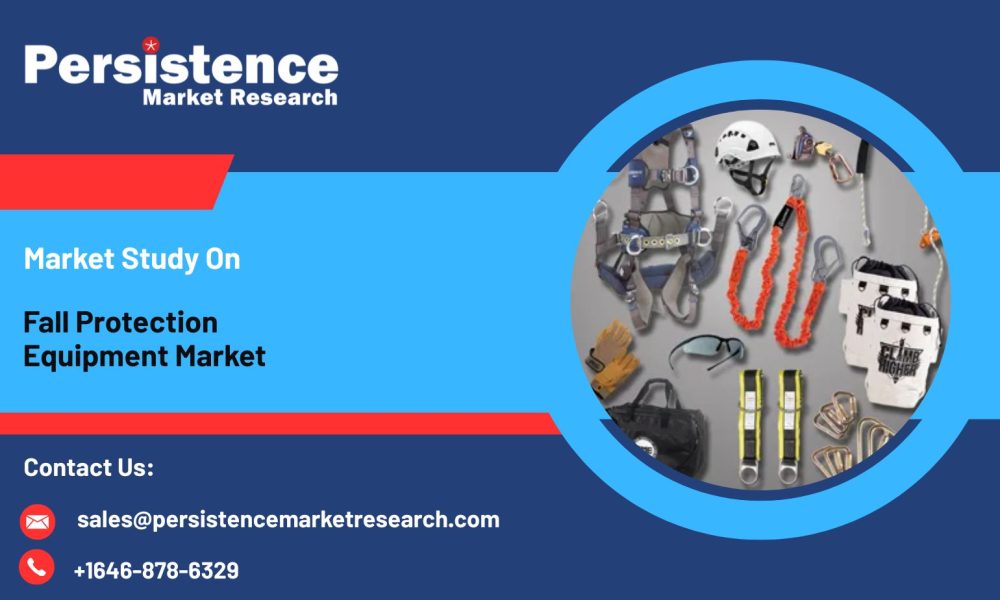
The fall protection equipment market has become a critical component of global occupational safety systems as industries increasingly recognize the human, legal, and financial consequences of workplace falls. Fall protection equipment refers to a broad range of safety solutions designed to prevent or mitigate injuries caused by falls from height, including harnesses, lanyards, connectors, anchor points, guardrails, safety nets, and self-retracting lifelines. These systems are widely used across construction, manufacturing, oil & gas, utilities, mining, transportation, and maintenance activities, where working at elevated heights is unavoidable. As industrial operations expand and infrastructure projects grow in complexity, fall protection has shifted from being a compliance-driven requirement to a strategic investment in workforce safety and productivity.
From a market standpoint, the global fall protection equipment market size is likely to be valued at US$3.3 billion in 2026 and is expected to reach US$5.1 billion by 2033, growing at a CAGR of 6.4% during the forecast period from 2026 to 2033. This steady growth is driven by the increasing prevalence of stringent workplace safety regulations, rising awareness of occupational hazards, and continuous advancements in lightweight, ergonomic, and high-performance protective gear. Among product categories, personal fall arrest systems represent the leading segment due to their mandatory use in many high-risk environments. Geographically, North America leads the global market, supported by strict enforcement of safety standards, strong regulatory oversight by agencies such as OSHA, and widespread adoption of advanced safety technologies across construction and industrial sectors.
Key Highlights from the Report
• The market is witnessing sustained growth due to strict enforcement of workplace safety regulations worldwide.
• Construction remains the largest end-use industry for fall protection equipment adoption.
• Technological advancements are improving comfort, mobility, and compliance among workers.
• North America dominates the market owing to strong regulatory frameworks and safety awareness.
• Emerging economies are creating new growth opportunities through infrastructure development.
• Manufacturers are increasingly focusing on ergonomic and lightweight safety solutions.
𝐃𝐨𝐰𝐧𝐥𝐨𝐚𝐝 𝐅𝐫𝐞𝐞 𝐒𝐚𝐦𝐩𝐥𝐞 & 𝐂𝐡𝐞𝐜𝐤 𝐭𝐡𝐞 𝐋𝐚𝐭𝐞𝐬𝐭 𝐌𝐚𝐫𝐤𝐞𝐭 𝐀𝐧𝐚𝐥𝐲𝐬𝐢𝐬: https://www.persistencemarketresearch.com/samples/20266
Evolution of Fall Protection Equipment and Industry Standards
The evolution of fall protection equipment has been closely tied to advancements in industrial safety standards and regulatory frameworks. Early safety systems were often basic and reactive, offering limited protection and comfort to workers. Over time, regulatory bodies and industry associations have played a crucial role in defining performance benchmarks, testing requirements, and usage guidelines for fall protection products. These standards have driven manufacturers to invest in research and development, resulting in more reliable, durable, and user-friendly equipment.
Modern fall protection systems are designed not only to prevent falls but also to reduce fatigue, enhance worker mobility, and encourage consistent usage. Innovations such as energy-absorbing lanyards, automatic locking mechanisms, and smart sensors that monitor worker movement have significantly improved safety outcomes. The alignment of equipment design with international standards has also facilitated global trade and adoption, allowing manufacturers to serve multiple markets with compliant product portfolios.
Market Segmentation Analysis
The fall protection equipment market can be segmented based on product type, system type, end-user industry, and distribution channel, each contributing to overall market expansion. Based on product type, the market includes harnesses, lanyards, connectors, anchor points, guardrails, safety nets, and self-retracting lifelines. Harnesses and lanyards account for a substantial share of the market due to their widespread use in personal fall arrest systems. These products are essential for workers operating at heights and are often mandated by safety regulations across industries.
In terms of system type, the market is categorized into personal fall arrest systems, fall restraint systems, positioning systems, and collective protection systems. Personal fall arrest systems dominate the market as they are designed to stop a fall in progress and minimize injury, making them indispensable in construction, utilities, and maintenance operations. Fall restraint and positioning systems are increasingly used in tasks that require controlled movement at height, while collective protection systems such as guardrails and safety nets are gaining traction in large-scale infrastructure projects.
From an end-user perspective, the construction industry remains the largest consumer of fall protection equipment due to the high incidence of falls and the dynamic nature of construction sites. Other significant end-users include manufacturing, oil & gas, energy and utilities, mining, and transportation. The distribution landscape includes direct sales, authorized distributors, and online platforms, with digital channels gaining importance as companies seek convenient procurement and product information access.
Regional Insights and Market Dynamics
North America continues to hold the leading position in the global fall protection equipment market, driven by stringent occupational safety regulations and a strong culture of compliance. The United States, in particular, has well-established safety standards enforced by regulatory bodies, compelling employers to invest in certified fall protection solutions. High awareness among employers and workers, coupled with regular safety audits and training programs, has sustained demand for advanced fall protection equipment across industries.
Europe represents another significant market, supported by comprehensive workplace safety directives and harmonized standards across member states. Countries such as Germany, the United Kingdom, and France have strong industrial bases and construction sectors that prioritize worker safety. European manufacturers are also at the forefront of innovation, focusing on ergonomics, sustainability, and compliance with evolving safety norms.
Asia Pacific is emerging as a high-growth region due to rapid industrialization, urbanization, and large-scale infrastructure development. Countries such as China, India, and Southeast Asian nations are witnessing increased adoption of fall protection equipment as governments strengthen safety regulations and multinational companies implement global safety practices. Latin America and the Middle East & Africa are also showing steady growth, driven by expanding construction activities, energy projects, and increasing awareness of occupational safety requirements.
𝐆𝐞𝐭 𝐚 𝐂𝐮𝐬𝐭𝐨𝐦𝐢𝐳𝐞𝐝 𝐌𝐚𝐫𝐤𝐞𝐭 𝐕𝐢𝐞𝐰 𝐢𝐧 𝐎𝐧𝐞 𝐂𝐥𝐢𝐜𝐤 : https://www.persistencemarketresearch.com/request-customization/20266
Market Drivers
The primary driver of the fall protection equipment market is the growing emphasis on workplace safety and the enforcement of stringent safety regulations across industries. Governments and regulatory bodies worldwide have implemented comprehensive occupational safety standards that mandate the use of fall protection equipment in high-risk environments. Non-compliance can result in severe penalties, legal liabilities, and reputational damage, prompting organizations to prioritize investment in certified safety solutions.
Another key driver is the rising demand for worker protection in high-risk industries such as construction, oil & gas, utilities, and mining. As these industries expand and projects become more complex, the need for reliable fall protection systems has intensified. Additionally, advancements in lightweight materials and ergonomic design have improved user comfort and acceptance, encouraging consistent usage and reducing resistance among workers, which further supports market growth.
Market Restraints
Despite strong growth prospects, the fall protection equipment market faces certain restraints that may hinder adoption in specific regions or industries. One of the primary challenges is the high cost associated with advanced fall protection systems, particularly for small and medium-sized enterprises. The initial investment in certified equipment, regular inspections, and employee training can be financially burdensome for organizations operating with limited budgets.
Another restraint is the lack of awareness and inconsistent enforcement of safety regulations in some developing regions. Inadequate training and improper usage of fall protection equipment can reduce its effectiveness and discourage adoption. Additionally, discomfort and perceived inconvenience associated with wearing safety gear for extended periods may lead to non-compliance among workers, highlighting the need for continued innovation and education.
Market Opportunities
The fall protection equipment market presents significant opportunities driven by technological advancements and expanding industrial activities in emerging economies. The integration of smart technologies, such as wearable sensors and IoT-enabled safety systems, offers new possibilities for real-time monitoring, predictive safety analytics, and improved incident prevention. These innovations are expected to enhance safety outcomes and create value-added offerings for end-users.
Infrastructure development in emerging markets presents another major opportunity for market expansion. Governments across Asia Pacific, Latin America, and the Middle East are investing heavily in construction, transportation, and energy projects, creating sustained demand for fall protection equipment. Additionally, increasing emphasis on sustainability and worker well-being is encouraging manufacturers to develop eco-friendly materials and ergonomic designs, opening new avenues for differentiation and growth.
Competitive Landscape and Industry Structure
The fall protection equipment market is moderately consolidated, with several global players competing alongside regional manufacturers. Leading companies focus on innovation, product certification, and comprehensive safety solutions to maintain competitive advantage. Strategic partnerships, mergers, and acquisitions are common as companies seek to expand their geographic presence and product portfolios.
Competition in the market is driven by factors such as product reliability, compliance with international standards, ease of use, and after-sales support. Manufacturers are increasingly investing in training programs, digital tools, and customer education to enhance brand loyalty and long-term relationships. As safety standards continue to evolve, companies that can quickly adapt and offer compliant, user-centric solutions are likely to gain a competitive edge.
𝐂𝐥𝐢𝐜𝐤 𝐭𝐨 𝐏𝐮𝐫𝐜𝐡𝐚𝐬𝐞 𝐭𝐡𝐞 𝐅𝐮𝐥𝐥 𝐑𝐞𝐩𝐨𝐫𝐭 & 𝐒𝐭𝐚𝐫𝐭 𝐄𝐱𝐩𝐥𝐨𝐫𝐢𝐧𝐠 :https://www.persistencemarketresearch.com/checkout/20266
Company Insights
• 3M Company
• Honeywell International Inc.
• MSA Safety Incorporated
• WernerCo
• FallTech
• Guardian Fall Protection
• Skylotec GmbH
• Petzl Group
Recent developments in the market include the introduction of next-generation fall protection harnesses featuring advanced ergonomic designs and lightweight composite materials to improve worker comfort and compliance. Additionally, several leading players have expanded their product portfolios with smart fall protection solutions incorporating sensors and digital monitoring capabilities, reflecting the industry’s shift toward connected safety systems.
Conclusion
The global fall protection equipment market is poised for steady growth as industries increasingly prioritize worker safety, regulatory compliance, and operational efficiency. With the market expected to expand from US$3.3 billion in 2026 to US$5.1 billion by 2033 at a CAGR of 6.4%, fall protection equipment will remain a vital component of occupational safety strategies worldwide. While challenges such as high costs and uneven awareness persist, ongoing technological innovation, expanding infrastructure development, and stronger regulatory enforcement are creating favorable conditions for market growth. As manufacturers continue to focus on ergonomic design, smart technologies, and comprehensive safety solutions, the fall protection equipment market is well-positioned to support safer workplaces and sustainable industrial progress in the years ahead.




