
The recombinant cell culture supplements market is gaining strong momentum as biopharmaceutical manufacturers worldwide accelerate the shift toward safer, animal-free, and highly consistent upstream production systems. These supplements, produced using recombinant DNA technology, are increasingly replacing traditional animal-derived components in cell culture media, driven by regulatory pressure, ethical considerations, and the growing complexity of biologics manufacturing. With biologics, vaccines, and advanced therapies forming the backbone of modern medicine, recombinant cell culture supplements have become a critical enabler of scalable and reproducible cell culture processes.
Market Size and Growth Outlook
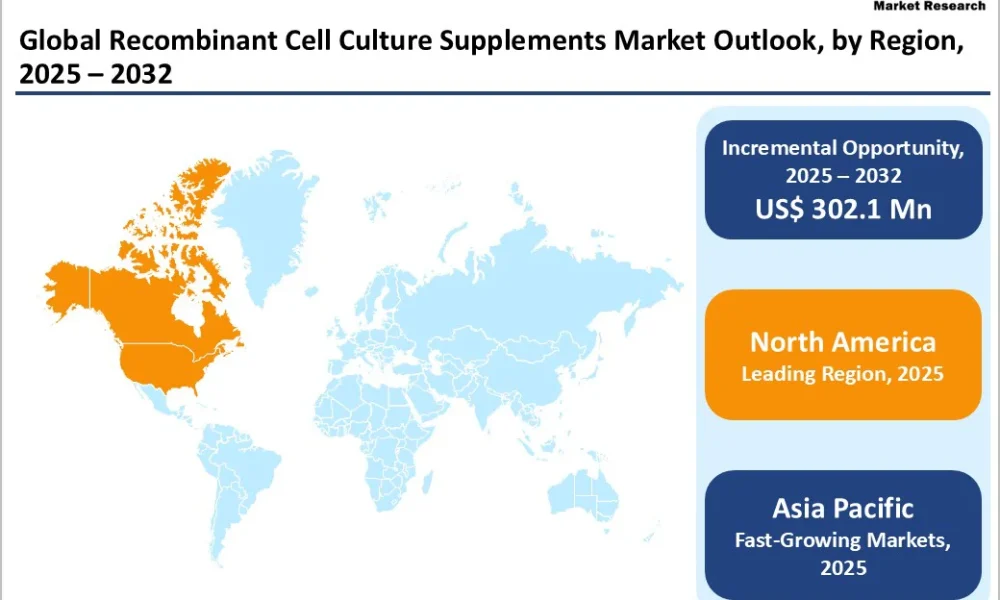
The global recombinant cell culture supplements market size is valued at US$591.3 million in 2025 and is projected to reach US$893.4 million by 2032. The market is expected to expand steadily during the forecast period, supported by increasing adoption of serum-free and chemically defined media across research and commercial manufacturing. The projected compound annual growth rate during 2025 to 2032 reflects the growing reliance on recombinant growth factors, cytokines, and proteins to ensure batch-to-batch consistency and regulatory compliance. Historical growth from 2019 to 2024 demonstrates a strong foundation, with sustained investments in biologics development continuing to shape market dynamics.
Download Your Free Sample & Explore Key Insights: https://www.persistencemarketresearch.com/samples/31310
Rising Importance of Recombinant Supplements in Biopharmaceutical Manufacturing
Biopharmaceutical companies are increasingly focused on producing high-value biologics such as monoclonal antibodies, recombinant proteins, vaccines, and viral vectors. These products require precise control over cell growth conditions to ensure quality, safety, and efficacy. Recombinant cell culture supplements offer significant advantages over animal-derived alternatives, including reduced risk of contamination, improved traceability, and consistent performance across production batches. As a result, they have become integral to modern Good Manufacturing Practice workflows, particularly in large-scale upstream processes.
The growing demand for cell and gene therapies, including CAR-T therapies and gene-modified cell products, further strengthens the role of recombinant supplements. These advanced therapies require tightly controlled culture environments, where variability in raw materials can directly impact therapeutic outcomes. Recombinant supplements provide the reliability and scalability required to meet these stringent requirements.
Key Industry Highlights and Technology Trends
One of the most notable trends in the recombinant cell culture supplements market is the customization of formulations to meet the specific needs of different cell lines and applications. Manufacturers are offering tailored recombinant transferrin, fibronectin, cytokines, and hormones to optimize cell growth, productivity, and viability. This trend reflects the broader industry shift toward precision bioprocessing, where one-size-fits-all solutions are no longer sufficient.
Recombinant growth factors are expected to hold a significant market share in 2025, as they play a central role in driving cell proliferation and differentiation. Their importance is particularly pronounced in serum-free and chemically defined media, where they replace the complex and variable components traditionally supplied by serum. On the application side, stem cell therapy is anticipated to represent a substantial share of the market, supported by rising government funding, expanding clinical pipelines, and growing interest in regenerative medicine.
Market Dynamics
A major driver shaping the recombinant cell culture supplements market is the transition to serum-free media. Conventional serum-based media, especially those derived from fetal bovine serum, pose risks of viral, mycoplasma, and prion contamination. These risks are unacceptable in large-scale biologics manufacturing, where contamination can lead to costly batch failures and regulatory setbacks. Serum-free media supplemented with recombinant components provide a consistent and contamination-free alternative, with adoption rates increasing significantly in recent years.
Ethical concerns related to animal welfare have also accelerated this transition. Regulatory agencies such as the FDA and EMA are encouraging the use of animal-free components to improve product safety and consistency. Regulatory frameworks, including European animal welfare directives, have further incentivized manufacturers to adopt recombinant alternatives. Serum-free formulations offer additional benefits such as improved scalability, reduced variability, and the ability to tailor media compositions for specific cell types.
Get Custom Insights Designed for Your Business: https://www.persistencemarketresearch.com/request-customization/31310
Despite these advantages, the market faces certain restraints related to contamination risks and quality control challenges. Recombinant cell culture systems are highly sensitive, and contamination from microorganisms, chemical impurities, or human error can compromise entire production batches. Mycoplasma contamination remains a significant concern, accounting for a large proportion of contamination incidents in cell culture processes. Ensuring stringent quality control and robust contamination detection systems is therefore critical for manufacturers operating in this space.
Emerging Opportunities in Tissue Engineering
Tissue engineering and regenerative medicine represent a major growth opportunity for the recombinant cell culture supplements market. The global shortage of donor organs and the rising prevalence of chronic diseases have intensified the search for alternative therapeutic solutions. Tissue engineering relies heavily on advanced cell culture techniques to develop functional tissues and organs, creating strong demand for high-quality recombinant growth factors and cytokines.
Recombinant supplements are particularly well suited for tissue engineering applications, as they provide consistent performance and reduce variability compared to serum-based media. This consistency is essential for producing reproducible and clinically viable tissue constructs. As regenerative medicine research expands and moves closer to commercialization, demand for recombinant cell culture supplements is expected to rise significantly.
Category-wise Market Analysis
By product type, recombinant growth factors dominate the market due to their essential role in supporting cell proliferation, differentiation, and productivity. They are widely used across biopharmaceutical manufacturing platforms, including monoclonal antibody production, vaccine development, and cell therapy manufacturing. Their ability to enhance cell performance while supporting regulatory compliance makes them indispensable components of modern cell culture systems.
By end user, biopharmaceutical companies account for the largest share of the market. These organizations are the primary consumers of recombinant cell culture supplements, driven by large-scale biologics manufacturing and continuous investment in upstream process optimization. Their focus on producing high-quality, GMP-compliant products has increased reliance on animal-free, traceable recombinant ingredients. Expanding pipelines in oncology, immunology, and rare diseases further reinforce their dominant position in the market.
Regional Market Insights
North America leads the recombinant cell culture supplements market, supported by a robust biopharmaceutical ecosystem, advanced research infrastructure, and strong regulatory oversight. The region’s emphasis on serum-free and animal-component–free media has driven widespread adoption of recombinant supplements. The United States plays a central role, with numerous biotechnology companies, contract development and manufacturing organizations, and academic institutions driving innovation and demand.
Asia Pacific is emerging as a high-growth region for recombinant cell culture supplements. Rapid expansion of biologics manufacturing, increased government funding, and the establishment of GMP-compliant facilities are strengthening the regional market. Countries such as China, India, South Korea, and Singapore are investing heavily in biotechnology infrastructure, driving demand for vaccines, biosimilars, and advanced therapies. As local manufacturers and research institutions transition toward animal-free production systems, the region is expected to witness accelerated growth.
Checkout Now & Download Complete Market Report: https://www.persistencemarketresearch.com/checkout/31310
Global Recombinant Cell Culture Supplements Market Segmentation
By Product
- Recombinant Growth Factors
- Transforming Growth Factor
- Epidermal Growth Factor
- Platelet-Derived Growth Factors
- Fibroblast Growth Factor
- Vascular Endothelial Growth Factors (VEGFs)
- Interleukins
- Recombinant Stem Cell Factor
- Other
- Recombinant Insulin
- Recombinant Albumin
- Recombinant Transferrin
- Recombinant Trypsin
- Recombinant Aprotinin
- Recombinant Lysozyme
- Others
By Source
- Animals
- Microorganisms
- Human
By Application
- Stem Cell Therapy
- Gene Therapy
- Bioprocess Application
- Vaccine Development
- Others
By End User
- Academic and Research Institutes
- Biopharmaceutical Companies
- Cancer Research Centers
- Contract Research Centers (CROs)
By Region
- North America
- Europe
- East Asia
- South Asia and Oceania
- Latin America
- Middle East and Africa
Competitive Landscape and Industry Developments
The recombinant cell culture supplements market is characterized by active innovation and portfolio expansion. Leading companies are investing in research and development to enhance product purity, performance, and specificity. Many manufacturers are introducing specialized supplements designed to support stem cell culture, tissue regeneration, and scaffold-based growth systems.
Recent industry developments highlight the pace of innovation in this market. Advances in synthetic biology, chemically defined media platforms, and cell therapy-focused formulations are reshaping product offerings. Companies are also focusing on strategic collaborations and technology platforms to address the evolving needs of biologics and advanced therapy manufacturing.
Outlook
The recombinant cell culture supplements market is positioned for sustained growth as the biopharmaceutical industry continues to prioritize safety, consistency, and scalability. With rising demand for biologics, vaccines, and regenerative therapies, recombinant supplements will remain essential components of modern cell culture systems. Ongoing innovation, regulatory support for animal-free solutions, and expanding applications in tissue engineering and advanced therapies are expected to drive long-term market expansion and shape the future of cell culture technologies.




