
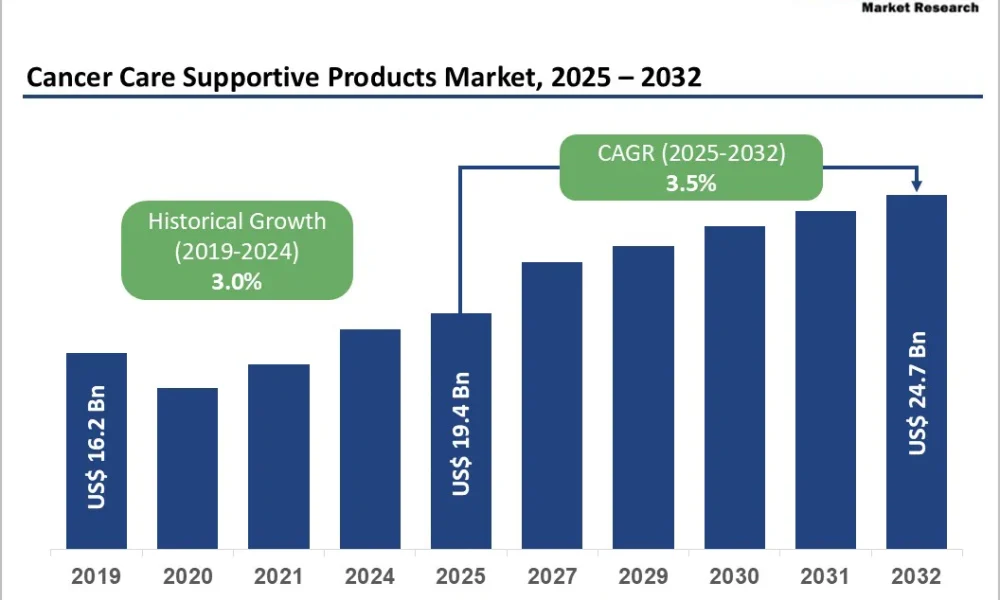
The global Cancer Care Supportive Products Market is experiencing steady expansion as cancer incidence rises worldwide and treatment regimens become more complex. Valued at US$ 19.4 billion in 2025, the market is projected to reach US$ 24.7 billion by 2032, registering a compound annual growth rate (CAGR) of 3.5% between 2025 and 2032. This growth reflects the critical role of supportive products in managing treatment-related complications, improving patient tolerance, and ensuring continuity of increasingly advanced oncology therapies. As cancer care shifts toward precision medicine, immuno-oncology, and targeted biologics, supportive care has evolved from an adjunct function to an essential pillar of comprehensive cancer management.
Cancer Care Supportive Products Market Share and Trends Analysis
Supportive care products are designed to prevent or manage side effects associated with cancer therapies, including chemotherapy-induced neutropenia, nausea and vomiting, pain, anemia, infections, and mucositis. The rising adoption of aggressive and long-duration treatment regimens has significantly increased reliance on these products. Pharmaceutical companies, healthcare providers, and oncology centers are expanding investments in supportive oncology to enhance patient quality of life and improve clinical outcomes. This trend is reinforced by growing awareness among clinicians and patients that effective supportive care can directly influence survival rates by enabling patients to complete prescribed treatment protocols without dose reductions or delays.
Download Your Free Sample & Explore Key Insights: https://www.persistencemarketresearch.com/samples/5336
Key Industry Highlights
North America leads the global market with a dominant share of 46.2%, supported by advanced oncology infrastructure, favorable reimbursement frameworks, and rapid uptake of innovative supportive care therapies. Asia Pacific represents the fastest-growing region, expected to expand at a CAGR of 4.4% during the forecast period, driven by rising cancer prevalence, improving healthcare access, and availability of cost-effective supportive products. Granulocyte colony-stimulating factor (G-CSF) remains the leading service category with a 25.5% market share due to its central role in preventing chemotherapy-induced neutropenia. Lung cancer dominates by indication with a 15.2% share, reflecting its high global incidence and intensive treatment-related toxicity. Hospital pharmacies account for 51.8% of distribution, benefiting from oncology-linked oversight and high utilization of injectable supportive therapies. Increasing adoption of biologics, harmonized regulatory frameworks, and expanding institutional investment further define the competitive and growth landscape.
Market Dynamics
Driver: Rising Cancer Burden and Advancing Therapies
The increasing global cancer burden is the primary driver of the cancer care supportive products market. According to projections from the World Health Organization, new cancer cases are expected to exceed 35 million annually by 2050, ensuring sustained long-term demand. Aging populations, improved diagnostic rates, and greater access to treatment in emerging economies are expanding the patient pool. At the same time, advances in oncology therapies, including targeted agents and immunotherapies, have extended survival but introduced new toxicity profiles that require specialized supportive management. Pediatric oncology represents a particularly critical unmet need, with survival disparities between high-income and low-income regions prompting access initiatives and global health programs. Precision oncology collaborations and investments in diagnostic technologies are also reinforcing the integration of supportive care into personalized treatment pathways.
Restraint: High R&D Costs and Biosimilar Competition
Despite favorable growth drivers, the market faces notable constraints. The entry of biosimilars across key oncology and supportive drug classes has intensified price competition, compressing margins for originator products. Simultaneously, research and development costs remain exceptionally high, with oncology products often requiring more than a decade of clinical validation and facing elevated late-stage failure risks. Regulatory complexity adds further pressure, as agencies impose stringent safety, manufacturing, and post-marketing surveillance requirements. These factors collectively slow innovation, deter smaller players, and challenge the commercial sustainability of novel supportive care solutions.
Opportunity: Expanding Access Programs and Precision Diagnostics
Significant growth opportunities are emerging from expanding access initiatives and advancements in precision diagnostics. Emerging economies with large populations and rising healthcare expenditure present substantial untapped potential for supportive care adoption. Regulatory approvals of chemotherapy-free and targeted regimens are increasing the need for adjunct supportive products tailored to new toxicity patterns. Early access programs, investigator-initiated trials, and global partnerships are improving availability of supportive therapies in underserved regions. As precision oncology becomes standard practice, supportive care products that align with biomarker-driven treatment strategies are expected to gain rapid traction.
Get Custom Insights Designed for Your Business: https://www.persistencemarketresearch.com/request-customization/5336
Category-wise Analysis
By Service: Granulocyte Colony Stimulating Factor
Granulocyte colony-stimulating factor is projected to maintain a 25.5% share of the market in 2025. Its widespread use in preventing neutropenia across multiple high-incidence cancers makes it a cornerstone of supportive care. However, the gradual shift toward immuno-oncology therapies that reduce reliance on myelosuppressive chemotherapy is moderating long-term growth, leading to a more balanced demand outlook.
By Indication: Lung Cancer
Lung cancer is expected to account for approximately 15.2% of the global market. High incidence rates, frequent late-stage diagnoses, and aggressive treatment regimens drive substantial demand for supportive products to manage hematologic, gastrointestinal, and respiratory toxicities. Improved survival outcomes further extend the duration of supportive care requirements.
By Distribution Channel: Hospital Pharmacies
Hospital pharmacies dominate distribution with a 51.8% share, reflecting their role in managing high-acuity oncology products. Their ability to ensure cold-chain integrity, clinical oversight, and coordination with oncology departments makes them the preferred channel for injectable biologics and regulated supportive therapies.
Regional Insights
North America
North America’s leadership is anchored in a high cancer burden, continuous therapeutic innovation, and strong reimbursement systems. Frequent regulatory approvals, breakthrough therapy designations, and expanding access to advanced oncology drugs sustain robust demand for supportive care products across both solid tumors and hematologic malignancies.
Europe
Europe holds a 24.3% share of the global market, supported by rising cancer prevalence and a strong emphasis on patient-centered care. Regional collaborations, advocacy initiatives, and consistent regulatory approvals across major markets continue to strengthen adoption of supportive therapies.
Asia Pacific
Asia Pacific is the fastest-growing region, driven by increasing cancer incidence, accelerating drug approvals, and expanding local R&D ecosystems. Japan, China, India, and Australia are key contributors, with rising breast, lung, and gynecological cancer burdens intensifying demand for supportive care solutions.
Checkout Now & Download Complete Market Report: https://www.persistencemarketresearch.com/checkout/5336
Market Segmentation
By Drug Class
- Granulocyte Colony Stimulating Factor
- Nonsteroidal Anti-inflammatory Drugs
- Monoclonal Antibodies
- Erythropoietin Stimulating Agents
- Opioid Analgesics
- Others
By Indication
- Lung Cancer
- Breast Cancer
- Prostate Cancer
- Leukaemia
- Ovarian Cancer
- Melanoma
- Others
By Distribution Channel
- Hospital Pharmacies
- Retail Pharmacies
- Compounding Pharmacies
By Region
- North America
- Europe
- East Asia
- South Asia & Oceania
- Latin America
- Middle East and Africa
Competitive Landscape
The competitive landscape is characterized by rapid innovation, strategic alliances, and global licensing agreements. Companies are expanding late-stage pipelines in targeted therapies, antibody-drug conjugates, and immuno-oncology while strengthening supportive care portfolios to complement advanced treatments. Frequent mergers, partnerships, and research collaborations are intensifying competition across major oncology indications.
Companies Covered
Key players in the Cancer Care Supportive Products Market include Amgen Inc., Johnson & Johnson, Novartis AG, Baxter, Fagron, Teva Pharmaceutical Industries Ltd., F. Hoffmann-La Roche Ltd., Daiichi Sankyo, GSK plc, Heron Therapeutics, Helsinn Healthcare, Bristol-Myers Squibb, Eli Lilly, Takeda Pharmaceutical Company, Sanofi, AbbVie, AstraZeneca, and others. Collectively, these companies continue to shape the market through innovation, global expansion, and a growing focus on holistic cancer care solutions that prioritize both survival and quality of life.




