
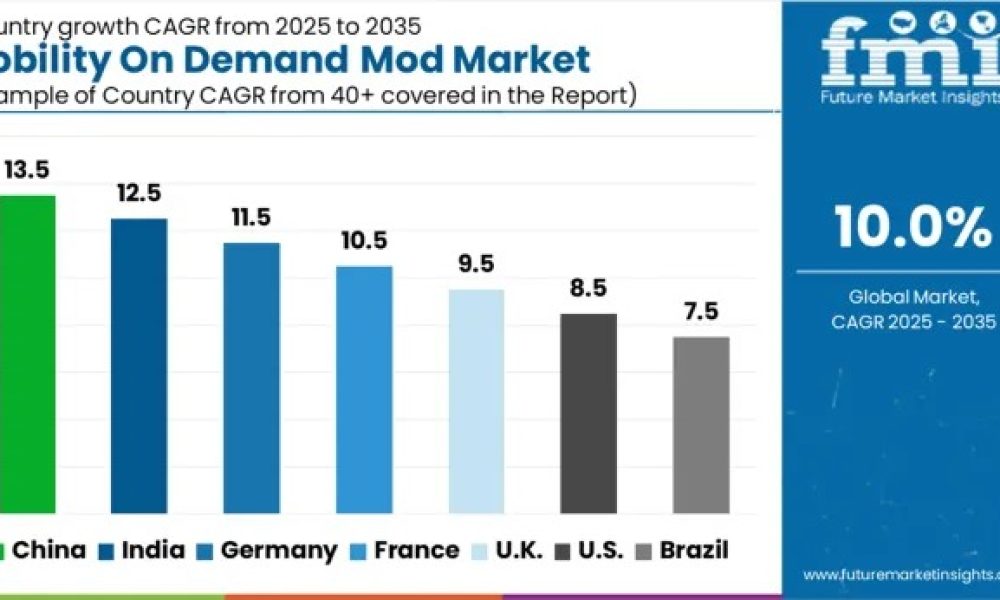
The global Mobility on Demand (MoD) market is undergoing a structural transformation as cities, corporations, and consumers increasingly prioritize flexible, technology-enabled transportation over traditional ownership models. Valued at USD 214.4 billion in 2025, the market is projected to more than double to USD 556.0 billion by 2035, expanding at a compound annual growth rate (CAGR) of 10.0% over the forecast period. This sustained growth trajectory underscores the rising strategic importance of on-demand mobility as a core pillar of modern transportation ecosystems.
Mobility on demand encompasses ride-hailing, car sharing, short-term rentals, and app-based transport services that leverage digital platforms to deliver scalable, demand-responsive mobility. Its rapid expansion reflects a fundamental shift in how mobility is consumed—away from fixed schedules and ownership toward access-based, data-driven, and user-centric solutions.
Market Expansion Anchored in Urbanization and Platform Economics
The growth curve of the MoD market highlights accelerating adoption among urban populations and enterprise users alike. The increase from USD 214.4 billion in 2025 to USD 313.8 billion by 2029 signals that operational efficiency, cost predictability, and convenience are increasingly valued across personal and business travel use cases. Service providers are investing heavily in fleet optimization, dynamic routing, and real-time pricing models, improving utilization rates while maintaining service quality.
Get access to comprehensive data tables and detailed market insights — request your sample report today!
https://www.futuremarketinsights.com/reports/sample/rep-gb-24907
By 2035, the market’s progression to USD 556.0 billion reflects the scaling of platform-based mobility models capable of handling multimodal transport, high-frequency usage, and geographically diverse demand. Operators that successfully balance supply density with user experience are emerging as long-term leaders, reinforcing MoD’s role as an indispensable component of urban and suburban mobility networks.
Ride Hailing Remains the Cornerstone of Market Revenue
By service type, ride hailing dominates the MoD market, accounting for 46.8% of total revenue in 2025. Its leadership is underpinned by widespread availability, flexible pricing structures, and seamless mobile application interfaces that cater to both short- and medium-distance travel. Ride-hailing platforms continue to strengthen their position through integration with digital payments, loyalty programs, and AI-driven demand forecasting.
Ongoing electrification initiatives, partnerships with corporate clients, and alignment with public transport systems are further reinforcing the segment’s resilience. As cities seek to reduce congestion and emissions, ride hailing is increasingly positioned as a complementary solution within broader mobility-as-a-service (MaaS) frameworks.
Private Applications Drive Consistent Usage and Revenue Stability
From an application perspective, private use leads with a 58.4% market share, reflecting strong demand for personalized, point-to-point mobility. Urban professionals, frequent commuters, and business travelers continue to favor MoD services for their reliability, privacy, and time efficiency. The segment benefits from enhanced vehicle standards, multiple service tiers, and predictive arrival times that reduce travel uncertainty.
Seasonal demand peaks in dense metropolitan areas, combined with limited parking availability and rising congestion, have further reinforced reliance on private MoD services. As disposable incomes rise in emerging economies and urban sprawl intensifies, private applications are expected to remain a dominant contributor to overall market value.
Digital Integration and Multimodal Connectivity Shape Market Evolution
The MoD market’s expansion is being reinforced by rapid advances in digital connectivity, mobile applications, and data analytics. Providers are integrating real-time tracking, AI-powered route optimization, and dynamic pricing to improve responsiveness and customer satisfaction. Increasingly, MoD services are being embedded into multimodal platforms that combine ride hailing, car sharing, public transit, and micromobility into unified user experiences.
This convergence supports higher asset utilization, improved first- and last-mile connectivity, and more efficient urban transport planning. Investment in operational infrastructure and platform reliability is becoming a defining factor in sustaining competitive advantage and scaling services across regions.
Asia-Pacific Leads Growth While Mature Markets Focus on Integration
Regionally, growth is strongest in Asia-Pacific, with China (13.5% CAGR) and India (12.5% CAGR) leading global expansion. Rapid urbanization, high smartphone penetration, and government-backed smart city initiatives are accelerating adoption of app-based mobility services. These markets benefit from digitally native consumers and large, dense urban populations that favor shared mobility solutions.
In contrast, Europe and North America are characterized by steady but strategic growth. Germany (11.5% CAGR), France (10.5%), the UK (9.5%), and the USA (8.5%) are focusing on regulatory alignment, connected mobility, and integration with existing transport infrastructure. In these regions, MoD growth is increasingly tied to sustainability goals, emission reduction targets, and intelligent transportation systems.
Drive Your Business Growth Strategy: Checkout the Report for Key Insights
https://www.futuremarketinsights.com/checkout/24907
Competitive Landscape Defined by Scale, Technology, and User Experience
The MoD market is shaped by a competitive landscape that rewards platform scalability, service reliability, and localized execution. Companies such as Uber Technologies, Lyft, Didi Chuxing, Grab, Turo, Drivy, and Hertz are differentiating through advanced app functionality, fleet availability, and regional customization.
Leading players are investing in AI-driven optimization, customer support infrastructure, and strategic partnerships with automotive OEMs, technology providers, and public authorities. Peer-to-peer rentals and subscription-based models are also gaining traction, expanding addressable markets beyond traditional ride hailing. As competition intensifies, the ability to deliver consistent user experiences while navigating regulatory complexity remains a critical success factor.
Outlook: Mobility on Demand as a Core Urban Infrastructure Layer
Looking ahead, the mobility on demand market is expected to remain on a stable, high-growth trajectory as cities adapt to rising mobility needs and consumers continue to prioritize flexibility over ownership. Opportunities linked to autonomous vehicles, electric fleets, and connected mobility platforms are set to further enhance operational efficiency and service differentiation.
With an absolute growth opportunity exceeding USD 340 billion between 2025 and 2035, the MoD market represents a structurally important segment within the global transportation landscape. As digital platforms, shared mobility, and multimodal integration converge, mobility on demand is transitioning from a disruptive alternative to a foundational element of future transportation systems, positioning the market for sustained long-term expansion.
Why Choose FMI: Empowering Decisions that Drive Real-World Outcomes: https://www.futuremarketinsights.com/why-fmi
About Future Market Insights (FMI)
Future Market Insights, Inc. (FMI) is an ESOMAR-certified, ISO 9001:2015 market research and consulting organization, trusted by Fortune 500 clients and global enterprises. With operations in the U.S., UK, India, and Dubai, FMI provides data-backed insights and strategic intelligence across 30+ industries and 1200 markets worldwide.



