
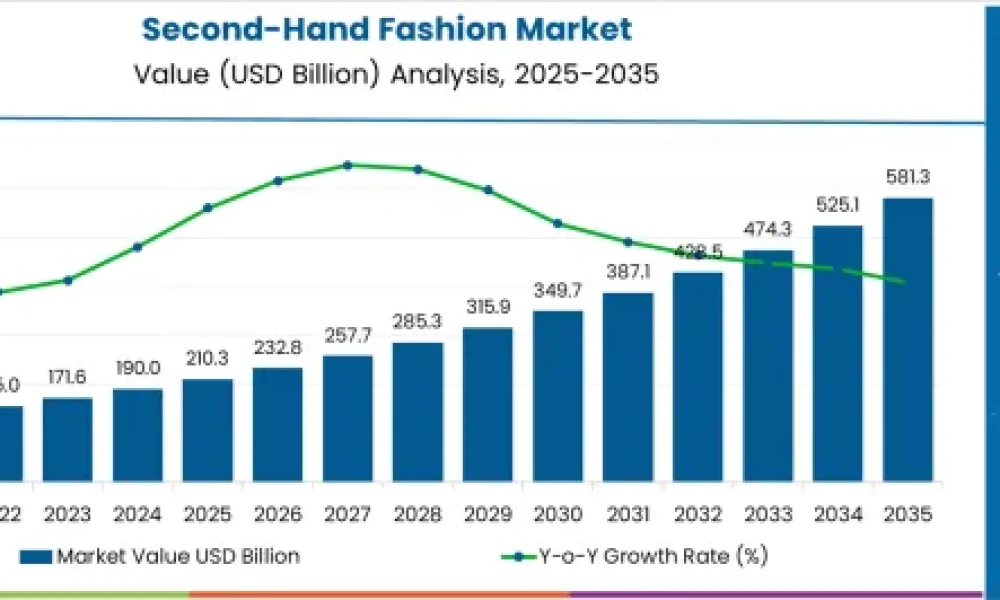
The global Second-Hand Fashion Market is estimated at USD 210.3 billion in 2025 and is projected to reach USD 581.3 billion by 2035, growing at a 10.7% CAGR from 2025–2035. This forecast covers major regions including Asia-Pacific, Europe, and North America, with Asia-Pacific identified as the highest-growth region. Growth is driven by increased environmental awareness, rising digital adoption, the proliferation of online resale platforms, and technology-enabled authentication and logistics improvements.
The second-hand fashion market is undergoing a significant transformation as sustainability and digital innovation reshape consumer behavior worldwide. Increasingly, shoppers are turning to pre-owned apparel for its affordability, uniqueness, and lower environmental impact, fueling rapid growth across key regions.
Access detailed data tables and actionable market insights — Request Your Sample Report Now
Market context and key findings — data-backed overview
The second-hand fashion sector is shifting from niche to mainstream as consumers prioritize circular consumption, affordability, and uniqueness. Key data points for editorial and analyst use:
- 2025 market value: USD 210.3 billion
- 2035 forecast: USD 581.3 billion
- Forecast CAGR (2025–2035): 10.7%
- Leading product segment (2025): Clothing — 51.7% of market revenue
- Price range leader (2025): Low price range — 42.9% of revenue
- Prominent consumer group (2025): Men — 38.6% of revenue
Regional outlook — where growth is occurring
Asia-Pacific: Poised to outpace other regions, powered by younger, tech-savvy demographics, mobile marketplaces, and rapid e-commerce penetration. China and India are highlighted growth engines with projected CAGRs of 14.4% and 13.4% respectively.
Europe: A mature but steady market driven by established resale infrastructure, regulatory support for circular fashion, and a culture of sustainable consumption. Growth is moderate relative to Asia-Pacific due to saturation in key Western European markets.
North America: Adoption is significant but comparatively slower, reflecting mature retail structures, competitive dynamics, and emphasis on operational efficiency and brand differentiation.
Drivers, restraints, and sector-level trends
Primary drivers
- Sustainability and environmental awareness: Consumers and brands are adopting resale as a circular economy strategy to reduce textile waste and carbon footprint.
- Digital resale platforms: Mobile apps and e-commerce marketplaces increase accessibility and transaction volume.
- Technology adoption: AI, image recognition, blockchain, and improved logistics enable authentication, reduce counterfeits, and streamline returns.
Constraints and challenges
- Quality and perception issues: Hygiene concerns, wear-and-tear, and inconsistent grading standards can hinder higher-price segment adoption.
- Logistics and returns costs: Reverse logistics and quality checks impact platform profitability.
- Price volatility: Limited-edition and premium items exhibit valuation fluctuations requiring robust authentication and pricing protocols.
Segment analysis — who buys what, and how they buy it
- Product type: Clothing dominates (51.7% in 2025), driven by high listing volume, trend turnover, and repeat purchase potential. Accessories form a complementary share.
- Price range: Low price range is the most active tier (42.9% in 2025), reflecting consumer demand for affordable alternatives to fast fashion.
- Consumer groups: Women remain important, but male participation (38.6% in 2025) is increasing due to curated offerings, streetwear demand, and utility trends.
- Channels: Online resale and curated marketplaces are primary growth channels; offline thrift stores and brick-and-mortar consignments continue to serve local markets.
Country highlights and growth drivers
Top country CAGRs referenced for strategy planning:
- China: 14.4% — driven by social commerce, mobile marketplaces, and younger demographics.
- India: 13.4% — supported by curated marketplaces and influencer-led demand.
- Germany: 12.3% — established thrift culture and government circular initiatives.
- UK: 10.2% — e-commerce resale and vintage adoption.
- USA: 9.1% — mature resale chains, authenticated vintage, and branded pre-owned demand.
Competitive landscape and sector implications
Major market participants include pure-play online platforms (eBay, Poshmark, ThredUp, The RealReal, StockX, Vinted), specialty marketplaces (Grailed, Vestiaire), and brick-and-mortar operators (Beyond Retro, Buffalo Exchange). Market winners will likely be those that:
- Integrate robust authentication and grading systems,
- Optimize reverse logistics and operational efficiency, and
- Tailor regional digital strategies to local consumer behavior, especially in Asia-Pacific.
Implications for investors and industry leaders
The market’s uneven regional development signals opportunity for targeted investment in digital platforms, localized supply chains, and authentication technologies. Stakeholders should prioritize regulatory compliance in Europe and operational scalability in North America, while pursuing accelerated market entry and consumer-engagement strategies in Asia-Pacific.
Have a specific Requirements and Need Assistant on Report Pricing or Limited Budget please contact us – [email protected]
About Future Market Insights (FMI)
Future Market Insights, Inc. (FMI) is an ESOMAR-certified, ISO 9001:2015 market research and consulting organization, trusted by Fortune 500 clients and global enterprises. With operations in the U.S., UK, India, and Dubai, FMI provides data-backed insights and strategic intelligence across 30+ industries and 1200 markets worldwide
Why Choose FMI: https://www.futuremarketinsights.com/why-fmi



