
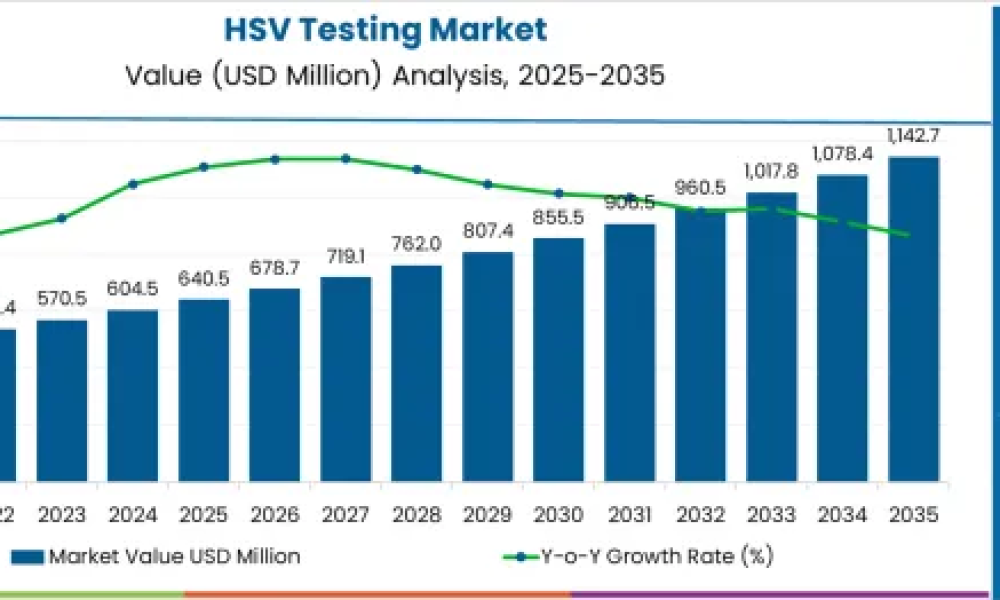
Future Market Insights (FMI), a leading provider of market intelligence and consulting services, today released its latest in-depth report on the global Herpes Simplex Virus (HSV) testing market is emerging as a cornerstone of public health strategy. According to the latest comprehensive analysis from Future Market Insights (FMI), the market is valued at USD 640.5 million in 2025 and is forecasted to expand at a compound annual growth rate (CAGR) of 6.0%, surging to USD 1,142.7 million by 2035. This growth trajectory underscores a pivotal shift toward early detection, innovative testing solutions, and integrated digital health ecosystems, empowering industry leaders to make informed decisions in a rapidly evolving sector.
The HSV testing market, encompassing diagnostics for HSV-1 and HSV-2, is driven by the escalating global prevalence of these infections, which affect millions worldwide. HSV-1, often associated with oral herpes, and HSV-2, linked to genital herpes, pose significant health risks, including complications during pregnancy and increased vulnerability to other STIs like HIV. As awareness intensifies, particularly among sexually active populations, the demand for accurate, accessible testing is skyrocketing. “The surge in HSV infections isn’t just a statistic—it’s a call to action for healthcare providers and policymakers,” notes an FMI analyst in the report. “Early detection through advanced testing not only mitigates transmission but also aligns with broader preventive healthcare goals, reducing long-term societal and economic burdens.”
Key growth drivers illuminate a market ripe for innovation. Public health initiatives and government programs are at the forefront, promoting routine STI screenings and offering subsidized or free testing to destigmatize the process. Technological breakthroughs, such as polymerase chain reaction (PCR) assays, serological tests, and point-of-care (POC) devices, are enhancing accuracy and speed, making diagnostics feasible in diverse settings—from bustling hospitals to remote telemedicine consultations. The integration of these tests with electronic health records and digital platforms further streamlines patient management, allowing for real-time monitoring and personalized care. Moreover, the rise of home-based testing kits is democratizing access, enabling individuals to take proactive steps in privacy and convenience.
Despite these positives, the market faces hurdles that savvy leaders must navigate. Reimbursement challenges in certain regions limit widespread adoption, while lingering social stigma around HSV can deter testing uptake. Competition from alternative diagnostic methods also pressures providers to differentiate through superior sensitivity and user-friendliness. However, these restraints present strategic opportunities. For instance, expanding POC platforms in underserved areas could bridge infrastructure gaps, while advancements in molecular diagnostics like isothermal amplification and next-generation sequencing promise deeper viral insights and improved outcomes.
Market segmentation reveals nuanced opportunities for targeted investments. By type, combined HSV-1/HSV-2 tests dominate with a 48.9% share in 2025, favored for their efficiency in delivering comprehensive results in a single procedure. Serological tests lead the test type category at 49.8%, excelling in detecting antibodies and uncovering asymptomatic infections through immunoassay innovations. Blood samples hold the largest share at 62.4%, owing to standardized collection and reliability for both serological and molecular analyses. End-user wise, hospitals command 34.1% of the market, serving as hubs for emergency and specialized care in fields like obstetrics and infectious diseases. Clinics, diagnostic labs, and the burgeoning home care segment are also gaining traction, reflecting a shift toward decentralized healthcare.
Regionally, the market’s dynamism varies, offering decision-makers a roadmap for geographic expansion. Asia Pacific stands out as a high-growth hub, with China projecting an 8.0% CAGR and India at 7.5%, fueled by infrastructure development and rising infectious disease management focus. North America and Europe remain mature powerhouses; the U.S. anticipates a 5.1% CAGR, bolstered by robust awareness campaigns, while Europe sees strong performances in Germany (6.9%), France (6.3%), and the UK (5.7%). These regions benefit from advanced healthcare systems, evidence-based services, and investments in Eastern Europe and Nordic countries. Latin America and the Middle East & Africa, though smaller, hold potential through emerging healthcare networks.
The competitive landscape is concentrated yet vibrant, with 8-12 major players capturing 60-65% of the market. Abbott leads with a 22% share, pioneering molecular platforms and rapid kits tailored for clinical and POC environments. Other frontrunners include F. Hoffmann-La Roche Ltd., Thermo Fisher Scientific Inc., BD, and Bio-Rad Laboratories, Inc., renowned for PCR and ELISA advancements. bioMérieux SA, DiaSorin S.p.A., Hologic, Inc., Cepheid, and QuidelOrtho Corporation round out the elite, emphasizing automated systems and user-centric designs. Competition hinges on regulatory compliance, workflow integration, and evidence-based validation, with top firms leveraging global distribution to maintain edge.
Subscribe for Year-Round Insights → Stay ahead with quarterly and annual data updates: https://www.futuremarketinsights.com/reports/brochure/rep-gb-26195
Request for Discount: https://www.futuremarketinsights.com/reports/sample/rep-gb-26195
Recent developments signal a forward momentum that’s decision-grade for stakeholders. Innovations in multiplex assays and automated systems are accelerating lab efficiency, while government-led awareness drives are normalizing screenings. The push toward digital health integration, including telemedicine for remote diagnostics, is particularly transformative, especially in emerging markets like China and India. “As we look to 2035, the HSV testing market isn’t just growing—it’s evolving into a proactive shield against STIs,” the FMI report emphasizes. “Industry leaders who invest in rapid, accessible solutions will not only capture market share but also contribute to global health equity.”
This narrative positions the HSV testing market as a beacon of opportunity in preventive medicine. For healthcare executives, investors, and policymakers, the insights highlight strategic imperatives: prioritize R&D in POC and home testing, advocate for policy reforms to enhance reimbursement, and expand into high-CAGR regions. By harnessing these trends, stakeholders can drive sustainable growth while advancing public health outcomes.
About Future Market Insights (FMI)
Future Market Insights, Inc. (FMI) is an ESOMAR-certified, ISO 9001:2015 market research and consulting organization, trusted by Fortune 500 clients and global enterprises. With operations in the U.S., UK, India, and Dubai, FMI provides data-backed insights and strategic intelligence across 30+ industries and 1200 markets worldwide.
Why FMI: Decisions that Change Outcomes- https://www.futuremarketinsights.com/why-fmi
Contact Us:
Future Market Insights Inc.
Christiana Corporate, 200 Continental Drive,
Suite 401, Newark, Delaware – 19713, USA
T: +1-347-918-3531
Website: https://www.futuremarketinsights.com
LinkedIn| Twitter| Blogs | YouTube
Have a specific Requirements and Need Assistant on Report Pricing or Limited Budget please contact us – sales@futuremarketinsights.com



