
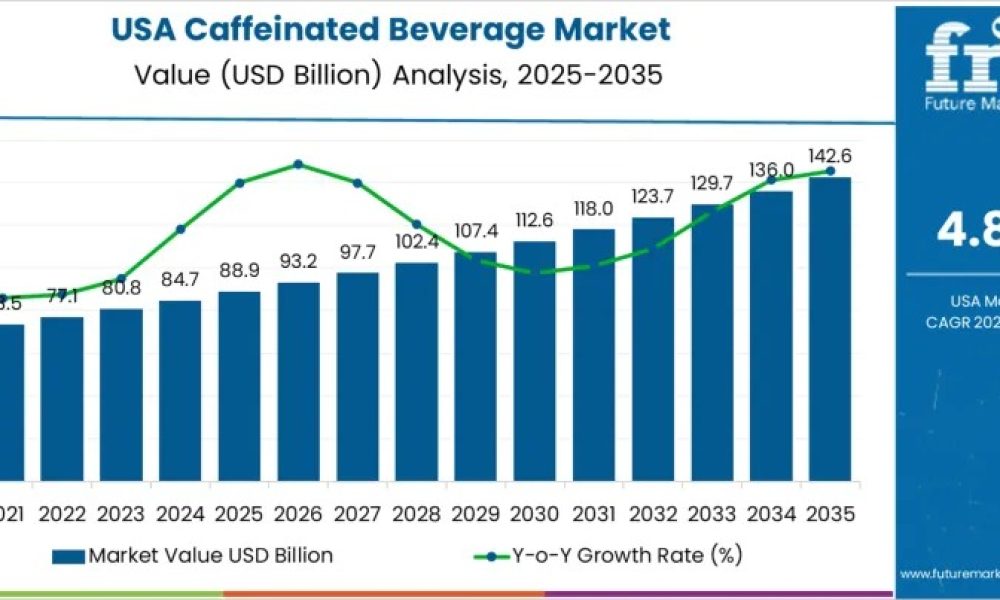
The USA caffeinated beverage market is set for steady long-term expansion, with total demand valued at USD 88.9 billion in 2025 and forecast to reach USD 142.6 billion by 2035, reflecting a 4.8% CAGR. Growth is being shaped by consumer reliance on convenient energy solutions, established daily consumption habits, and strong retail and foodservice penetration. Caffeinated drinks remain embedded in lifestyle routines tied to commuting, hybrid work models, and on-the-go consumption.
Caffeine-based formulations continue to serve functional roles in alertness, productivity, and refreshment across diverse age groups. Carbonated beverages, energy blends, and coffee-derived drinks collectively anchor both volume and revenue performance, while innovation in portion formats and ready-to-drink (RTD) offerings enhances accessibility.
Explore trends before investing – request a sample report today!
Carbonated soft drinks hold the largest share of demand, supported by strong brand portfolios, habitual purchasing behavior, and widespread availability across grocery, quick-service restaurants, and vending channels. Energy beverages and RTD coffees contribute incremental gains, driven by positioning around focus, stamina, and performance support. Reformulation priorities now emphasize sugar reduction, calorie balancing, and removal of artificial ingredients to maintain consumer alignment with wellness expectations.
Growth patterns show faster expansion in the early part of the forecast period due to premium cold brew, plant-based caffeine sources, and functional blends containing vitamins and electrolytes. Later years are expected to reflect more measured gains as moderation trends and dietary awareness influence purchasing, shifting innovation toward natural caffeine and clean-label positioning.
Market Snapshot
- 2025 Market Value: USD 88.9 billion
- 2035 Forecast Value: USD 142.6 billion
- CAGR (2025–2035): 4.8%
- Leading Category: Carbonated Soft Drinks
- High-Growth Regions: West, South, Northeast USA
Demand drivers include rising consumption of RTD beverages, strong coffee culture, and growing interest in hybrid functional drinks. Portable formats suit office, commuting, and fitness routines, while flavor diversification sustains repeat purchases. Retailers prioritize chilled displays and impulse-oriented placements in high-traffic zones, reinforcing purchase frequency.
Constraints stem from consumer caution around excessive caffeine and sugar intake. Some buyers are moderating usage for sleep quality and overall wellness. Competition from non-caffeinated hydration beverages and plant-based wellness drinks is also reshaping category dynamics, prompting reformulation and product diversification.
Segment Performance Highlights
- By Product Type: Carbonated soft drinks account for 42.7%, followed by coffee (27.0%), RTD tea (12.0%), energy drinks (8.3%), and other caffeinated beverages (10.0%).
- By Flavor Profile: Synthetic flavors represent 69.3% due to scalability and consistency, while natural flavors (30.7%) are expanding with clean-label demand.
- By Sales Channel: Grocery stores lead with 40.2%, ahead of specialty stores (22.0%), other retail outlets (19.0%), modern trade (13.2%), and convenience stores (5.6%).
Regional performance varies by lifestyle and channel infrastructure. The West USA leads with 5.6% CAGR, driven by premium coffee culture and functional beverage innovation. The South USA follows at 5.0%, supported by warm-weather demand and strong energy drink consumption. The Northeast USA grows at 4.5%, influenced by urban convenience and specialty café networks, while the Midwest USA records 3.9%, reflecting stable household purchasing and value-oriented multipack sales.
Supply chain strategies focus on cold-chain efficiency, frequent restocking, and SKU optimization across single-serve and multipack formats. Category management emphasizes flavor rotation and premium-tier differentiation to maintain shelf visibility and consumer interest.
Get the full scoop—view the complete report!
Competitive Landscape
Leading participants maintain strong distribution and brand equity in high-velocity retail locations:
- Dr Pepper Snapple Group
- Monster Energy Company
- Nestlé
- PepsiCo
- Red Bull
These companies invest in functional variants, packaging optimization, and tailored SKUs suited to both impulse and household consumption. Innovation momentum centers on natural caffeine sources, shelf-stable cold coffee, and reduced-sugar energy beverages aligned with evolving dietary expectations.
Overall, the U.S. caffeinated beverage sector demonstrates resilient, routine-driven demand supported by functional appeal and convenience-focused consumption patterns. While health moderation influences late-period growth, product reformulation and premium innovation are expected to sustain stable expansion through 2035.
About Future Market Insights (FMI)
Future Market Insights, Inc. (FMI) is an ESOMAR-certified, ISO 9001:2015 market research and consulting organization, trusted by Fortune 500 clients and global enterprises. With operations in the U.S., UK, India, and Dubai, FMI provides data-backed insights and strategic intelligence across 30+ industries and 1200 markets worldwide.



