
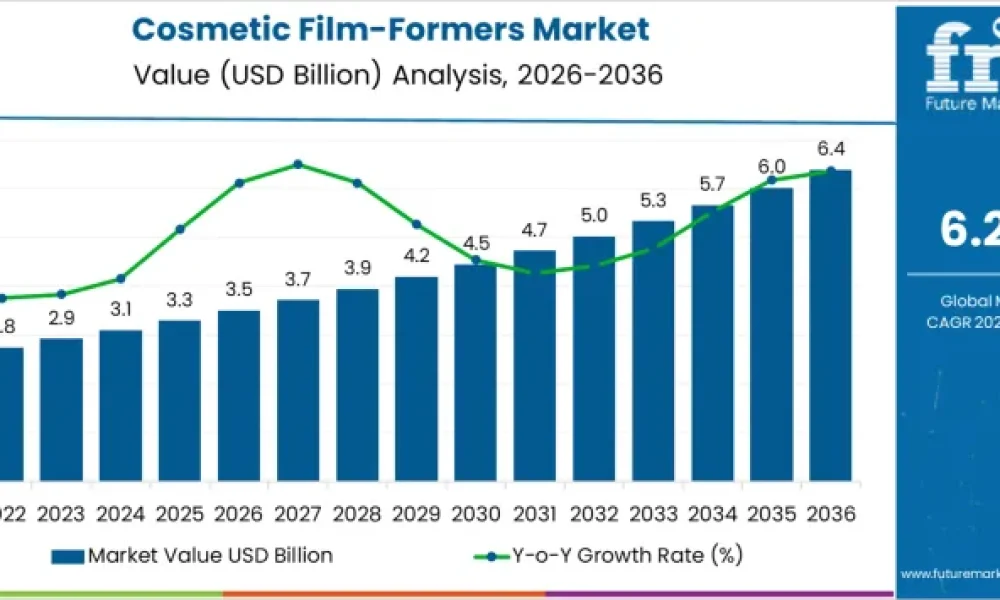
The global cosmetic film-formers market is projected to expand robustly from an estimated USD 3.5 billion in 2026 to approximately USD 6.4 billion by 2036, representing a compound annual growth rate (CAGR) of about 6.2 % over the next decade—underscoring steady adoption of advanced film-forming agents across cosmetics and personal care formulations. This sustained growth reflects rising consumer demand for long-lasting, performance-driven beauty products, the rapid evolution of multifunctional formulations, and increasing demand for eco-friendly and skin-safe ingredients in makeup, skincare, hair care, and sun care applications.
Emerging trends in natural and bio-based film-forming polymers, coupled with strong industry focus on ingredient transparency, are further strengthening the market’s value proposition. As beauty brands innovate to meet expectations for durability, texture enhancement, and sustainability, film-formers are becoming integral to both premium and mass-market cosmetic products worldwide.
Key Market Insights at a Glance
In 2026, the cosmetic film-formers market is valued at approximately USD 3.5 billion, with forecasts indicating a rise to around USD 6.4 billion by 2036, driven by consistent consumer interest in products offering extended wear, robust performance, and multifunctional benefits. The projected CAGR of 6.2 % evidences healthy expansion as cosmetic brands integrate advanced film-forming technologies to address market demand for long-lasting formulations that enhance product efficacy and user experience. Among segment leaders, aqueous dispersions/latexes are expected to hold the largest share with about 46 % of the market, owing to their broad utility in color cosmetics and skin-friendly formulation profiles.
Segment Overview
The market is broadly segmented by form and application. In terms of form, aqueous dispersions/latexes dominate due to their ease of formulation, consumer preference for water-based systems, and regulatory favorability related to lower volatile organic compounds (VOCs). Solvent-based solutions, powders/granules, and hybrid systems such as water-in-silicone constitute additional sub-segments with specialized uses. On the application side, color cosmetics—including lip, face, and eye products—lead demand as film-formers improve longevity, transfer resistance, and finish quality in makeup formulations. Other notable applications include sun care and long-wear SPF products, hair styling agents, and skin primers and finishes.
Regional Overview
Geographically, the market exhibits diverse growth dynamics. China is anticipated to be a high-growth region with robust adoption rates and a strong beauty and personal care ecosystem, projecting the highest CAGR among key markets. The United States follows with stable demand for performance-oriented cosmetics, while Europe (including the UK and Germany) demonstrates consistent expansion linked to sustainability-focused consumers and strict regulatory frameworks emphasizing ingredient safety and eco-friendly formulations. Japan also shows steady growth supported by innovation in high-performance cosmetic products tailored to local beauty trends.
To access the complete data tables and in-depth insights — Request Your Sample Report Now
Competitive Landscape
The competitive environment is characterized by a mix of global chemical and ingredient specialists driving innovation in film-forming technologies. Major players shaping the market include Dow, BASF, Ashland, Lubrizol, Eastman, Wacker Chemie, Evonik, Clariant, Shin-Etsu Chemical, and Momentive. These firms are investing in research-driven product portfolios that balance performance with sustainability, aiming to meet evolving consumer expectations for clean, biodegradable, and multifunctional cosmetic ingredients. Performance, regulatory compliance, formulation versatility, and sustainability credentials are key differentiators in this competitive landscape.
Recent Strategic Developments
Industry activity in recent years has centered on strategic partnerships, expansions of specialty film-former portfolios, and sustainability-oriented R&D initiatives. The drive toward natural and bio-sourced film-forming polymers reflects broader market shifts favoring clean-beauty claims and reduced environmental impact. Formulators are also leveraging advanced analytics and high-throughput screening to tailor film-forming systems for targeted performance outcomes, such as enhanced breathability, adhesion, and sensory feel across product formats. These developments support immediate market needs while positioning players to capture long-term growth opportunities.
Market Outlook: Powering the Next Decade
Looking ahead to the next decade, the cosmetic film-formers market is positioned for sustained momentum, bolstered by ongoing innovation in multifunctional and sustainable ingredients. As consumer preferences evolve and demand for high-performance cosmetics continues to rise, film-formers will remain a critical category within the beauty and personal care industry. Companies that successfully integrate sustainability with performance and regulatory compliance will be best placed to lead this expanding market.
Key Players of Sustainable Label Industry
Industry leaders including Dow, BASF, Evonik, and Clariant are at the forefront of sustainable film-former development, increasingly prioritizing bio-based and biodegradable technologies to align with consumer demand for green products. Their strategic focus on sustainability enhances market appeal and fosters long-term competitive advantage in the global cosmetics ingredient landscape.
Have a specific Requirements and Need Assistant on Report Pricing or Limited Budget please contact us – [email protected]
About Future Market Insights (FMI)
Future Market Insights, Inc. (FMI) is an ESOMAR-certified, ISO 9001:2015 market research and consulting organization, trusted by Fortune 500 clients and global enterprises. With operations in the U.S., UK, India, and Dubai, FMI provides data-backed insights and strategic intelligence across 30+ industries and 1200 markets worldwide.
Why Choose FMI: https://www.futuremarketinsights.com/why-fmi



