
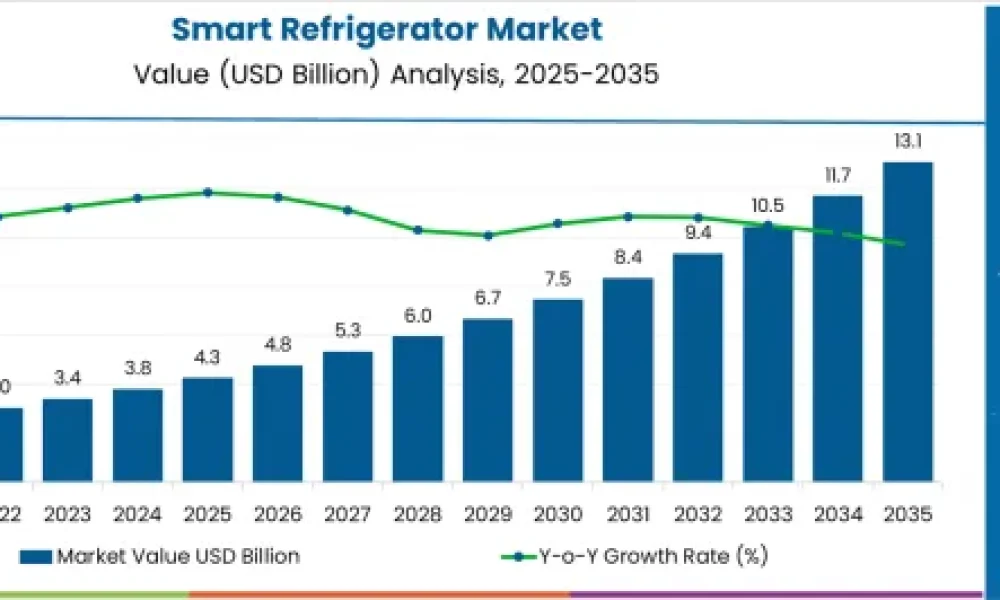
The global smart refrigerator market is entering a decade of sustained expansion, with market value projected to increase from USD 4.3 billion in 2025 to USD 13.1 billion by 2035, according to the latest industry analysis. This growth represents a compound annual growth rate (CAGR) of 11.9% over the forecast period, reflecting the steady transition of smart refrigerators from niche products for early adopters to mainstream household and commercial appliances.
The market’s growth trajectory follows a classic S-curve adoption pattern. Between 2025 and 2027, revenues are expected to rise from USD 4.3 billion to USD 5.3 billion, supported by early adopters seeking connected appliances with energy efficiency, intelligent food management, and smart home compatibility. During this phase, manufacturers are focused on refining IoT integration, improving user interfaces, and addressing interoperability within broader smart home ecosystems.
From 2028 to 2032, the market is forecast to accelerate from USD 6.0 billion to USD 9.4 billion as adoption expands into the early majority segment. Declining costs of sensors, connectivity modules, and displays, combined with rising consumer awareness, are expected to improve accessibility across mid-range product categories. By 2033 to 2035, the market is projected to reach USD 13.1 billion, signaling entry into the late majority phase, where smart refrigerator functionality becomes a standard expectation rather than a premium feature.
Access detailed data tables and actionable market insights — Request Your Sample Report Now
Market Context: Technology Convergence Reshapes Refrigeration
Smart refrigerators are increasingly positioned as multifunctional kitchen hubs rather than standalone cooling appliances. IoT-enabled connectivity, AI-based food management systems, predictive maintenance alerts, and real-time energy monitoring are reshaping how consumers and businesses manage food storage. Integration with voice assistants, mobile applications, and cloud platforms is enabling remote monitoring, inventory tracking, and automated alerts, aligning refrigerators with broader smart home and smart kitchen environments.
Sustainability considerations are also influencing demand. Energy-efficient cooling systems, adaptive compressors, and intelligent defrosting technologies are helping reduce electricity consumption and food waste. Government regulations and incentive programs promoting energy-efficient appliances are further accelerating adoption across developed and emerging markets.
Supply Chain and Operational Implications
The evolution of smart refrigerators is introducing new complexities across appliance supply chains. Manufacturers now balance traditional sourcing of compressors, insulation materials, and metal components with procurement of specialized sensors, touchscreen displays, and IoT modules. These electronic components often involve longer lead times and faster obsolescence cycles, creating inventory management challenges distinct from conventional refrigeration production.
Operationally, installation and service ecosystems are adapting to higher technical requirements. Retail installers and field technicians increasingly require training in network configuration, software setup, and connectivity troubleshooting, alongside traditional refrigeration skills. Customer service teams are also managing more complex support cases that span mechanical, software, and home network issues, necessitating closer coordination between appliance service and IT-oriented support functions.
Segment Insights: Product, Type, and Capacity Trends
- By product category, double-door smart refrigerators are expected to account for 38.6% of global revenue in 2025, making them the leading segment. Their appeal lies in balanced storage design, improved organization, and reduced energy loss through separated compartments. Manufacturers are embedding features such as humidity control, adaptive defrosting, and smart diagnostics into these models, reinforcing their position among mid- to large-sized households.
- Freestanding smart refrigerators are projected to represent 53.4% of total market revenue in 2025. Their dominance reflects ease of installation, flexible placement, and lower upfront costs compared to built-in alternatives. Compatibility with modular kitchens and standardized dimensions continues to support adoption among first-time buyers and retrofit consumers.
- In terms of capacity, medium-sized models ranging from 20 to 29 cubic feet are forecast to capture 46.8% of revenue in 2025. This segment aligns with average household needs and has become the primary focus for manufacturers integrating AI-driven freshness management, inventory tracking, and energy usage reporting.
Regional Growth Patterns and Country-Level Outlook
Asia-Pacific is emerging as the fastest-growing region, led by China with a projected CAGR of 16.1% from 2025 to 2035. Large-scale urbanization, smart home adoption, and government support for energy-efficient appliances are driving demand. India follows with a CAGR of 14.9%, supported by rising disposable incomes, expanding e-commerce channels, and growing awareness of connected home technologies.
In Europe, Germany is forecast to grow at 13.7%, benefiting from strong regulatory support for energy efficiency and consumer preference for premium, connected appliances. The United Kingdom is expected to expand at 11.3%, driven by smart home integration and sustainability-focused purchasing behavior. The United States, with a projected CAGR of 10.1%, continues to see steady demand from tech-savvy households and commercial users.
Competitive Landscape and Industry Direction
The competitive landscape is shaped by established appliance manufacturers and technology-driven innovators. Companies including Samsung Electronics, LG Electronics, Whirlpool Corporation, Haier Smart Home, Bosch Home Appliances, Panasonic, Hisense, Electrolux, GE Appliances, Siemens Home Appliances, and Miele are advancing smart refrigerator portfolios with features centered on connectivity, energy optimization, and intelligent food management.
As the market matures, competitive differentiation is expected to focus on software reliability, ecosystem integration, cybersecurity, and total cost of ownership. While challenges related to pricing, data privacy, and system complexity remain, ongoing improvements in affordability, interoperability, and security are positioning smart refrigerators as a core component of modern residential and commercial kitchens worldwide.
Have a specific Requirements and Need Assistant on Report Pricing or Limited Budget please contact us – [email protected]
About Future Market Insights (FMI)
Future Market Insights, Inc. (FMI) is an ESOMAR-certified, ISO 9001:2015 market research and consulting organization, trusted by Fortune 500 clients and global enterprises. With operations in the U.S., UK, India, and Dubai, FMI provides data-backed insights and strategic intelligence across 30+ industries and 1200 markets worldwide
Why Choose FMI: https://www.futuremarketinsights.com/why-fmi



