
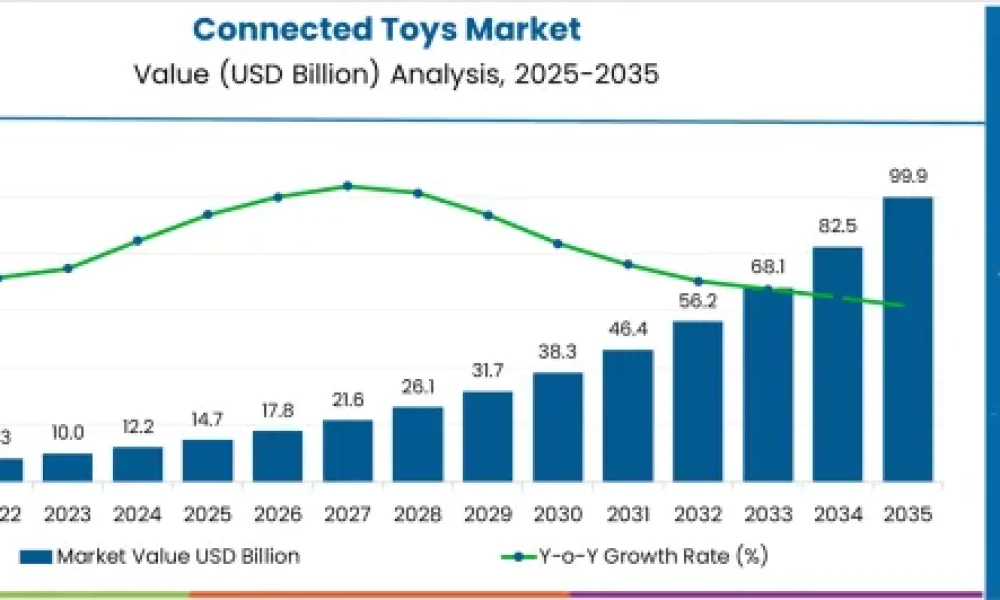
The global connected toys market is undergoing a structural shift as digital connectivity, artificial intelligence, and interactive learning reshape children’s play experiences worldwide. Valued at USD 14.7 billion in 2025, the market is projected to expand to USD 99.9 billion by 2035, advancing at a compound annual growth rate (CAGR) of 21.1% over the forecast period. Growth is being driven by rising demand for educational, interactive, and technology-enabled toys that integrate seamlessly with digital ecosystems at home and in classrooms.
Access detailed data tables and actionable market insights — Request Your Sample Report Now
Market Outlook: Where Growth Is Coming From and Why It Matters
The connected toys market is expected to generate USD 50.1 billion in total incremental value between 2025 and 2035. Nearly 47.3% of this growth—USD 23.6 billion—will occur in the first five years, reflecting strong early adoption of smart toys that combine physical play with digital engagement. The second half of the forecast period (2030–2035) is projected to contribute USD 26.7 billion, signaling sustained momentum as connected play becomes mainstream across global markets.
Annual market additions are forecast to rise from USD 3.5 billion in the early years to USD 6.3 billion by 2035, underpinned by advancements in voice recognition, augmented reality (AR), robotics, and machine learning. Manufacturers that integrate next-generation connectivity with enhanced safety and data protection features are expected to capture the largest share of this expanding opportunity.
Why the Connected Toys Market Is Expanding
Market growth is closely tied to the convergence of interactive hardware and digital content ecosystems. Parents and educators are increasingly prioritizing toys that support STEM learning, cognitive development, and experiential education, while maintaining engagement through play. Connected toys now commonly offer real-time feedback, adaptive learning modules, and interactive storytelling—features that align with evolving expectations for educational entertainment.
The widespread adoption of smartphones, tablets, and home automation systems has further accelerated market expansion. These devices enable toys to connect with apps, voice assistants, and cloud-based platforms, extending functionality without requiring dedicated infrastructure. At the same time, improvements in wireless communication protocols, low-power connectivity, and data security frameworks have strengthened consumer confidence in smart toys, particularly in home and classroom settings.
Segment Insights: Age, Devices, and Technology
- By age group, children aged 6 to 8 years represent the largest revenue segment, accounting for 5% of global market share in 2025. This demographic aligns with a critical developmental phase in which toys increasingly support structured learning, language development, and problem-solving skills. Products targeting this age group often emphasize screen-free engagement, gamified learning, and safety controls, reinforcing their appeal to parents and educators.
- From an interfacing perspective, smartphones dominate the market, holding an estimated 4% revenue share in 2025. Their ubiquity allows for cost-effective integration, content management, and real-time interaction through secure applications. Subscription-based educational platforms and personalized content delivery have further solidified smartphones as the primary bridge between children and connected toy experiences.
- By technology, Bluetooth connectivity leads adoption with a projected 7% market share in 2025. Bluetooth-enabled toys benefit from low power consumption, reliable short-range communication, and offline functionality—attributes that address both usability and privacy concerns. The use of Bluetooth Low Energy (BLE) has also extended battery life and enabled continuous engagement without frequent charging.
Regional Performance and Country-Level Growth
Regionally, North America, Asia-Pacific, and Europe remain the core growth markets. Among individual countries, China leads with a projected 28.5% CAGR, supported by rapid urbanization, rising disposable incomes, and strong demand for interactive and educational toys. India follows with a 26.4% CAGR, driven by a growing middle class, expanding e-commerce infrastructure, and rising smartphone penetration.
In Europe, France is forecast to grow at 22.2%, reflecting sustained demand for digital learning tools and smart play experiences. The United Kingdom is projected to expand at 20.0%, while the United States, a more mature market, is expected to grow at 17.9%, supported by continued interest in STEM education, mobile gaming, and high-quality tech-driven toys.
Competitive Landscape and Industry Direction
The market is led by established toy manufacturers including Lego Group, Mattel Inc., Hasbro Inc., and Fisher-Price Inc., alongside technology-focused players such as VTech, LeapFrog, and Sphero. Competitive differentiation increasingly centers on AI-powered personalization, voice interaction, IoT integration, and enhanced child safety features. As regulatory scrutiny around data privacy intensifies, compliance with standards such as GDPR is becoming a defining factor in product design and market positioning.
Looking Ahead
As connected toys continue to evolve from novelty products to essential learning and engagement tools, the market’s trajectory reflects broader shifts in digital education, smart home adoption, and interactive entertainment. With sustained innovation and regulatory alignment, connected toys are expected to play a central role in shaping the future of play and learning worldwide.
Have a specific Requirements and Need Assistant on Report Pricing or Limited Budget please contact us – [email protected]
About Future Market Insights (FMI)
Future Market Insights, Inc. (FMI) is an ESOMAR-certified, ISO 9001:2015 market research and consulting organization, trusted by Fortune 500 clients and global enterprises. With operations in the U.S., UK, India, and Dubai, FMI provides data-backed insights and strategic intelligence across 30+ industries and 1200 markets worldwide
Why Choose FMI: https://www.futuremarketinsights.com/why-fmi



