
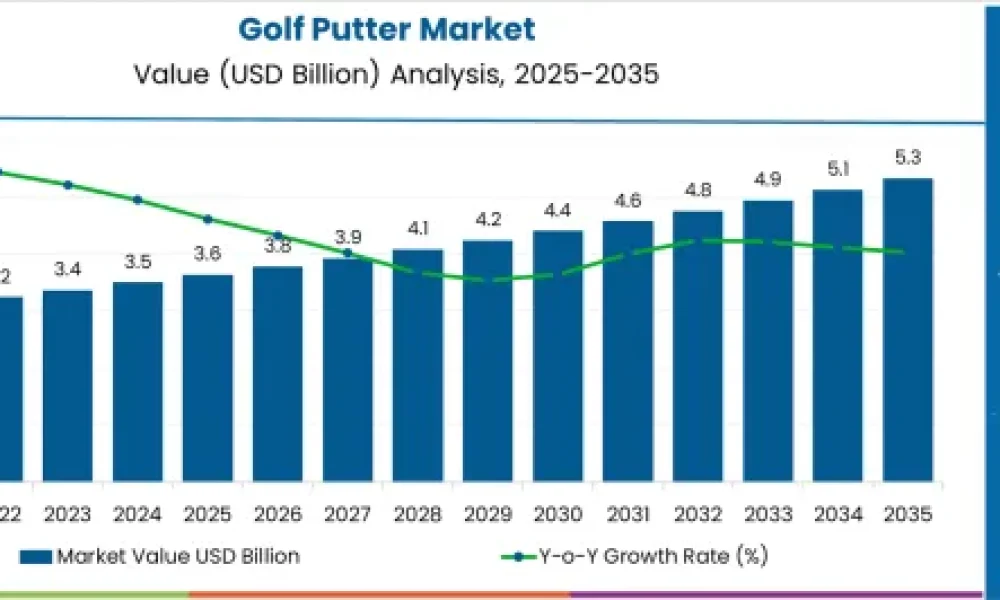
The global golf putter market is projected to grow from USD 3.6 billion in 2025 to USD 5.3 billion by 2035, expanding at a compound annual growth rate (CAGR) of 3.9%, according to the latest industry analysis. The forecast reflects a mature, widely penetrated market characterized by steady replacement cycles, incremental technology upgrades, and gradual expansion in emerging golf regions rather than disruptive innovation.
The market’s growth trajectory highlights its position in the late majority stage of adoption, particularly in established regions such as North America and Europe, where awareness and trial rates are already high. Growth in these markets is largely sustained by product replacement, brand loyalty, and modest performance enhancements. Meanwhile, Asia-Pacific and Latin America are contributing incremental gains as golf participation, infrastructure development, and consumer accessibility continue to expand.
Access detailed data tables and actionable market insights — Request Your Sample Report Now
Market Context: Stability in a Mature Golf Equipment Segment
Golf putters are among the most essential and frequently replaced clubs in a golfer’s bag, given their direct influence on scoring performance. Early adoption—once driven by professional golfers and high-end enthusiasts—has transitioned into broad-based usage across recreational and amateur segments. As a result, market expansion is now shaped by ergonomic refinements, material upgrades, and personalized fitting, rather than rapid shifts in design philosophy.
Manufacturers continue to focus on face-milling accuracy, weight distribution, alignment aids, and grip ergonomics, reinforcing incremental performance improvements. This approach supports consistent demand while limiting volatility, positioning the golf putter market as a stable and steadily evolving segment within the broader golf equipment industry.
Operational and Manufacturing Considerations Shape Market Dynamics
- Beyond consumer demand, operational realities across retail, manufacturing, and golf course management influence market performance. Custom fitting operations in pro shops require specialized workflows, as putter fitting involves stroke analysis, alignment verification, and grip customization that differ significantly from standard club fitting. These processes must be coordinated around peak playing times and facility availability, adding complexity to retail operations.
- On the manufacturing side, quality assurance protocols play a critical role. Production lines incorporate testing for face milling precision, alignment accuracy, and weight balance, alongside standard assembly checks. These validation steps often require skilled technicians and specialized equipment, affecting production scheduling during periods of high demand.
- Golf course operators also factor into the ecosystem. Practice putting greens experience higher traffic than course greens and require distinct maintenance schedules to ensure surface consistency. Grounds crews and operations managers coordinate maintenance practices that support accurate putter testing and a reliable player experience across skill levels.
Key Segments: Face-Balanced, Mallet, and Traditional Length Putters Lead
- By product type, face-balanced putters are expected to account for 4% of global revenue in 2025, reflecting strong preference among golfers with straight-back, straight-through strokes. Their neutral torque alignment and forgiveness on off-center hits continue to support widespread adoption among both amateurs and professionals.
- By design, mallet putters are projected to represent 1% of market revenue, driven by higher moment of inertia, enhanced stability, and visual alignment aids. These features appeal to golfers seeking consistency and confidence at address, contributing to strong adoption across skill levels.
- In terms of length, traditional putters (32–36 inches) are anticipated to hold 9% of revenue share in 2025. This configuration remains the standard across coaching practices and retail offerings, supporting natural posture, eye alignment, and pendulum-style strokes for a wide range of players.
Regional Outlook: Emerging Markets Add Incremental Growth
While North America remains the largest market by value, growth rates are higher in select emerging economies. China leads with a projected CAGR of 5.3%, supported by rising recreational participation, domestic manufacturing, and growing interest in professional tournaments. India follows at 4.9%, driven by expanding golf facilities and increasing leisure sports participation.
In Europe, Germany (4.5%), France (4.1%), and the United Kingdom (3.7%) benefit from established sporting goods industries, quality-focused manufacturing, and steady growth in recreational golf. The United States, growing at 3.3%, continues to see stable demand supported by high participation rates and ongoing product innovation.
Competitive Landscape: Precision, Craftsmanship, and Customization
The competitive environment is defined by a mix of global leaders and specialist manufacturers. Companies such as Acushnet Holdings Corp., TaylorMade Golf Company, and Topgolf Callaway Brands Corp. maintain strong market positions through precision engineering, material innovation, and broad distribution. Other established players, including Mizuno, Cleveland Golf, Bridgestone Sports, Cobra Golf, Honma, and Bettinardi, emphasize craftsmanship, balance optimization, and tailored performance.
Collectively, manufacturers are advancing the market through player-centric design, incremental technology upgrades, and precision manufacturing, ensuring continued relevance in a mature but resilient global golf equipment market.
Have a specific Requirements and Need Assistant on Report Pricing or Limited Budget please contact us – [email protected]
About Future Market Insights (FMI)
Future Market Insights, Inc. (FMI) is an ESOMAR-certified, ISO 9001:2015 market research and consulting organization, trusted by Fortune 500 clients and global enterprises. With operations in the U.S., UK, India, and Dubai, FMI provides data-backed insights and strategic intelligence across 30+ industries and 1200 markets worldwide
Why Choose FMI: https://www.futuremarketinsights.com/why-fmi



