
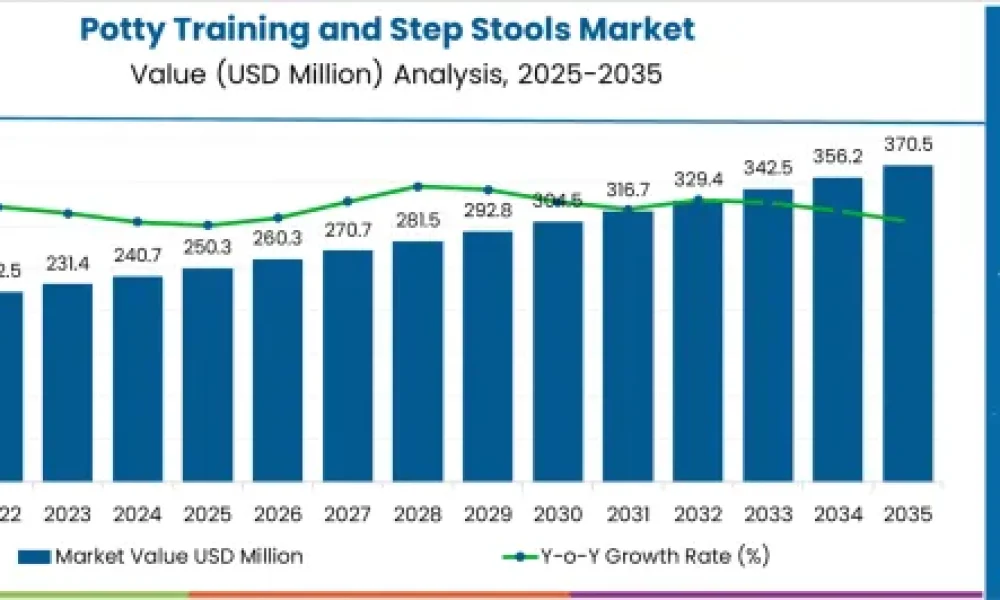
The global Potty Training and Step Stools Market is expected to record steady and reliable growth over the next decade, driven by rising awareness of early childhood development, increasing urbanization, and demand for safe, ergonomic child care products. According to the latest market assessment, the market is valued at USD 250.3 million in 2025 and is forecast to reach USD 370.5 million by 2035, expanding at a compound annual growth rate (CAGR) of 4.0% during the forecast period.
The market outlook reflects consistent year-on-year expansion, with revenues increasing from USD 260.3 million in 2026 to USD 281.5 million by 2028. Growth momentum strengthens in 2029 as the market reaches USD 292.8 million, followed by a gradual rise to USD 342.5 million in 2033. By 2035, the market is projected to close at USD 370.5 million, highlighting stable consumer demand across both developed and emerging economies.
Gain access to detailed segment-wise analysis and forecast statistics – Request the Sample Report Today
Market Context: Supporting Early Childhood Independence
Potty training products and step stools play a critical role in helping young children transition from diapers to independent toilet use while safely accessing sinks and counters. The market’s growth is closely linked to changing family structures, particularly the rise of dual-income households and urban living, which has increased demand for compact, hygienic, and easy-to-use child care solutions.
Parents are placing greater emphasis on products that support independence, safety, and comfort during early developmental stages. This has led manufacturers to focus on ergonomically designed products with features such as non-slip bases, adjustable seating, easy-to-clean surfaces, and child-friendly aesthetics. Regulatory attention on non-toxic materials and safety standards is further reinforcing market credibility and long-term adoption.
Key Market Highlights and Segmentation Insights
In 2025, potty training products account for 60.2% of total market revenue, making them the leading product type. Early-age toilet training, particularly in urban households, has driven strong demand for structured and mess-free solutions. Compact designs, portability, and features such as splash guards and soft-grip handles have contributed to widespread adoption across homes, daycare centers, and travel settings.
By material, plastic-based products dominate with a 51.7% revenue share in 2025. Lightweight construction, durability, cost efficiency, and ease of cleaning have made plastic the preferred material for child-focused designs. Advances in molding technology have enabled safer edges, brighter colors, and BPA-free, recyclable variants that align with safety and sustainability expectations.
From a pricing perspective, the medium-priced segment (USD 15–30) leads the market, capturing 48.2% of revenue in 2025. Consumers in this category seek a balance between affordability and quality, favoring products that offer adjustable height, padded seating, and durable construction without premium pricing. Strong retailer support and bundling strategies have further strengthened this segment’s position.
Regional Outlook: Asia-Pacific Leads Growth
Regionally, North America, Europe, and Asia-Pacific remain the key growth markets. Asia-Pacific shows the strongest expansion, led by China and India. China records the highest country-level CAGR at 5.4%, supported by urbanization, rising disposable incomes, and evolving parenting practices. India follows closely with a 5.0% CAGR, driven by an expanding middle class, growing awareness of child development, and increased access to products through e-commerce platforms.
In Europe, France is projected to grow at 4.2% CAGR, reflecting strong demand for practical, ergonomic, and high-quality child products. The UK market is expected to expand at 3.8%, supported by rising focus on hygiene and child safety, while the United States records a 3.4% CAGR, driven by steady demand for durable, well-designed potty training solutions and strong online retail penetration.
Competitive Landscape and Industry Direction
The market features a competitive landscape with established brands including Baby Bjorn, Munchkin, Tomy International, OXO, Mattel, Kids2, Skip Hop, Ubbi, BÉABA, Kolcraft, Regalo Baby, Prince Lionheart, and Dream Baby. These companies focus on product safety, ergonomic design, and innovation to maintain consumer trust and market share.
Looking ahead, demand for multi-functional and ergonomically designed products is expected to shape the industry’s direction. Products that combine potty training and step stool functionality, offer adjustable features, and support long-term use are gaining traction. As online retail continues to expand and parents increasingly rely on reviews and safety certifications, manufacturers are expected to prioritize quality, compliance, and user-centric design.
Overall, the Potty Training and Step Stools Market is positioned for sustained growth through 2035, supported by demographic trends, product innovation, and the ongoing emphasis on early childhood development and independence.
Have a specific Requirements and Need Assistant on Report Pricing or Limited Budget please contact us – [email protected]
About Future Market Insights (FMI)
Future Market Insights, Inc. (FMI) is an ESOMAR-certified, ISO 9001:2015 market research and consulting organization, trusted by Fortune 500 clients and global enterprises. With operations in the U.S., UK, India, and Dubai, FMI provides data-backed insights and strategic intelligence across 30+ industries and 1200 markets worldwide
Why Choose FMI: https://www.futuremarketinsights.com/why-fmi



