
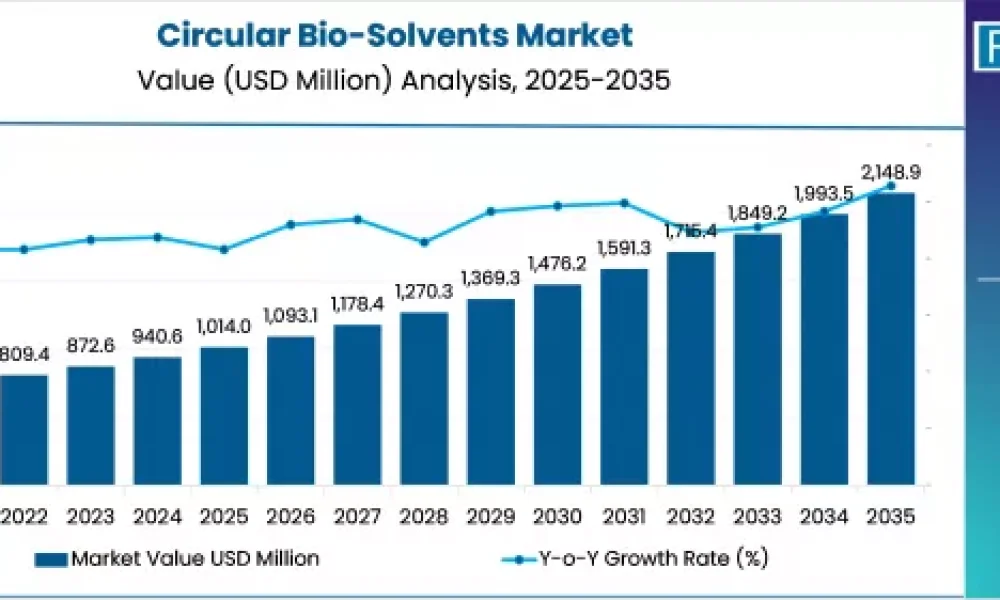
As the global chemical industry enters a pivotal fiscal year, the transition from fossil-derived chemicals to Circular Bio-Solvents has moved from a sustainability goal to a primary industrial standard. Driven by stringent Volatile Organic Compound (VOC) regulations and the maturation of “”Safe and Sustainable by Design”” (SSbD) frameworks, the circular bio-solvent sector is projected to reach a market valuation of $2.35 billion by the end of 2026, growing at a compound annual growth rate (CAGR) of 11.5%.
This shift is spearheaded by a coalition of European and North American manufacturing leaders who are integrating renewable feedstock—ranging from agricultural waste to forestry by-products—into high-performance solvent toolkits. The move addresses a critical gap in the supply chain, providing non-toxic, biodegradable alternatives to traditional polar aprotic and halogenated solvents like dichloromethane (DCM).
Request for Sample Report | Customize Report |purchase Full Report – https://www.factmr.com/connectus/sample?flag=S&rep_id=10839
Answering the Industrial “”Why””: Decarbonization and Performance
The “”who”” of this movement encompasses major chemical conglomerates, such as those participating in the Circular Bio-based Europe Joint Undertaking (CBE JU), and specialized innovators like Circa Group. The “”what”” is the deployment of a new generation of solvents—such as levoglucosenone-derived Cyrene™—that maintain industrial efficiency while reducing carbon footprints by up to 80%.
This transition is happening now, as 2026 marks the enforcement of new environmental benchmarks across the EU and North America. The “”where”” is global, though the Asia-Pacific region is emerging as a production powerhouse, expected to account for 35.3% of market share by the decade’s end.
The “”how”” involves advanced “”circular chemistry,”” where waste streams are upcycled into functional inputs. By utilizing fermentation and enzymatic processes at ambient temperatures, manufacturers are successfully lowering input expenses by 30% to 50% while meeting ESG (Environmental, Social, and Governance) compliance.
Strategic Market Context: The $2.35 Billion Milestone
Industry analysts highlight that the 2026 growth is not merely a result of corporate goodwill but a strategic response to market volatility. Circular bio-solvents provide a hedge against the price fluctuations of crude oil, offering long-term price stability for manufacturers in the paints, coatings, and pharmaceutical sectors.
“”The integration of circular economy principles into solvent production is no longer a niche endeavor,”” says an industry lead at the CBE JU. “”In 2026, we are seeing the results of ‘lab to fab’ scaling, where bio-based additives are unlocking recyclability across the entire value chain.””
Key Industry Drivers and Technical Innovations
To maintain editorial credibility and search visibility, it is essential to note the specific technological levers driving this 2026 surge:
- VOC Compliance: New federal and state-level VOC limits are forcing a move away from traditional petrochemicals in precision cleaning and aerospace degreasing.
- Safe and Sustainable by Design (SSbD): This framework ensures that bio-solvents are not only renewable but also non-carcinogenic and non-corrosive, protecting worker health.
- Valorization of Waste: Using “”Circular Bio-Solvents”” allows companies to turn industrial by-products—such as lignin from the paper industry or winery waste—into high-value platform molecules.
2026 Outlook: Toward a Sustainable Chemical Toolkit
As 2026 progresses, the industry expects to see a surge in “”product-as-a-service”” models, where companies lease solvent cleaning functions rather than purchasing raw chemicals. This ensures that spent solvents are recovered, distilled, and reintroduced into the production cycle, embodying the “”circular”” prefix of the sector.
For investors and market professionals, the data is clear: the green chemistry chemicals market is on track to exceed $224 billion by 2030. The success of circular bio-solvents in 2026 serves as a bellwether for the broader biomanufacturing revolution.
About the Circular Bio-Solvents Movement
The Circular Bio-Solvents movement represents a global collaborative effort between academia, industry, and regulatory bodies to replace hazardous petrochemicals with high-performance, renewable alternatives. By focusing on resource efficiency and non-toxic chemistry, the sector aims to secure a sustainable future for global manufacturing.
Related Reports
Circular Plastic Packaging Ecosystem Market
“



