
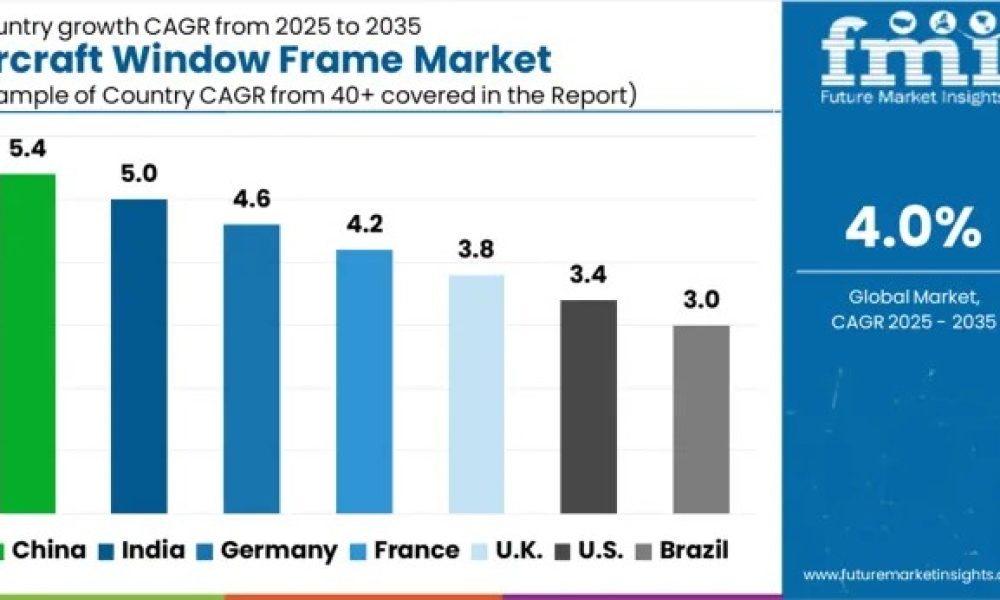
The global aircraft window frame market is positioned for sustained growth over the next decade, supported by rising commercial aircraft deliveries, modernization of aging fleets, and increasing emphasis on lightweight, high-strength cabin structures. Valued at USD 177.7 million in 2025, the market is projected to reach USD 263.0 million by 2035, expanding at a compound annual growth rate (CAGR) of 4.0% during the forecast period.
Aircraft window frames play a critical structural and functional role, ensuring fuselage integrity, maintaining cabin pressurization, and contributing to passenger comfort and safety. As airlines and manufacturers prioritize fuel efficiency, lifecycle durability, and improved cabin environments, window frames are evolving from conventional aluminum components toward advanced composite and hybrid material solutions.
Consistent Growth Trajectory Backed by Fleet Expansion and Retrofits
Year-on-year analysis indicates a stable upward trajectory for the aircraft window frame market, punctuated by periods of accelerated adoption linked to regulatory updates and material innovation. From 2025 to 2027, market value is expected to rise from USD 177.7 million to USD 192.1 million, supported by early adoption of corrosion-resistant and lightweight composite frames. During this phase, OEM-led initiatives and retrofit programs gain momentum as operators seek to extend aircraft life while improving fuel efficiency and cabin durability.
Between 2028 and 2031, revenues are projected to grow from USD 199.8 million to USD 224.8 million, reflecting broader fleet modernization programs and rising production of both narrow-body and wide-body aircraft. Growth during this period is reinforced by stronger demand from commercial airlines and business aviation, where cabin upgrades and structural optimization are becoming standard practice.
From 2032 to 2035, the market is forecast to strengthen further, reaching USD 263.0 million. Adoption expands through new aircraft programs, accelerated replacement cycles, and heightened focus on energy-efficient, high-strength materials that align with long-term sustainability and operational efficiency goals.
Get access to comprehensive data tables and detailed market insights — request your sample report today!
https://www.futuremarketinsights.com/reports/sample/rep-gb-25446
Commercial Aircraft and Cabin Applications Drive Demand
By aircraft type, commercial aviation represents the leading segment, accounting for 43.7% of total market demand in 2025. The dominance of this segment reflects the expanding global fleet of narrow-body and wide-body jets, particularly in Asia-Pacific and North America. Window frames used in commercial aircraft must endure repeated pressurization cycles, UV exposure, and structural stress, driving demand for high-performance, certified solutions.
From a product perspective, cabin window frames constitute the largest share, with 59.4% of market demand in 2025. These components are central to passenger safety, comfort, and cabin aesthetics. Innovations in material science—such as hybrid composite-metal assemblies—are enabling manufacturers to balance weight reduction with structural strength, while supporting trends such as larger windows, enhanced insulation, and personalized cabin lighting.
Market Structure Anchored in Aircraft Manufacturing and Safety
The aircraft window frame market is shaped by several interconnected parent industries. Commercial aircraft manufacturing contributes approximately 40% of overall demand, reflecting the importance of window frames in large-scale aircraft production. The defense and military aviation segment accounts for around 25%, relying on specialized frames designed to withstand extreme operational conditions.
The business and general aviation market represents 15%, driven by demand for customized, aesthetically refined window solutions. The aerospace components and materials sector contributes 12%, supplying advanced alloys and composites, while the maintenance, repair, and overhaul (MRO) market accounts for 8%, supporting ongoing inspection and replacement needs. Together, aircraft manufacturing and operational safety requirements underpin nearly 80% of total market demand, highlighting the sector’s structurally essential nature.
Regional Outlook: Asia-Pacific Leads Growth Momentum
Regionally, Asia-Pacific is emerging as the fastest-growing market, led by China, which is projected to expand at a 5.4% CAGR through 2035. Rapid airline fleet expansion, domestic aircraft programs, and retrofit initiatives are driving demand for lightweight aluminum and composite window frames. India follows closely with 5.0% CAGR, supported by rising domestic air travel, new aircraft deliveries, and expanding MRO capacity.
In Europe, Germany is forecast to grow at 4.6% CAGR, benefiting from its strong aerospace manufacturing base and focus on advanced materials. France and the UK show steady growth at 4.2% and 3.8%, respectively, driven by fleet modernization and passenger comfort upgrades. The United States, expanding at 3.4% CAGR, remains a key market supported by retrofit activity, MRO demand, and continued investment in material innovation.
Technology Trends and Market Dynamics
Key growth drivers include rising passenger expectations for comfort and visibility, stricter safety and certification standards, and the industry-wide push for lightweight structures to reduce fuel consumption. At the same time, manufacturers face challenges related to high production costs, complex certification processes, and precision manufacturing requirements.
Opportunities are expanding in advanced composites, titanium alloys, and modular frame designs that enable faster installation and maintenance while improving durability. Trends indicate increasing adoption of enhanced sealing technologies, noise-reduction features, and thermally efficient designs that support both passenger experience and operational efficiency.
Drive Your Business Growth Strategy: Checkout the Report for Key Insights
https://www.futuremarketinsights.com/checkout/25446
Competitive Landscape Focused on Performance and Compliance
Competition in the aircraft window frame market is shaped by material expertise, manufacturing precision, and regulatory compliance. Leading participants such as PPG Industries Inc., SIFCO Industries, LMI Aerospace, Nordam Group, ACE Advanced Composite Engineering GmbH, and GKN Aerospace are strengthening their positions through investment in advanced materials, automated production systems, and close collaboration with aircraft OEMs.
Suppliers that can deliver certified, lightweight, and corrosion-resistant window frame solutions—while supporting long-term fleet reliability—are expected to capture the greatest value as aircraft production and retrofit programs continue worldwide.
Outlook Through 2035
As global aviation demand recovers and expands, the aircraft window frame market is set to benefit from a steady pipeline of new aircraft deliveries, replacement cycles, and cabin upgrade initiatives. The convergence of lightweight materials, safety compliance, and passenger comfort priorities positions window frames as a critical, value-enhancing component within modern aircraft design.
Why Choose FMI: Empowering Decisions that Drive Real-World Outcomes: https://www.futuremarketinsights.com/why-fmi
About Future Market Insights (FMI)
Future Market Insights, Inc. (FMI) is an ESOMAR-certified, ISO 9001:2015 market research and consulting organization, trusted by Fortune 500 clients and global enterprises. With operations in the U.S., UK, India, and Dubai, FMI provides data-backed insights and strategic intelligence across 30+ industries and 1200 markets worldwide.



