
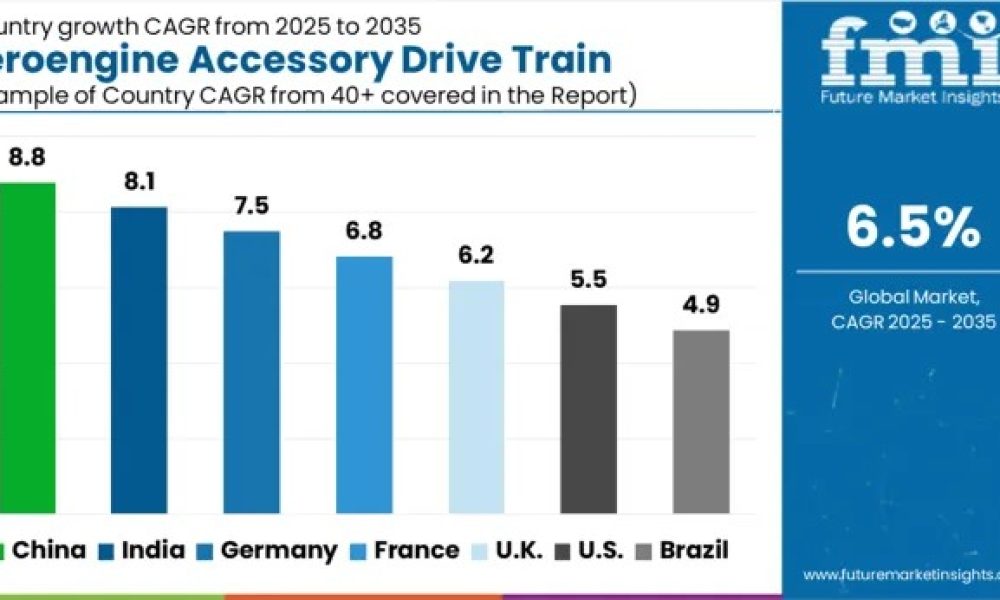
The global aeroengine accessory drive train market is positioned for sustained expansion, projected to grow from USD 1.2 billion in 2025 to USD 2.2 billion by 2035, registering a compound annual growth rate (CAGR) of 6.5%. Market momentum is anchored in rising aircraft production rates, fleet modernization initiatives, and the aviation industry’s increasing focus on fuel efficiency, reliability, and system integration across commercial and military platforms.
Accessory drive trains play a critical role in transferring mechanical power from the engine to essential subsystems such as fuel pumps, generators, lubrication units, and hydraulic systems. As engine architectures evolve toward higher power density and more-electric configurations, demand for advanced, lightweight, and digitally enabled drive train solutions continues to accelerate.
Steady Market Expansion Supported by OEM Adoption
Between 2025 and 2027, the market expands from USD 1.2 billion to USD 1.4 billion, reflecting early-stage adoption of high-performance and lightweight drive train systems in next-generation aeroengines. Leading OEMs, including Safran, Honeywell, Rolls-Royce, and GE Aviation, are integrating advanced accessory systems to improve efficiency, reliability, and compliance with increasingly stringent emission regulations.
Get access to comprehensive data tables and detailed market insights — request your sample report today!
https://www.futuremarketinsights.com/reports/sample/rep-gb-25443
Key factors driving early growth include:
- Integration of lightweight materials to reduce overall engine mass
- Improved gearbox efficiency to support higher accessory loads
- Alignment with evolving regulatory and environmental standards
Fleet Modernization Accelerates Revenue Contribution (2028–2031)
From 2028 to 2031, market revenues rise from USD 1.5 billion to USD 1.8 billion, with volume expansion contributing more significantly than price increases. This phase reflects increased deployment across new aircraft programs and retrofitting of existing fleets with modular and digitally monitored accessory systems.
Growth during this period is supported by:
- Increased adoption of modular accessory drive architectures
- Integration with engine control and health-monitoring systems
- Expansion of commercial aviation fleets and defense aircraft programs
Market Strengthens with Advanced Integration (2032–2035)
By 2035, the market reaches USD 2.2 billion, driven by advanced gear technologies, enhanced thermal management, and predictive maintenance capabilities. OEMs and MRO providers increasingly prioritize lifecycle durability and reduced maintenance downtime, positioning accessory drive trains as strategic components in long-term engine performance optimization.
Quick Market Highlights
- Market Value (2025): USD 1.2 billion
- Forecast Value (2035): USD 2.2 billion
- Forecast CAGR (2025–2035): 6.5%
- Leading Component Segment (2025): Gearboxes (35.4%)
- Key Growth Regions: North America, Asia-Pacific, Europe
Commercial Aviation Dominates Demand Landscape
Commercial aircraft engines account for 35% of total market demand, making them the largest contributing parent market. High passenger traffic growth, strong aircraft order backlogs, and airline fleet renewal programs continue to support demand for reliable and efficient accessory drive systems.
Additional demand contributions include:
- Defense and military aircraft engines: 25%
- Helicopter and rotorcraft engines: 15%
- Aerospace components and engine systems: 15%
- Maintenance, repair, and overhaul (MRO): 10%
Collectively, commercial aviation, defense, and rotorcraft applications represent 75% of total market demand, reinforcing aircraft engine platforms as the primary growth drivers.
Gearboxes Lead Component Adoption
Gearboxes are projected to command 35.4% market share in 2025, driven by their essential role in torque conversion and power distribution to engine accessories. Recent advancements in high-speed gearing materials, vibration damping, and thermal coatings have significantly improved efficiency and operational lifespan.
Key gearbox trends include:
- Higher power-density designs for more-electric aircraft
- Enhanced durability for high-temperature engine environments
- Compact configurations supporting next-generation turbofan engines
Drive Your Business Growth Strategy: Checkout the Report for Key Insights
https://www.futuremarketinsights.com/checkout/25443
Asia-Pacific Emerges as High-Growth Region
China and India are among the fastest-growing national markets, recording CAGRs of 8.8% and 8.1%, respectively. Growth is fueled by civil aviation expansion, defense modernization programs, and increased domestic manufacturing capabilities supported by OEM partnerships and MRO investments.
Competitive Landscape Focused on Precision and Reliability
Market competition is defined by engineering precision, certification expertise, and system integration capabilities. Leading players such as Safran Aircraft Engines, Collins Aerospace, GE Aviation, Honeywell Aerospace, Pratt & Whitney, and Rolls-Royce plc are strengthening their positions through modular designs, predictive maintenance integration, and long-term lifecycle service offerings.
As aircraft engines evolve toward higher efficiency and digital connectivity, suppliers delivering certified, lightweight, and digitally monitored accessory drive train solutions are expected to capture significant OEM and aftermarket opportunities.
Why Choose FMI: Empowering Decisions that Drive Real-World Outcomes: https://www.futuremarketinsights.com/why-fmi
About Future Market Insights (FMI)
Future Market Insights, Inc. (FMI) is an ESOMAR-certified, ISO 9001:2015 market research and consulting organization, trusted by Fortune 500 clients and global enterprises. With operations in the U.S., UK, India, and Dubai, FMI provides data-backed insights and strategic intelligence across 30+ industries and 1200 markets worldwide.



