
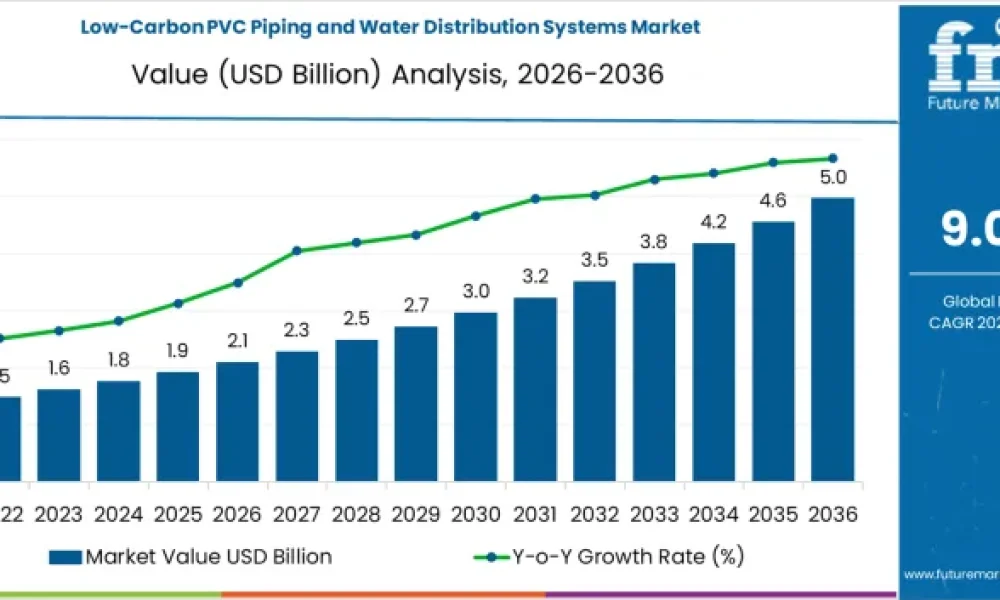
Global demand for low-carbon PVC piping and water distribution systems is entering a high-growth phase, with the market projected to expand from USD 2.1 billion in 2026 to nearly USD 5.0 billion by 2036, registering a compound annual growth rate of approximately 9% over the forecast period. This growth is being driven by large-scale investments in water infrastructure renewal, rising regulatory pressure to reduce embodied carbon in construction materials, and increasing adoption of sustainable piping solutions across municipal, industrial, and agricultural water distribution networks.
Low-carbon PVC piping systems are gaining strong preference due to their extended service life, corrosion resistance, lower lifecycle emissions, and cost efficiency compared to conventional materials. Governments and utilities worldwide are prioritizing these systems as part of long-term climate resilience strategies, positioning low-carbon PVC as a cornerstone material for future-ready water infrastructure.
Key Market Insights at a Glance
Market expansion is supported by accelerating urbanization, infrastructure modernization programs, and sustainability-focused procurement policies. Public water authorities are increasingly shifting toward low-carbon materials to meet emission targets without compromising durability or performance. Advancements in production efficiency and recycled content integration are further strengthening the economic case for adoption.
Segment Overview
Municipal water distribution remains the dominant application segment, accounting for the largest share of total market revenue as cities upgrade aging pipelines and expand water access. Infrastructure and public works projects also represent a significant demand driver, particularly in regions investing heavily in climate-resilient utilities. Across applications, low-carbon PVC solutions are favored for their reliability, ease of installation, and reduced maintenance requirements.
Product segmentation includes bio-attributed and certified PVC, recycled-content PVC, energy-optimized low-carbon PVC, and standard PVC enhanced with eco-additives. These variants allow end users to balance sustainability goals with performance and cost considerations.
To access the complete data tables and in-depth insights — Request Your Sample Report Now
Regional Overview
North America, Europe, and Asia Pacific collectively lead the global market, supported by strong regulatory frameworks and infrastructure spending. The United States continues to see rising adoption due to climate-aligned infrastructure funding and water system rehabilitation initiatives. Europe remains a sustainability innovation hub, while Asia Pacific is emerging as the fastest-growing region, fueled by rapid urban expansion, industrial development, and smart city investments in countries such as China and India.
Competitive Landscape
The competitive environment is shaped by established global manufacturers and regional specialists focusing on sustainable product innovation. Key players active in the market include Aliaxis Group, Georg Fischer AG, Saint-Gobain PAM, Westlake Chemical Corporation, INEOS Group Ltd., Sekisui Chemical Co., Ltd., JM Eagle, China Lesso Group, VinylPlus, and Aalberts Integrated Piping Systems. These companies are differentiating through low-carbon manufacturing processes, recycled material integration, and compliance with evolving environmental standards.
Market Outlook: Powering the Next Decade
Over the next decade, the low-carbon PVC piping market is expected to benefit from continued policy support, growing awareness of lifecycle carbon impacts, and rising investment in sustainable water systems. Ongoing research and development efforts are anticipated to further enhance material performance while reducing production emissions, enabling broader adoption across both developed and emerging markets.
Key Players of Sustainable Label Industry
Industry leaders are increasingly aligning their portfolios with sustainability certifications, circular economy principles, and transparent environmental performance reporting. Strategic partnerships with municipalities and infrastructure developers are strengthening market penetration while reinforcing sustainability commitments.
Recent Strategic Developments
Recent activity across the market includes capacity expansions for low-carbon PVC lines, investments in energy-efficient manufacturing technologies, and initiatives to improve recycling and traceability across supply chains. These developments reflect the sector’s shift toward long-term value creation through sustainability-driven innovation.
Have a specific Requirements and Need Assistant on Report Pricing or Limited Budget please contact us – [email protected]
About Future Market Insights (FMI)
Future Market Insights, Inc. (FMI) is an ESOMAR-certified, ISO 9001:2015 market research and consulting organization, trusted by Fortune 500 clients and global enterprises. With operations in the U.S., UK, India, and Dubai, FMI provides data-backed insights and strategic intelligence across 30+ industries and 1200 markets worldwide.
Why Choose FMI: https://www.futuremarketinsights.com/why-fmi



