
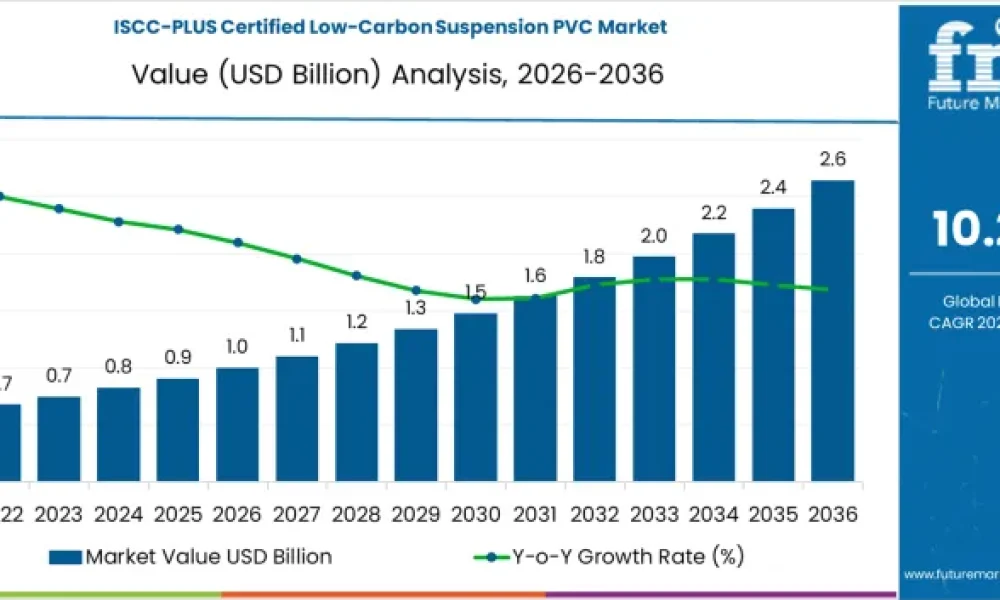
The global ISCC-PLUS certified low-carbon suspension PVC market is on a compelling growth trajectory, poised to nearly double in value from an estimated USD 2.9 billion in 2026 to approximately USD 5.94 billion by 2036, reflecting robust demand for sustainable polyvinyl chloride driven by stringent environmental standards and corporate decarbonization commitments. Over the next decade, the market is expected to register a strong compound annual growth rate (CAGR) of 7.6%, underscoring the accelerating shift toward low-carbon materials that reduce lifecycle emissions without compromising performance in key industrial applications. This growth narrative highlights how certified low-carbon PVC is rapidly transitioning from a niche sustainable product to a cornerstone material in green manufacturing and construction supply chains.
Key Market Insights at a Glance
The market’s rapid momentum is rooted in global sustainability mandates and evolving industrial priorities. Manufacturers are integrating ISCC-PLUS certified feedstocks — such as bio-circular resins, recycled inputs, and mass balance polymers — into suspension PVC production to meet environmental, social, and governance (ESG) benchmarks. Certified low-carbon PVC offers verified traceability of renewable or recycled carbon content, enabling brands to substantiate carbon footprint reductions in Scope 3 emissions reporting and circular economy initiatives. Across construction, automotive, packaging, and healthcare sectors, demand is intensifying for materials that deliver both performance and environmental credentials, confirming the strategic importance of low-carbon PVC in future value chains.
Segment Overview
Segment analysis reveals that certain formulations and applications are spearheading market expansion. Construction grade certified PVC formulations dominate the landscape, commanding the largest share due to extensive use in pipes, window profiles, cable insulation, and other critical building components that benefit from both durability and sustainability. Following closely are advanced certified materials tailored for automotive components, industrial processing systems, and packaging solutions that require low carbon impacts without sacrificing mechanical integrity. Applications in the construction sector alone account for more than two-fifths of the market, reflecting a compelling convergence of regulatory push and market pull toward green building materials.
Regional Overview
Growth patterns vary across geographies, but universal trends toward sustainability drive adoption everywhere. North America, Europe, and the Asia-Pacific region are key contributors to market volume, each showing strong demand backed by policy frameworks and corporate sustainability goals. In advanced economies such as the United States, Germany, and Japan, regulatory pressure to decarbonize plastics and building materials has spurred certification adoption, while emerging markets in China and South Korea are following suit with ambitious climate agendas and infrastructure development plans that include sustainable material use. Across all regions, the PVC value chain is evolving to incorporate certified low-carbon options as an industry standard rather than a premium niche product.
Competitive Landscape
The competitive landscape is characterized by a blend of global chemical majors and innovative specialty resin producers investing in certified low carbon technologies. Industry leaders include established enterprises known for their scalable polymer production and sustainability commitments, with strategic capabilities in integrating renewable feedstocks and optimizing mass balance certification processes. These players are differentiating through expanded certified PVC portfolios, supply chain partnerships, and investments in low-carbon innovation that enhance traceability and product performance. As competition intensifies, market players are emphasizing sustainability credentials as a critical differentiator for long-term value creation.
To access the complete data tables and in-depth insights — Request Your Sample Report Now
Market Outlook: Powering the Next Decade
Looking ahead, the outlook for the ISCC-PLUS certified low-carbon suspension PVC market remains fundamentally strong. Market growth over the next decade is expected to be powered by converging forces: the increasing adoption of circular economy principles, expanded access to certified feedstocks, and rising corporate and regulatory commitments to reduce carbon footprints. Technological advances — including more efficient integration of bio-based and recycled raw materials — will further enhance cost competitiveness and performance reliability. As industries strive to meet net-zero goals and consumers demand greater transparency in sustainability claims, certified low-carbon PVC is poised to become a strategic supplier of choice in next-generation material ecosystems.
Key Players of Sustainable Label Industry
Leading companies at the forefront of this transition include major specialty chemical and PVC resin producers that have embedded sustainability into their core strategies. These companies are actively expanding their certified portfolios and forging collaborations to scale low-carbon PVC production. Their leadership in developing and delivering ISCC-PLUS certified products is catalyzing wider market acceptance and creating a robust ecosystem for sustainable PVC supply chains.
Recent Strategic Developments
Recent strategic developments underscore a dynamic market environment where innovation and sustainability targets are reshaping industry priorities. Companies are announcing partnerships to source certified feedstocks, enhancing production capabilities with renewable energy integration, and launching new low-carbon product lines designed for high-volume industrial applications. These initiatives not only reflect competitive positioning but also signal a broader industry commitment to sustainable materials adoption, marking a significant shift from traditional petrochemical dependence to a more resilient, low-carbon future.
Have a specific Requirements and Need Assistant on Report Pricing or Limited Budget please contact us – [email protected]
About Future Market Insights (FMI)
Future Market Insights, Inc. (FMI) is an ESOMAR-certified, ISO 9001:2015 market research and consulting organization, trusted by Fortune 500 clients and global enterprises. With operations in the U.S., UK, India, and Dubai, FMI provides data-backed insights and strategic intelligence across 30+ industries and 1200 markets worldwide.
Why Choose FMI: https://www.futuremarketinsights.com/why-fmi



