
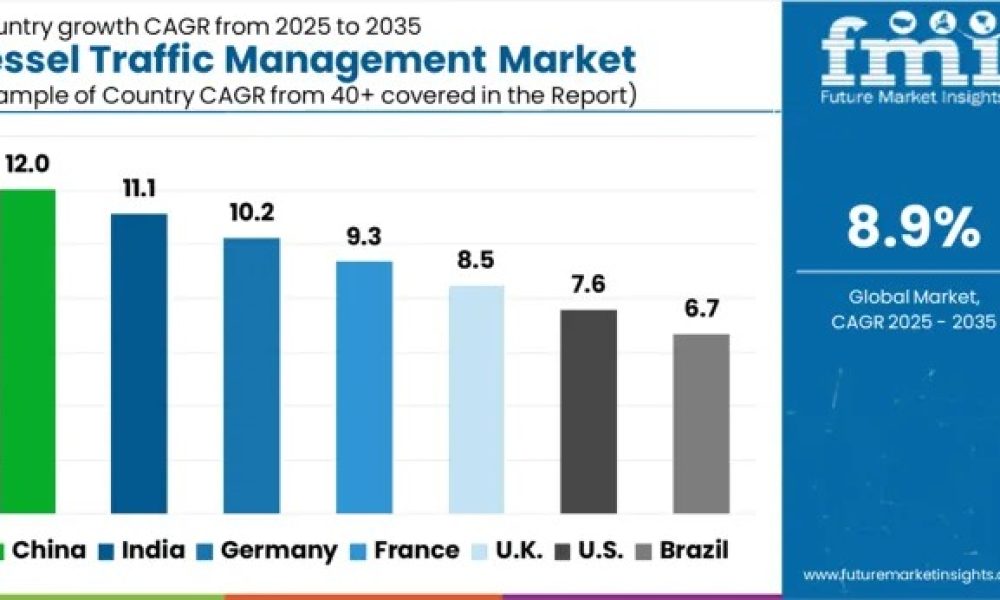
The global vessel traffic management market is on a steady growth trajectory, with market value expected to expand from USD 6.6 billion in 2025 to USD 15.6 billion by 2035, registering a compound annual growth rate (CAGR) of 8.9% over the forecast period. This growth reflects rising maritime trade volumes, increasing congestion in global shipping lanes, and sustained investment in advanced navigation and monitoring systems aimed at improving safety, efficiency, and regulatory compliance across ports and coastal waterways.
Long-term value accumulation analysis indicates that market expansion is being shaped by phased infrastructure deployment and progressive technology integration. Early investments in foundational monitoring systems are enabling accelerated value creation in later years, positioning vessel traffic management as a core component of modern maritime operations worldwide.
Gradual Early Growth Followed by Accelerated Value Creation
Between 2025 and 2028, market value accumulation is expected to progress steadily as ports in developed regions upgrade radar installations, Automatic Identification Systems (AIS), and integrated communication platforms. These investments establish the baseline infrastructure required to manage increasing vessel density and enhance navigational safety in high-traffic zones.
From 2028 to 2032, the value curve is projected to steepen as adoption accelerates in emerging maritime economies. Expanding port infrastructure, rising regional trade activity, and stricter navigation safety regulations are driving demand for comprehensive vessel traffic management solutions. During this phase, AI-assisted traffic coordination, predictive analytics, and real-time vessel tracking are expected to contribute significantly to incremental market value.
Between 2032 and 2035, growth is forecast to continue at a stable pace as existing systems are upgraded and integrated with smart port platforms, cloud-based monitoring tools, and digital twin environments. This phase highlights how early infrastructure investments enable sustained efficiency gains and long-term value realization.
Get access to comprehensive data tables and detailed market insights — request your sample report today!
https://www.futuremarketinsights.com/reports/sample/rep-gb-25599
Technology Adoption Transforming Maritime Traffic Control
Digitalization is reshaping vessel traffic management systems, moving them beyond basic monitoring toward predictive and automated decision-making. AI-based analytics are increasingly used to forecast congestion, optimize routing, and improve berth utilization—enhancing port throughput by an estimated 10–12%. Integration of satellite AIS with coastal radar has improved coverage reliability by approximately 15%, supporting safer navigation in complex and remote waterways.
Cloud-based vessel traffic management platforms are also gaining traction, with deployment growing at nearly 20% year-on-year. These systems enable centralized oversight, remote decision-making, and scalable expansion across port networks. At the same time, cybersecurity and automated alert mechanisms are becoming critical investment priorities as digital dependence increases.
Strong Demand Across Multiple End-User Segments
The vessel traffic management market is supported by a diverse ecosystem of end users and solution providers:
- Port authorities and maritime regulators (36%) rely on VTMS to ensure safe vessel movement, enforce compliance, and manage congestion.
- Shipping companies and fleet operators (28%) use traffic management systems to optimize schedules, reduce collision risk, and improve fuel efficiency.
- Technology and software providers (17%) supply integrated platforms, analytics, and monitoring solutions.
- Navigation and communication equipment manufacturers (12%) deliver essential hardware such as radar, sensors, and transmitters.
- Consultancies and system integrators (7%) support deployment, customization, and long-term maintenance.
This diversified demand base reinforces the market’s resilience and long-term growth potential.
Vessel Traffic Services Lead System Adoption
By system type, Vessel Traffic Services (VTS) are projected to account for 39.6% of total market revenue in 2025, maintaining their position as the leading segment. VTS solutions are widely deployed by ports and coastal authorities to monitor, coordinate, and guide vessel movements in congested or environmentally sensitive waters.
The integration of radar, AIS, and real-time communication tools has significantly improved response times and situational awareness, reducing collision and grounding incidents. Compliance with International Maritime Organization (IMO) guidelines continues to drive global deployment, reinforcing VTS as a foundational element of maritime safety infrastructure.
Hardware Remains the Backbone of Market Value
From a component perspective, hardware is expected to contribute 46.8% of market revenue in 2025, reflecting continued demand for radar systems, sensors, communication equipment, and control consoles. Ports and marine authorities are prioritizing durable, high-performance hardware capable of operating reliably in harsh marine environments.
Ongoing replacement cycles for aging equipment, combined with adoption of solid-state radar and multi-sensor platforms, are sustaining demand. As ports expand capacity and modernize operations, hardware investment remains central to system effectiveness and reliability.
Marine Authorities Drive End-Use Demand
By end use, marine authorities are projected to hold 34.7% of market revenue in 2025, underscoring their central role in maritime traffic oversight. These organizations are increasingly investing in integrated control centers, real-time data sharing platforms, and coordinated surveillance systems to manage international shipping lanes, protect coastal environments, and respond to emergencies.
Collaboration with naval forces for coastal security and monitoring further expands the scope of vessel traffic management deployments, particularly in strategic waterways and high-risk regions.
Regional Growth Highlights Emerging Market Momentum
Regionally, the market is expanding at different rates based on trade activity, infrastructure development, and regulatory intensity. China leads with a CAGR of 12.0%, driven by large-scale port expansion, smart port initiatives, and rising maritime trade volumes. India follows at 11.1%, supported by port modernization programs and inland waterway development.
In Europe, Germany (10.2%) benefits from advanced automation and predictive traffic monitoring, while the UK (8.5%) shows stable growth through selective technology upgrades. The United States, growing at 7.6%, reflects steady adoption across commercial and naval applications within a mature port infrastructure.
Drive Your Business Growth Strategy: Checkout the Report for Key Insights
https://www.futuremarketinsights.com/checkout/25599
Competitive Landscape Focused on Integration and Intelligence
The vessel traffic management market is led by established players including Northrop Grumman Corporation, Kongsberg Gruppen, Leonardo S.p.A., ST Engineering, and Saab AB. Competitive differentiation is increasingly driven by system integration capabilities, data analytics, and reliability rather than standalone hardware.
Investments in AI-driven monitoring, interoperable platforms, and secure communication architectures are shaping competitive strategies as ports and maritime authorities seek scalable, future-ready solutions.
Market Outlook
As global maritime trade continues to expand and port congestion intensifies, vessel traffic management systems are becoming essential infrastructure for safe and efficient navigation. The projected rise to USD 15.6 billion by 2035 reflects not only growing deployment but also increasing system sophistication.
With smart port development, automation, and predictive analytics redefining maritime operations, vessel traffic management is positioned as a strategic enabler of safety, efficiency, and long-term operational resilience across the global shipping ecosystem.
Why Choose FMI: Empowering Decisions that Drive Real-World Outcomes: https://www.futuremarketinsights.com/why-fmi
About Future Market Insights (FMI)
Future Market Insights, Inc. (FMI) is an ESOMAR-certified, ISO 9001:2015 market research and consulting organization, trusted by Fortune 500 clients and global enterprises. With operations in the U.S., UK, India, and Dubai, FMI provides data-backed insights and strategic intelligence across 30+ industries and 1200 markets worldwide.



